

Has your trust been damaged by betrayal? Does this make the thought of trusting others nearly impossible? Whether it was the misuse of confidential information, a broken promise or some other form of hurt, trust after betrayal often feels like walking through a minefield.
That deep wound, suspicion and constant distrust can isolate you and keep you from building authentic, close relationships. You are not alone. Many struggle with dealing with disappointment and the fear of being hurt again[1]. It can even lead to PTSD symptoms, especially if your foundation is not stable anyway, such as when you don't have a good place to live[2].
In this blog article, read more about the healing process, the importance of healthy boundaries and get practical tips for reconnecting with others step by step.
You will learn how to use your intuition as a compass and how to rebuild close relationships based on genuine connection despite previous setbacks.
Trust damaged by betrayal hurts
Betrayal touches us at the core of our being. It is not just a disappointment. It is a violation of a deep social contract, whether it is friendship, family or a professional relationship.
Our expectations are brutally disrupted and the basic sense of safety and reciprocity suddenly disappears. This leads to a wide range of emotions, from anger and sadness to confusion and a sense of disorientation.
The impact is often more than superficial:
- Emotional wounds: A sense of mourning for what has been lost. It's not just the relationship, but also your innocence or belief in the other person.
- Psychological effects: Hyper-vigilance can occur; you are then constantly on guard, looking for hidden motives. Even guilt ("what have I done wrong?") can rear its head, although the blame always lies with the traitor.
- Hurt self-esteem: Bet rayal can lead to doubts about your own judgment or attractiveness as a friend/partner.
It is a natural reaction to shut down after such an experience of damaged confidence. You build a wall around yourself, not to shut others out, but to protect yourself.
This is understandable, but in the long run it can lead to loneliness and an inability to make the deep connections we as humans crave. The first thing to know is that your pain makes sense and this feeling of distrust is a defense mechanism. However, this is a feeling that will pass again.
Healing damaged trust
Recovering from betrayal is not a linear process. It is a journey with peaks and valleys. It requires courage and a willingness to admit your vulnerability, but it is essential to your emotional well-being. You cannot get over an experience without living through it.
Essential steps in the healing process:
- Acknowledge your emotions: Allow yourself to feel what you are feeling. Anger, sadness, frustration, all are allowed. Suppressing it only prolongs the process of healing. Talk about it with someone you do trust, write it down, or find another healthy outlet.
- Practice self-compassion: Be as kind to yourself as you would be to a good friend. You have been hurt and that is painful. You deserve to cherish yourself, not criticize yourself for your feelings or for having "stepped in something."
- Seek professional help if needed: Sometimes the wounds are so deep that professional guidance from a (hypno)therapist or coach is needed. They can help you process trauma and develop coping mechanisms. It is a sign of strength to ask for help.
- Shift the focus: Focus your attention on what you can control, such as: your own reactions, your recovery and the lessons learned. Leave the responsibility for the betrayal with the other person. Letting go of control of another's actions is crucial to your inner peace.
- Take your time: Healing takes time. Don't force yourself to "be over it." Accept that there will be days when it feels heavier than others. That's perfectly normal.
The process of recovery requires active involvement on your part if you want it to accelerate. You are the architect of your own healing.
Trust damaged: setting healthy boundaries
After betrayal, there is a strong tendency to put up walls. The difference between walls and boundaries is crucial: walls shut out everything and everyone, while healthy relationships benefit from clear boundaries.
Boundaries are not a punishment for others, but a form of self-love and self-preservation. They define what is acceptable to you and what is not. People who have not damaged your trust should still be within your walls, dealing only with healthy boundaries.
How to set boundaries effectively:
- Identify your needs: What do you need to feel safe, respected and heard in a relationship? What actions of others are unacceptable to you?
- Communicate clearly: Boundaries are only effective when they are known. Communicate your boundaries in a calm, assertive manner. For example, "I am happy for our conversations to remain confidential." or "I am available until X time, after that I focus on my personal life."
- Be consistent: The power of a boundary lies in the consistency of its enforcement. Once you set your boundary, stick to it. This teaches others (and yourself) that you take your own needs seriously.
- Accept the reaction: Not everyone will be happy with your boundaries. Some will test them, or even get angry. This is a sign that the boundary was necessary. It is their reaction, not your responsibility.
- Start small: You don't have to set the most drastic limits right away. Start with small steps, such as saying "no" more often to requests that stress you out. This is how you build your assertiveness.
Setting boundaries is an act of courage and helps create a safe space in which trust can grow again after betrayal. It enables you to enter into new relationships with more confidence and less fear.
Trust Breached: Strengthening Intuition
One of the most valuable lessons after betrayal is learning to listen to your inner voice, your gut feeling. Often there were subtle signals before the betrayal occurred, but we ignored them.
The gut is called our "second brain" for a reason. They contain millions of nerve cells and are directly connected to our emotional and intuitive center.
Tips for strengthening your intuition:
- Recognize signals: Intuitive signals are physical. For example: a knot in your stomach, goose bumps, a feeling of restlessness, or just a sense of lightness and openness. Learn to recognize these sensations in different situations.
- Distinguish intuition from fear: Fear is based on past experiences and future projections ("what if...?"). Intuition is a snapshot in time, an immediate knowing without logical explanation. It is often calmer, more subtle and less dramatic than fear.
- Take the "bad luck test": Think back to times when you ignored your gut feeling and it indeed turned out to be"bad luck. Connect these memories to the physical feeling. The more you do this, the stronger the connection between the feeling and its lessons becomes.
- Practice with small decisions: Start practicing trusting your intuition in small, everyday decisions. What route do I take? What book do I choose? How does this person I just met feel? This trains your "radar system."
- Take a break: If you feel uncomfortable with someone or a situation, you don't have to have an immediate reason to leave. Just distance yourself."I feel this, I'm not going to elaborate on this right now." That's enough.
Your intuition is your personal guardian. By learning to trust this internal guide, you can better assess who is safe to open up to. This can be the first step toward building close relationships.
Building close relationships after damaged trust
The thought of re-establishing deep connections after damaged trust can be overwhelming. The key word is "gradually." You don't have to immediately share your whole life story with people you are just getting to know. Build slowly and observe.
A roadmap to gently reconnect:
- Start superficially: Start with general, low-key interactions. Talk about hobbies, shared interests or general topics. You get to know the other person without directly sharing personal details. Smalltalk is called "small" talk for a reason 😉.
- Observe consistency: Pay attention to how the other person behaves over time and in different situations. Are their words consistent with their actions? Are they reliable in small things (arriving on time, returning phone calls)? Consistency is a strong indicator of trustworthiness.
- Seek reciprocity: Healthy relationships are based on balance. Is there an exchange of give and take? Does the other person listen as much as he talks? Does he give as much as he receives? Avoid people who only seem to "take" or who use your information to enrich themselves.
- Share vulnerability gradually: If you notice a positive pattern of consistency and reciprocity, you can choose to gradually share more of yourself. Start with something small, observe the reaction and build on that. Share only what feels appropriate for the level of the relationship. Not everyone needs to be in your "inner circle."
- Test limits: Healthy people respect your limits. Test this by setting a small boundary and see how the other person responds. A respectful response is a good sign. A defensive or dismissive reaction is a red flag.
Remember: you don't have to trust everyone with everything. A few people you can trust deeply are far more valuable than hundreds of superficial contacts. Your ability to build close relationships is intact. It just needs the right conditions.
Recovering from shamed trust: avoid these pitfalls
While the path to recovery and new confidence is hopeful, there are some common pitfalls you need to be aware of. By recognizing these, you can avoid them and speed up your process.
Common pitfalls:
- All-or-nothing thinking: The tendency to think "I don't trust anyone anymore" or "I have to tell everyone my whole story to test if they can be trusted." Both extremes are unhealthy. It's about smaller things than that.
- Blaming yourself: Repeating thoughts such as "why did I share this?" or "I should have sensed it." This is a form of self-punishment that hinders the healing process. Focus on the lessons, not the blame.
- Going too fast: Overhype confidence in new contacts because you long for connection. This increases the risk of new disappointments. Patience is a fine thing.
- Building walls instead of boundaries: Shutting yourself off completely from the world for fear of new pain. This deprives you of the opportunity for new, valuable relationships.
- Ignoring red flags: Ignoring your intuition because you "would like it to click" or because the other person "seems so nice anyway." This is where the head, your ratio, overrules the gut feeling.
Be patient, be kind to yourself and trust your inner wisdom.
Hypnotherapy to restore confidence
Hypnotherapy can provide powerful support for healing trust after betrayal. Through focused relaxation and focus, hypnotherapy helps to safely address deep-seated beliefs, fears and emotional blockages.
Many people carry unconscious patterns with them after betrayal, such as a constant state of alertness or the belief that they can no longer trust anyone.
Hypnosis enables these unconscious beliefs to be uncovered and reprogrammed, creating space for greater peace, confidence and self-confidence.
Combined with talk therapy or coaching, this can significantly deepen and accelerate the recovery process.
For hypnotherapists who guide clients in restoring trust after betrayal, regression techniques and working with the inner child are particularly effective. Regression helps clients return to the original pain experience and relive and reinterpret it from safety. This creates space for healing on a deep level.
Also working with the inner child. The part that feels rejected, betrayed or unsafe, can bring many breakthroughs.
In addition, suggestive scripts aimed at strengthening self-confidence, safety and healthy boundaries (e.g., post-hypnotic suggestions or visualizations of a protective energy shield) can powerfully support the recovery process.
Importantly, hypnotherapists create a safe, non-judgmental space in which clients can follow their own pace. Restoring trust begins with feeling seen, heard and guided. That is precisely where the core of effective hypnotherapeutic work lies.
Confidence damaged and yet living life to the fullest again
The journey to repair damaged trust is challenging, but it is a journey that leads to deeper self-knowledge, stronger boundaries and a greater ability to make real connections. Hypnotherapy can play a role in accelerating this process.
You are no longer a victim of your past, but the determiner of your future. By embracing the healing process, setting healthy boundaries, strengthening your intuition, and re-establishing connections step by step, you regain your power.
Helping people trust
Do you want to help yourself or others cope with damaged confidence? Then knowledge of hypnosis is incredibly helpful. Come to the free master class for an introduction.
Or register directly for one of our events and trainings.
Wondering if our training is right for you? Schedule a 1-on-1 consultation here.
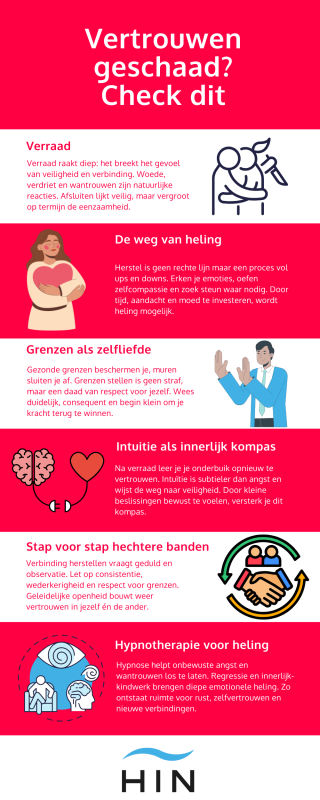
Also pin this handy infographic as a reminder:
Sources: