


Sometimes people come to me wanting more focus on themselves. Then I ask myself, "How then?" Of course, you can look at yourself in front of the mirror, but that's not what people mean. People then want to put themselves first. This is also interesting, because what place are you in?
How do you see yourself? Do you see yourself standing with literally a line of people in front of you? Do you see a stage with someone in the first three spots and yourself as a water carrier? What are you really?
Make a picture of it. From this, it sometimes becomes clearer what is stopping you from moving the person from the first place and standing there yourself. Even if it is in your mind.
That's when things often come up.
Am I worth it? Am I good enough? Then everyone sees me and I don't want to.
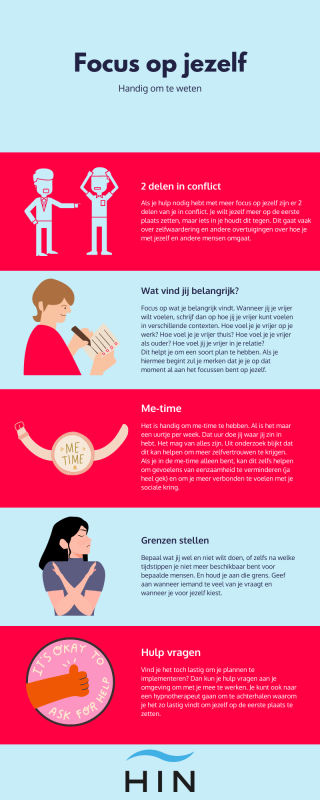
So this is a conflicting thing. If on the one hand you want to put yourself first and have more focus on yourself, but on the other hand you don't think you are good enough, there is something going on.
You have two parts in conflict. You can then ask yourself where that comes from, or you can communicate with those two facets of yourself. It is helpful then that you know what you are doing. This technique doesn't come into play with us until the 3.0 training, so not until the third training.
So people using this technique for their clients are already well advanced. To do this to yourself all at once I cannot recommend either. However, it is helpful that you know what you are doing (you can of course get guidance from a hypnotherapist for this).
Anything you put a "but" in front of is a conflict within yourself. If those statements are about yourself.
So how do you focus on yourself?
That language is already very crazy-who is yourself? Is it your body? Your thoughts? Your feelings? It's always more than that. Often it comes down to wanting to put what you care about first. You want to do what matters to you more often.
Then again, it's a whole different story.
You can think of things for that. Like asking yourself what you want.
If you don't know what you want, you are often put in front of the plans of someone who does know what they want. Those people have a plan and can put you to good use. That's not a bad thing. Everyone doesn't have to have a plan either, because you can also find it really cool to work on someone else's plan.
Being the plan creator can also be very exhausting.
That's how it is with many businesses. Someone has a plan and a lot of people enjoy working on that plan. If you like that, that's fine.
You can also have different plans. Like a relationship plan or a parenting plan. Many people don't have those at all, who think, "I'll see." That can work, but you also often see that it doesn't work. If you just do something, then at my house there are four boys just sitting around gaming all day. Then they draw their own plan, which is gaming. It's convenient for those boys, but it's not convenient for the parents. You know as a parent it's not convenient.
So then you get conflicts, again.
So focus on yourself, focus on what matters to you. When you want to feel freer, write down how you can feel freer in different contexts. How do you feel freer at work? How do you feel freer at home? How do you feel freer as a parent? How do you feel freer in your relationship?
This helps you to have some kind of plan. When you start with this you will find that you are already focusing on yourself at that point.
Also watch this video on focusing on yourself:
Focusing more on yourself as a caregiver
Of course, there are also parts of your life when it can seem difficult to take more care of yourself; this is the case, for example, when you have taken on the care of a loved one of yours. Women who care for their demented husband, for example, feel less well than daughters who care for their demented father, and are more likely to think this is because of the caregiving itself[1].
So even while caretaking, it is important to take good care of yourself. For example, have clear boundaries for yourself and dare to ask for help. Don't have anyone you can ask for help? Then go to your doctor, maybe you are entitled to home care. That will make a difference.
In addition, it is also helpful to have me-time[2]. Even if it's only an hour a week. That hour you do what you feel like doing. It can be anything. Research shows that this can help you become more confident. Being alone during me-time can even help reduce feelings of loneliness (yes very crazy) and feel more connected to your social circle.
Research also shows that hypnosis and self-hypnosis can help you as a caregiver to have more energy, be able to set boundaries, take good care of yourself and have more inner strength and resilience. You can retain these effects after hypnotherapy through self-hypnosis. This can prevent you from experiencing burnout or compassion fatigue[3].
Get help to take better care of yourself
Still find it difficult to implement your plans? Then you can ask for help from those around you to work with you. You can also see a hypnotherapist to find out why you find it so difficult to put yourself first.
For example, stress has a correlation with responsibility[4]. If you feel super responsible to take good care of other people, this can be incredibly stressful. That is why it is important to put yourself first. Then a lot of stress falls away.
As mentioned, an advanced hypnotherapist can help you engage with yourself, but fortunately there are other techniques that can be used as well.
For example, regression can be used to find out why you don't put yourself first. For example, are you a pleaser? How that started you can find out during such a regression session.
You will first be put into hypnosis. Then you are suggested to go back to the first moment when you felt that other people took precedence over you and that you had better maintain that.
Because you are in hypnosis, an event from your life will then immediately reveal itself to you. In your mind, you see the moment before you.
Now that you know what the moment is, the hypnotherapist will help you look at this moment in a different way. This can be done in many ways. For example, you can empathize with other people who were there at the time. You can put your adult self in the situation and have them talk to your younger self. It can be anything.
The hypnotherapist will choose something that suits you best.
Subsequently, then, your memory will have changed. The information you carry with you for the rest of your life has changed, and you will notice this in terms of focusing on yourself. You will have focused intensely on yourself for a while during the session, and changed something, making it easier to put yourself first in the future.
There are an awful lot of hypnosis techniques you can use to help yourself or other people. You can learn all of these during a hypnosis training course. Ideal if you are a coach, psychologist or even psychiatrist to help people. The training is conducted online from a professional studio with multiple trainers and assistants to help you master the techniques. If the weather allows, the trainings are given in Wormerveer and Zwolle.
You can also go to a hypnosis seminar. During such a seminar, you can see demonstrations of hypnosis and master the basics of hypnosis. Seminars are held online or on location.
Check our calendar for all events and when trainings begin.
Pin this handy infographic:
Sources:
[1] https://www.tandfonline.com/doi/abs/10.5172/jfs.4.1.87
[2] https://link.springer.com/article/10.1007/s11031-019-09759-9