
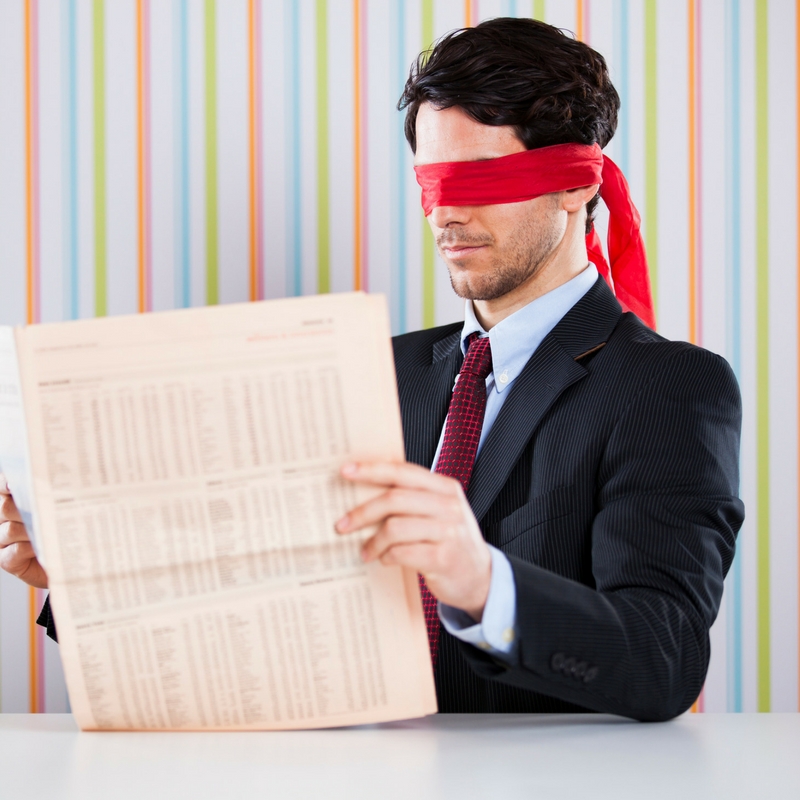

Actually, with the advent of the Internet, the term gut feeling has also become much more common than it used to be. This may be because we get much more information now than before the Internet existed. You can get news from anywhere now, and with the advent of social media, you also get local and smaller news stories faster that can still give you a weird gut feeling.
What these gut feelings are and whether you should do something with them or just ignore them is something I focus more on in this article.
We can now read so much news that sometimes the news makes us not know what the news is. To give you an example if you ask people how many animals of each species Moses put on the ark most people say 2, but people who think a little better say 0. Because in the end it was Noah.
Meanwhile, we get so many facts thrown around our ears that one story can become intertwined in your mind with another. This is also known as cognitive bias. You no longer have the facts right or complete and therefore can come to illogical answers or make a decision on facts that are not there.
On the other hand, this in turn can create cognitive dissonance. That is the feeling that a particular communication utterance can give you if it does not align with your beliefs.
Cognitive dissonance
Cognitive dissonance, for example, is often evoked by people engaged in persuasive communication, such as to get people to quit smoking.
Smoking kills.
This statement can be a nasty one for people who smoke, causing gut feelings. Their behavior is suddenly deadly and being reminded of that doesn't feel good.
There are two ways you can respond to cognitive dissonance through such a statement.
- You quit smoking.
- You put other beliefs about smoking in mind versus this statement to reduce its power.
For example, people who don't quit smoking often report that smoking reduces their stress levels, which is good because stress is not healthy in the long run either.
Usually they then overlook the fact that techniques such as meditation and mindfulness also reduce stress within 2 minutes and that those techniques are not deadly while lighting up a cigarette is deadly.
The news can also give you a gut feeling through dissonance. For example, things happening in society may not be consistent with the beliefs you have about that news topic.
For example, if you are a feminist and you suddenly read that men do quite a lot of housework. That can cause dissonance. The same goes for bad news, such as fires breaking out or like the child killer in Germany.
If you are suffering from cognitive dissonance because of the news, you can ask yourself the following questions:
- From what sources do I get my news?
- Why do I find these sources trustworthy?
- How do these sources possibly provide an incomplete picture?
- How do my beliefs cause me to believe what is in this news report or news source?
- Am I qualified enough to say anything about this news?
A newspaper is usually a better source of news than a blog telling someone's opinion. In the end, an opinion is different from a fact. So decide for yourself whether you are reading someone's opinion or reading real news.
From what sources is the news taken. Are figures from CBS cited? Is an expert speaking? Are all sides of the story told or do you really only hear something from 1 source and nothing from any other source?
For example, an incomplete picture is caused when no clear verifiable facts are told and when only 1 source is cited in a story with multiple players.
Your beliefs are very important in creating dissonance. Your beliefs also matter for the news you believe. In general, people often want to read news that confirms their beliefs and if it does not, it is usually ignored, because dissonance.
Google also takes this into account so that when you search results, you often only get results that match sites you are viewing and so you are not easily confronted with news or facts that make you feel bad.
Tingling in the lower abdomen due to stress reaction
Sometimes news can cause a stress reaction that makes you have a weird feeling in your stomach. This is because your body then releases adrenaline for your fight, flight, freeze response. In addition, your brain and muscles then need oxygen and that is exactly what adrenaline does, which is to take the blood with oxygen away from where it is not needed and move it to where it is needed.
Usually this means that blood moves away from your stomach and intestines and instead goes to your legs, arms and brain. This movement of blood causes the stress response.
This can also provide that itchy feeling in your arms when you actually really want to hit someone.
Tips for being less bothered by the news
If you are very bothered by the news and stressed by it, there are a number of things you can do.
Tip 1: Use mindfulness
If the news bothers you and starts to dominate your thoughts, it is important to do something about it. For most people, news stories do not affect their lives. For example, you might get very upset about news reports of a fire at a farm, but if you don't have a farm or don't live near one, it usually doesn't affect your life.
Therefore, try to stay in your own living space with your attention. By consciously making contact with your body and your immediate environment, which you can see, feel and smell, you make sure that your life takes place mostly around you and you base your feelings on what you experience yourself rather than what you read in the newspaper. This can be done well with mindfulness.
Tip 2: Limit the number of news moments in a day
You know, you're at work and suddenly you're on a news site or blog that's about politics or the environment. Your heart rate speeds up and you're furious at society again. Some people suffer a bit of a news addiction. This is also something that most news sites capitalize on, that it is vital to always be up to date with the latest news.
One such bar at the bottom of the screen on news channels that tries to tell something new in a sentence each time plays into this, for example.
Usually this is not the case and if not, you will get a text message from the government. Therefore, limit the number of news moments in a day. For example, for after work so you can focus on what you are doing.
Tip 3: Meditate
Meditating is incredibly important to reduce stress. Moreover, with meditation you also practice how your body can influence your emotions. You can then use this technique throughout the day to calm down.
Meditating daily for 10 minutes every morning will prevent you from building up too much stress.
Tip 4: Write down 3 positive things daily
Seeing the positive side of situations is not something many people can do automatically. We often see bears on the road rather than a cute teddy bear. To train yourself to see more of the positive side of news, and of other parts of your life, you can write down daily 3 positive things that happened that day.
For example:
- The flowers in my garden were extra beautiful today.
- Actor B has gotten super old after all.
- It was nice to have a chat at the coffee machine.
By doing this daily, such as every evening, you will also train yourself to see more positives. You can also write down more than 3 positives to really challenge yourself. You will find that you then often engage in the things you do with a more positive mindset.
Gut feelings caused by the news can be very annoying, but they usually have a protective function. For example, you want to prevent bad news from happening to you. Yet most news does not take place in your daily life. The steps you can take are, at most, to decide which political party to vote for during elections and to focus on things that are really happening in your own life. This can be done through mindfulness, limiting your viewing of news and training yourself to think positively.
Want to learn more about mental techniques that can make your life more enjoyable? Then come to a workshop or seminar and check out the training courses offered by the Hypnosis Institute Netherlands. These are also very useful if you want to help people other than yourself.
Sources:
http://www.kensho.io/blog/blog/how-to-handle-media-hypnosis-and-cognitive-dissonance



