There are people who are like Guus Happiness and there are people who are like Donald Duck. You don't often hear people say "I'm always lucky too," but you do often hear people say "I'm always unlucky too." Those are the Donald Ducks in our lives. And the people who are Guus Luck, you don't often see them
Because is it true that there are those who are always unlucky? Chances are, since we have about seven billion people on the planet. However, many people create their luck and sometimes their bad luck.
I don't believe you were born with a sour face and cranky thoughts and that you run around nagging other people all the time. It's also kind of crazy when you hear a baby complaining all the time, but you know what I mean.
This behavior is often learned. People sometimes think it's hereditary, like your brain is born cranky, I just don't believe that. You are not born that way. People are just sweet.
Sure, you can be born with a lack of empathy or something, or maybe some psychopathic traits, but that doesn't mean you will become a killer.
A surgeon also has psychopathic traits. This may sound a little crazy, but they often score high on that scale in surveys. But now it is precisely something they can help you with (they do end up cutting people open).
So whether you have some of that in you says nothing at all. It says nothing about what you will do with it.
Many things are learned and few are determined.
Many traits are determined, but what you do with them, how you deal with them and what you can create with them is all up to you. You have a lot of influence on that.
If you've lived in an acidic environment for eight or 10 years, the laughter does wear off. Then you also get a cranky head and then you have also become sour. With the emphasis on "become," because it wasn't like that.
You can be wrong about that. You think it is, you get affirmation and when you look in the mirror you see such a sour (unhappy) face.
After all, you were born a Guus Happiness, but became a Donald Duck.
If you were born here you are already a little Guus Happiness, because in places in the world other than the Netherlands it is not nearly as good.
Fortunately, you can always change. It doesn't have to be immediate or quick. You can heal yourself with small habit changes. This may take a relatively long time, but you will soon notice effects.
For example, starting to drink more water. For example, one good habit triggers another good habit. For example, this helps you to have a salad more often.
This helps you feel better and be less cranky. When that happens and you notice it, you can also take 100% responsibility. You then say, "Okay, so I'm doing all this." You then start claiming everything.
This does not mean that it is your fault that something is the way it is. It is just what it is because of whatever cause. What is important is that you give this a place for yourself. When you then claim your problem, you find that changing for the better goes a lot faster.
Fortunately, you can change it back.
https://www.buzzsprout.com/195236/1695262-ben-jij-een-donald-of-een-guus?play=true
Is always lucky or always unlucky a matter of perception?
This question researchers have also asked themselves, for what is luck (good luck) or bad luck (bad luck) anyway?
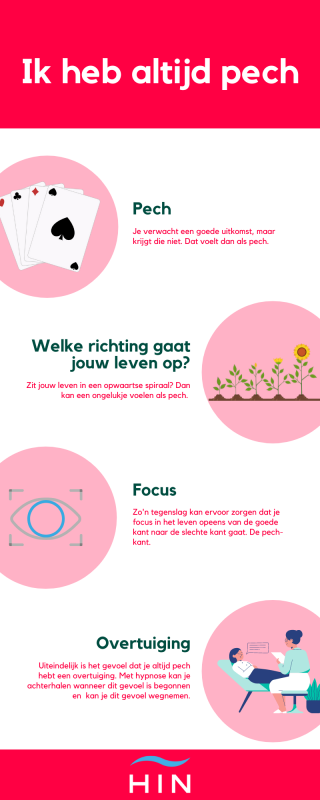
Getting lucky is often something where you didn't get a bad expected outcome, and having bad luck often means that you expected a good outcome but didn't get it[1].
So whether you are always lucky or always unlucky also depends a bit on the direction your life was going at those times. For example, if you find that you are in a downward spiral, but you suddenly find a job or a relationship, that feels like luck.
Did you just have an upward spiral at the time, such as getting that new job and a new relationship, but then suddenly your car crashes, it feels like bad luck.
So if your glass is always half full, you may experience the feeling of bad luck more often than if your glass is always half empty. Perhaps for a "normal" feeling, it is best to have the mindset that there is something in the glass and not worry about whether it is half full or half empty.
With hypnosis, you can change the story you tell yourself about yourself, reducing feelings of bad luck.
Types of happiness
Then again, according to Stanford University, there are multiple types of happiness, so multiple ways you can look at happiness.
- The outcome of your actions are subject to luck.
This version of happiness is quite related to bad luck. For example, you are studying to be a banker and seem to be able to get a good job, but just as you graduate, the financial bubble bursts, banks go bankrupt, and there is actually very little demand for your expertise.
While when the economy is doing well you will find it incredibly easy to get a job in finance.
- Conditions that create greater happiness.
With this version of happiness, happiness already depends more on yourself and your insights. For example, if you find yourself in the fortunate situation of getting that financial job, you will develop better in that world as a result and be able to make better financial choices in the future. Then you force future happiness a little bit, because you learn from previous happier moments.
So this also very much depends on recognizing happiness and knowing when to expect happy rewards.
- Happiness through traits you have.
In this case, it's about traits you have little control over, such as genetic factors. For example, you have some bad luck if you have type I diabetes, which is clearly something you can't do anything about.
This also explains, for example, why some people who smoke don't suffer from anything (genetic luck) or why people who smoke still get lung cancer.
Fortunately, what you do have control over is how you handle such a situation. Or in the case of surgeons, what you do if you are good with blood and would like to cut into a human being 😉 .
- To what extent you are programmed for happiness
This also brings us to the latest version of happiness. Namely, the environment you grow up in can also create happiness, this is a bit like the second version of happiness. Namely, if you grow up in a stimulating environment, this can give you the motivation to achieve this again later, whereas this can be lacking, for example, if you grow up in a more boring environment[2].
Where did your luck or bad luck start?
As you have seen, the feeling of happiness or bad luck often depends on your view of happiness and bad luck and the environment in which you grew up or in which you have been involved in your life.
The idea that you are always unlucky is a belief. It's a kind of rule you have about how the world works and how you function in it (apparently as a major unlucky person).
But when did that designation or line "I'm apparently only good for bad luck" come to you, and how do you turn it around to "I'm at least normal"?
This is something a hypnotherapist can help you with. This can be done, for example, with regression. With regression, you are first put into hypnosis and then suggested to go back to the moment when you first felt you were always unlucky.
Then, in your mind, you can do something with this moment to change the moment. You can change the interpretation of the moment by using your adult knowledge to relive the moment, as well as to empathize with other people who were present at that moment or by changing the situation in your mind, making the memory something to laugh at, for example.
This can quickly change your feeling of always being an unlucky person, allowing you to focus more on the happiness in your life.
This is just one technique, and depending on your feelings about bad luck, a hypnotherapist may also go for other techniques instead to help you better recognize the happiness in your life. This can be done, for example, with a socratic conversation while under hypnosis.
Want to learn more about how hypnosis works and how to put people under hypnosis? Then come to the free online master class.
Want to help yourself or others suffer less from bad luck? Then enroll in one of our trainings. The trainings are conducted online from a professional studio to ensure the continuity and flow of the training.
Also pin this handy infographic as a reminder:
[1] https://onlinelibrary.wiley.com/doi/abs/10.1002/(SICI)1099-0992(199912)29:8%3C981::AID-EJSP966%3E3.0.CO;2-Z
[2] https://stanford.library.sydney.edu.au/entries/justice-bad-luck/