


Guilt is a great way to get people to do something. For example, you see that Beggars in China have become very good at giving some kind of guilt because you have it so good as a non beggar.
They found out that people gave more if you have a dog sit with them. Preferably an emaciated doggie. Brings in a lot. You think you're helping, but the critter just sits there on that cold concrete floor longer.
Exactly counterproductive. Better not to give anything, but yes...guilt....
Not only beggars do something with guilt.
Other people are the same way. Whole stories about how bad things are and how bad they have it. They have it so hard and nothing helps them, of course.
Many times I fell for it and always what they said was right. It didn't work and they had no money either so double bad luck. They had lulled me to sleep and thus won the battle, you might say.
"See, nothing works?
So a perfect tactic you should never fall for. Emails full, messages full of those people. Never do I respond to them. When I get a story like this in my mailbox I already know.
Cry, cry, cry, cry, cry, cry, cry, no money, can't you help me for free....
No, I don't buy into those age-old samurai tactics anymore. I have already stepped out of that hypnosis. When you go into that fight, you have only losers. Nobody wins. Not entering the fight is best. Then you have a chance of two winners.
At least one, because a battle avoided is a battle won. And I have avoided many battles that way.
With any luck, people will feel emboldened by this and stop whining and crying. Being sad is fine, whining and whining is not. At least not in my mailbox.
Complainers and naggers want to weaken you. Retreat from that. Stay in your power and consciously do nothing with it. It will then make you stronger 👊.
Complainers who make you feel guilty
Complainers or whiny people often do this because their feelings with who they are and the reality of who they are do not match. This causes them to have bad feelings. This is then something that causes them to have lower self-esteem.
By then complaining, they ensure that those bad feelings diminish for a while. Unfortunately, this does not mean, for example, that they become better employees when people start complaining in the workplace[1].
People who make you feel guilty clearly want something from you. For example, they want you to give away a product for free, or as with me, a free hypnosis session. What I and many other entrepreneurs can tell you is that when you give something away for free people often do nothing with it.
Similarly, I know a businesswoman who occasionally gave away a relatively inexpensive online program because she had it anyway, but those people to whom she gave it away did nothing with it. As a result, they were still not helping their business. That is why she decided to always charge a price for everything, so that people do something with it and do help their business.
So whether it's coaching, hypnosis or just advising people about their business and what's helpful to do or not to do. When people make you feel guilty so you just give it away for free, it's often a way for them to still say, See I can't do anything, that I can't solve this or that I can't make money and the pathetic behavior continues.
Breaking the pattern of guilt talking
When someone begins their story to make you feel guilty, you often feel trapped in the situation already. After all, guilt is bad and must be solved, and the solution at first seems to be saying "yes."
It seems very rude to say no, but here's where it's helpful to take a moment to think about it. How polite is it really to make someone feel guilty? Now that is rude.
What often happens is that people want to make you feel that you are the only person who can provide the help they need. This, of course, is not the case. Of course I am a good hypnotherapist, but I am certainly not the only one. I even train people to be hypnotherapists and I stand in front of all my students who have passed the exam. That's where you'll be fine.
The person making you feel guilty wants to make you feel that something is very personal, when that really doesn't have to be the case.
Then, to still say no in a polite way, you can first explain how that person makes you feel. You can say that the way they act toward you makes you feel uncomfortable. A true friend will apologize and perhaps break the pathetic or victim pattern.
A person who is busy using guilt-tripping to get something done simply moves on to the next person he can guilt-trip.
A colleague who makes you feel guilty
Helping out a colleague at work every now and then works, but if you find that someone is wanting your feedback or expecting you to do his/her job quite often, the best thing to do is to bounce the ball back.
"Yes I agree with you that this and that should be done, how do you plan to address this?"
That's a comment that ensures you give back the responsibility.
Hypnosis to better stand up for yourself
Standing up for yourself as mentioned in these examples can still be very exciting to do. On the one hand, the person who is guilt-tripping you has the pattern of getting certain goals done that way.
On the other hand, you may have the pattern of taking guilt away by just saying yes to everything and everyone, thereby undermining yourself. Too bad!
You're worth more than that, aren't you? And in the end, this doesn't really help the person who uses guilt as a weapon either. In the end, everyone will be spiteful of that person.
So where does it come from that you can't just feel guilty and think, "but yeah, that causes that person to get something done from me"?
With hypnosis, you can find out why you feel so bad about having guilt. Why even when you are not responsible for that guilt, after all, you have no influence over the decisions that other person makes, you care so much about this that you say yes and stay in their hypnosis.
This can be done, for example, with regression.
But today we are going to look at it in a different way. To break a hypnosis or a pattern of feeling guilty and saying yes to get rid of this guilt, you can also start by behaving differently first and then experience how that makes you feel.
If you find this difficult to do at first, you can practice it with a hypnotherapist. In a preliminary conversation, for example, you can indicate if you have discovered a pattern of people who make you feel guilty and to which you then have to say "yes" from yourself.
Then the hypnotist helps you visualize how to say no in a polite way. How you anticipate their reaction. Suppose they get angry, what do you do? And how free you feel, perhaps how liberated you feel when you walk away and so nothing has to do anything because of guilt.
Delightful!
In addition, you often get affirmations that you can repeat out loud while in hypnosis to boost your confidence to say "no," such as:
"I prioritize my own work."
"I don't have to do something because of guilt by someone else."
"True friends make you feel good."
"It's good to set boundaries," he said.
"You get to remind people of their own responsibilities," he said.
These are just examples. Depending on your beliefs and the areas of your life where people use guilt to get something done from you, a hypnotherapist can help you with other suggestions or affirmations.
Rethinking, politely saying no and strengthening your own self-confidence and self-esteem are ways to ward off guilt and break the other person's pattern toward you. A hypnosis expert can help you with this.
Want to learn more about how hypnosis works? Then come to a hypnosis playshop. During the playshop you will learn how to hypnotize people in 1 day and what you can do with it to help yourself and others from problems, such as saying yes through guilt.
Instead, would you like to get started directly with techniques, such as how to give a guided visualization and what suggestions to give? Then enroll in 1 of our training courses right away.
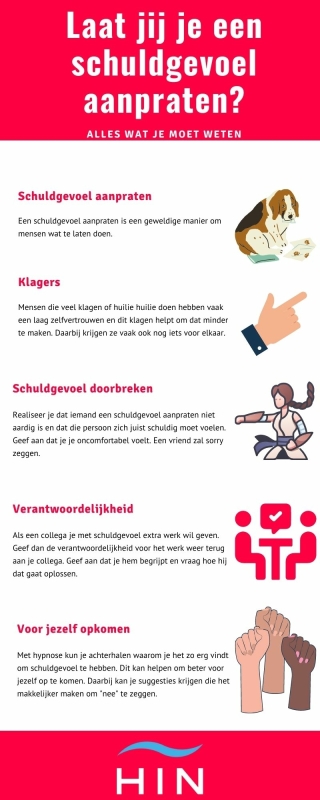
Pin this infographic as a reminder:
[1] https://digitalcommons.lsu.edu/gradschool_disstheses/7363/



