

There are all kinds of times in your life when you can get nervous about what is to come. Being nervous from time to time makes sense, such as when you have to give a speech , perform for the first time with your band or as a stand-up comedian. But there may be more to it if you are very consistently or consistently nervous at other times.
In this blog article, we take a closer look at nervousness, its causes and what you can do about it.
Always nervous
If you are always nervous, you actually suffer from chronic anxiety. This is not at all helpful. In fact, this can have all kinds of physical and mental consequences for you. Almost 1 in 5 people suffer from this anxiety.
Physically, always being nervous can lead to high blood pressure and even deadly problems in your veins. This is partly because your reaction when something actually stressful happens is even greater than in people who are otherwise not so nervous[1].
In the process, you may suffer more from hyperventilation if you are always nervous. If you then notice this, you may also have more negative thoughts about it[2].
Mentally, being always nervous and anxious can contribute to the development of depression. You can recognize the stage when the always nervous turns into depression by:
- More panic attacks.
- Blaming others for problems.
- Fear of getting sick(hypochondria).
- More fear.
- Insomnia.
- Slowing down thinking and moving[3].
Because chronic nervousness or chronic anxiety can cause so many problems, it is all the more important to do something about it.
Like finding out where that nervousness comes from and solving that cause. This is something a hypnotherapist helps people with. Meta-research, a type of research that summarizes results from multiple studies, also shows that hypnosis works well to reduce anxiety. This gets even better when hypnotherapy is combined with other therapeutic techniques[4].
You can think about NLP or cognitive behavioral therapy, for example.
If you don't feel like discussing your fears with a hypnotherapist, even self-hypnosis can help you suffer less from anxiety. In that case, it helps if you have a reasonable degree of hypnotizability. This helps lower your blood pressure and make you feel better. This was also tested with a psychic test and not only because study participants experienced it themselves[5].
The self-hypnosis recording helped people relax and get suggestions on how to look at their problems in a different way.
Always nervous before work
You can't always be nervous either, but you can always be nervous before you go to work. So what's going on?
Interestingly enough, this can be down to work and other issues.
When it comes to work, you may become nervous simply because the workload is very high. Factors such as performance pressure, social tension at work, social isolation, always being worried and anxiety also play a role in nervousness before work[6].
The type of work you have can also cause nervousness. For example, do you have work where you work mostly with your hands? Then you often get less nervous than if you have a job with a lot of responsibility, or where you need to have certain knowledge.
For example, a CNC miller may be more nervous than someone working with a simpler piece of equipment.
Factors that contribute to nervousness before work are:
- Leadership
- Teach
- Contact with people
- Driving
- Working with difficult equipment[7]
Looking at these studies, there may be several beliefs underlying always being nervous before work, such as beliefs about:
- Responsibilities.
- Performance.
- How to deal with colleagues.
- Whether your knowledge is good enough.
These are all beliefs that a hypnotherapist can help with. For example, if you have fears about how well you can perform or that you are good enough you may suffer from conman syndrome.
These problems can all be solved with hypnotherapy, because it deals with rules you once made up. With hypnotherapy, you can update those rules so that you go to work without nerves.
Then when colleagues get nasty , you can laugh about it instead of feeling on your toes. (And if it really goes too far, you laugh all the way up to the manager or HR department)
You may also be nervous because you have been sick for a long time and may be reintegrating again. Even if you are still suffering from chronic pain. Unfortunately, chronic pain is often associated with social anxiety. That combination can make it especially difficult to return to work.
This can reinforce each other if you have thoughts all the time about how anxious you are about your co-workers, for example, and how bad the pain can get. Fortunately, being able to ask for solutions to pain-related problems is already something that can break this unhealthy problem[8]. For example, consider arranging materials that will help you perform your work pain-free.
Then it is mainly the obstacle that someone finds it difficult, for example, to ask for help or to set limits that causes nerves for work.
With hypnotherapy, you can get good practice in stating boundaries and indicating that you need certain help, such as an ergonomic mouse. This is something you can practice under hypnosis with visualizations. This also makes it more likely that in real life you will also ask for help when you need it, or indicate your limits. Like that you don't overwork, because prolonged work causes pain.
Nervous for vacation
Then you also have the counterpart of being nervous for work, which is precisely being nervous for your vacation.
This can become an issue at multiple times, such as during trip planning and when you actually leave for your destination.
It can be a problem if you like to be in control , which is simply not always the case when traveling.
So the stress can already start while planning the vacation. After all, you will also be concerned with what can go wrong and for that you will want to organize a plan B[9].
So that fear can also be about having less support at your destination than at home. For example, family and friends are not around. You fear that you won't be able to communicate well with people at the destination[10].
The cool thing is, we don't live in 1990 anymore. We now have apps and even with Google translate you can make yourself understood, others can make themselves understood to you. There are even devices that translate what you say live. So now you don't even have to learn a language other than Dutch.
With hypnosis, you can boost your self-confidence and bring back to the surface just how self-reliant you are.
Making yourself less nervous
There are several ways to make yourself less nervous; we'll briefly cover what you can do physically and mentally.
Physical:
To instantly reduce nervousness, it is important to activate your parasympathetic nervous system. This is the part of the nerves that subconsciously causes your blood pressure to lower, your heart to beat slower and thus you are less likely to suffer from a variety of physical health issues.
To do this, you can use deep breathing and muscle relaxation[11]. These are also important steps during self-hypnosis.
You can also do more physical activities that you enjoy, such as yoga and dancing, to suffer less from nerves and anxiety[12].
Mental:
One way to make yourself less nervous is to develop your emotional intelligence. That way, you can better determine what kind of nerves you have, what causes them and how to calm yourself to be less bothered by them.
This also helps against anxiety in general[13].
In addition, you can double-check nervous thoughts. For example, are you nervous about work or vacation and then have certain thoughts? Then ask yourself if that thought is true? By thinking around, you can also do a lot to reduce nerves[14].
A hypnotherapist also helps people here.
You can also visualize difficult situations ahead of time, so that you already think about how you will handle that situation[15]. For example, do you have difficult colleagues who make the same "jokes" over and over again? With a visualization and a plan for a good comeback, you will make sure that going to work is no longer exciting at all.
This is another way a hypnotherapist can help people.
Learn Hypnosis
Learning hypnosis can do an awful lot to help yourself and other people. Want to know exactly how hypnosis achieves those benefits named in this article? Then come to a free master class for an introduction.
Or register directly for one of our events and trainings. Then you will see instant demonstrations of hypnotherapy and even during the events you will already learn some hypnosis techniques you can use to help yourself and others.
Click here for our training courses.
Have a question about our training? Schedule a free 1-on-1 consultation here .
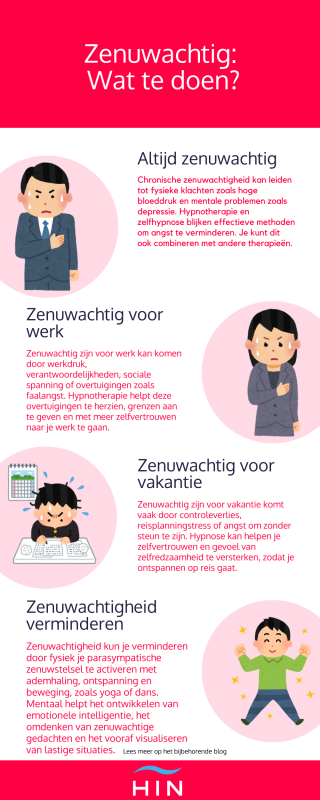
Also, pin this infographic as a reminder:
Sources:
[9] https://www.researchgate.net/publication/346055267_Anatolia_An_International_Journal_of_Tourism_and_Hospitality_Research_Beyond_travel_dreaming_planning_check-in_boarding_stress