

When you think of addictions, many people think of addictions to something tangible, such as coke, coffee, cigarettes or other drugs and substances. But as human beings, you can also become addicted to things you can do on your own.
Think about sex, shopping, masturbating, gambling, gaming, social media or other things you may do on the Internet. You then cannot control your behavior well[1]. For example, you masturbate even at work, or you gamble so much that you cannot pay other (important) bills.
What is behavioral addiction?
In behavioral addiction, certain behaviors almost immediately create a reward in the brain. You then produce substances that make you feel very good for a while. This can be just as addictive as being addicted to certain drugs.
And like certain drugs, you may need more of the behavior or more extreme behavior each time to feel good about it, as you build up tolerance[2].
As mentioned, things you think are perfectly normal can still be addictive.
- Even sports!
- Work
- And fall in love
With behavioral addiction, you have no control over the impulse to perform the behavior[3]. So when you should actually stop or do something better not to do, you do it anyway if you have a behavioral addiction.
Characteristics of behavioral addiction
There are a number of signs you can recognize that you or someone close to you is suffering from behavioral addiction, namely:
- Feeling guilty after or during behavior.
- Quick(er) irritated when you try to stop the behavior.
- Spending money you don't actually have, not being able to eat as a result, or not paying other bills.
- Feelings of shame about behavior[4].
- Continuing the behavior while not giving positive[5].
- Rather choose the behavior because it makes one feel good quickly, even if it produces a worse effect in the long run[6].
Behavioral addiction treatment
Behavioral addictions are relatively easy to treat because you don't become physically addicted to them like alcohol.
But that doesn't mean it's easy for everyone.
Generally, addictions are treated with cognitive behavioral therapy[7].
Previous research has already shown that those effects are enhanced when you do this while in hypnosis. So then it becomes so-called hypnotherapy.
The effects were especially strong in overweight people[8]. So if your behavioral addiction is food-related, hypnosis may be of extra interest.
Hypnosis against behavioral addictions
The great thing about hypnotherapy is that it is completely tailored to the individual. So you will never receive a treatment that someone else has followed in exactly the same way.
Especially in hypnotherapy, personal attention is incredibly important. In the case of addictions, hypnotherapy helps people have more control over themselves[9]. As a result, relapse can be prevented.
The best part is that hypnotherapy has an effect on your behavior even after the sessions[10], this is due to the changes caused in your subconscious.
For example, it helps well with gaming addictions, a form of behavioral addiction; researchers indicate that parents and teachers should teach hypnotherapy to combat gaming addictions[11].
In a small case study in which 2 students were helped with a social media addiction, also a behavioral addiction, it was found that hypnocoaching helped overcome it. A total of only 5 sessions were needed[12].
Hypnosis also helps people with Internet addiction overcome addiction[13].
Self-hypnosis and behavioral addictions
When treating substance addictions, self-hypnosis is also used to prevent relapses. Research shows that the more people engaged in self-hypnosis, that is, the more time they spent on it. The less likely they were to relapse[14].
Reward system normalization
Another thing that goes wrong in people suffering from addictions is that the body's reward system and stress system no longer function properly. This is why, for example, you have to do more and more extreme things, such as more expensive shopping, more gambling, playing more extreme games, to get your reward from certain behaviors.
Also, you get stressed faster if you can't perform certain behaviors.
This is because neurological pathways are altered by addiction. Hypnotherapy helps you re-establish those neurological pathways so that you have a more normal reward system and resume a healthier response to stress[15].
Finding the cause of behavioral addiction
At the Hypnosis Institute Netherlands, we assume that everything you do has at least the intention of making you better, even an addiction.
I too was once addicted, to substances, but at the time it was a solution to another problem for me. That way I got "better" from the addiction.
The same is true with behavioral addiction. You do it because it was once a solution to another problem.
What problem that was then, there can be confusion about that, and that is something hypnotherapists help people with.
Tracing the cause is often done with a combination of a comprehensive preliminary interview and the regression technique. In the preliminary interview, people can discuss what their own suspicions are as to why the addiction was a solution and for what problem then.
Then hypnosis is induced and therapy can begin. During one such session, people may be suggested to go to the first time the behavioral addiction showed up.
Like the first time "gaming" (or whatever the behavioral addiction is) was used to solve the problem.
Then they can look at what was really going on at the time. Was there a particular event preceding it, were and certain thoughts and feelings that needed to be covered up quickly?
This can provide great insight into the actual problem which needs a working solution instead of the behavioral addiction.
Solving the actual problem
Once there is an understanding of the actual problem, such as the limiting belief to deal with the problem correctly, treatment can then focus on that.
For example, if it has to do with anxiety, the fast phobia technique helps to put that moment behind them, so the anxiety is triggered less often and thus the addictive behavior as well.
On the contrary, if it has to do with relationships, a conversation with the inner child or social panorama can be used. It depends a bit on the client's needs whether one or the other technique is used.
Sometimes a combination of these techniques may also be needed to change the original problem.
Ego strengthening and alternatives
Solving a problem does create a mental hole about how to handle certain situations. After all, the addictive behavior the client no longer wants to use for coping.
So it is also important to offer the client an alternative in how to deal with potential problems that create stress or other things that can cause relapse.
Therefore, a hypnotherapist can have the client practice in their mind about how to deal with certain problems in the future and how the client stays strong in difficult moments.
A guided visualization about dealing with difficult family members, for example, or how to set boundaries at work when the stress gets too much. Practicing these behaviors in your mind will increase the chances of applying them in reality.
For this purpose, the client's ego is built up so that they remain strong in their minds even beyond the hypnosis session.
This can be done by repeating certain suggestions, such as:
"I am strong."
"I can do anything."
"I make wise choices."
These are just examples. Depending on a person's problems, they may receive very different suggestions.
Post-hypnotic suggestion can also be given on how the client will naturally leave behavioral addiction behind.
Many times 3 sessions are enough to solve problems with hypnosis.
Learn Hypnosis
Want to learn hypnosis to help yourself or people with behavioral addictions? Then come to a free online master class.
Or request the MP3 for self-hypnosis.
You can also join one of our events or register for one of our training courses right away.
You can take the trainings either in class in Assendelft (above Amsterdam) or live online. Ideal if you can't be there for once or are taking the training from abroad.
Click here for our training courses.
Have a question about the trainings? Schedule a 1-on-1 consultation here .
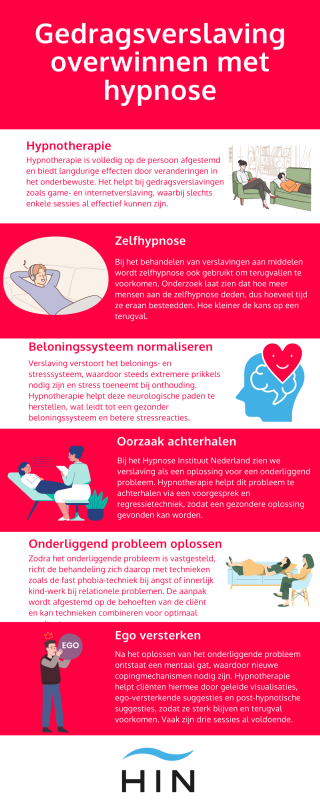
Also pin this handy infographic as a reminder:
Sources: