Do you often swallow words because you think people don't want to hear them, or because you're not sure if what you're saying is true, or because you're afraid that an argument might ensue, or perhaps because of all these reasons combined? Then you may be suffering from low self-confidence. Do you also notice, for example, that people often (figuratively) walk all over you? Do you find it difficult to say no to something? To make sure that you find your voice again and dare to use it, in this article I will discuss increasing your self-confidence.
Uncertainty
Insecurity is a feeling of discomfort or anxiety that can have adverse effects on your self-esteem. Insecurity can make you feel inferior to other people. Insecurity can also make you feel vulnerable. These feelings can negatively affect your self-image and diminish your ego.
Uncertainty mainly causes problems if it makes you unhappy, but there are other problems that uncertainty can cause that may not even be obvious at first glance. For example, you may take on more work than you can handle because you find it hard to say no.
What can also happen is that you work just below your level. For example, you can easily handle a job that requires HBO and several years of work experience and yet you keep applying for entry-level jobs. Of course, with work experience you then have a chance of getting that entry-level job, but a future employer may wonder why you applied for an entry-level job in the first place if you already have work experience.
In addition, your pay may be too low because you find it difficult to negotiate a good salary.
Uncertainty can therefore cause psychological symptoms, such as feeling unhappy or even depressed. In addition, insecurity can cause material complaints, such as getting less money for work than you deserve or even becoming overworked because you can't say no.
Why do you become insecure in the first place?
The creation of insecurity has to do with your psychological resilience. There has ever been a moment that pushed the spring too far, preventing your self-confidence from returning to its normal level.
For everyone, what moment this was is different. Insecurity can arise in childhood, but also in adult life. Losing your job, for example, can make you very insecure, and perhaps that one failing grade on a test that you thought you had made absolutely perfect created insecurity.
Moments in the relational sphere, such as the loss of friends or another relationship, can also make you feel insecure.
Health that lets you down can also put a dent in your self-confidence. That's why research is also being done on boosting the self-esteem of cancer patients and people with HIV. Hypnosis often plays a role in this. After all, your body has let you down, and to regain confidence in your health, self-confidence is also important.
To increase your self-confidence, it is wise to identify these kinds of key moments that have taken you from a confident person to an insecure one to see how you can walk away from this very thing with confidence.
If you are struggling with this, regression therapy can help.
Self Confidence
If you have been insecure for a while you may have forgotten what self-confidence is, what self-confidence feels like. With self-confidence, for example, you don't question your own knowledge. You do open your mouth because you are confident in what you say and are not afraid to back up your statement because you know it is true.
You also feel like you matter. That your activities at work or in your personal life add value. You bring yourself and your employer more and make everything you do better.
The consequence of good self-confidence is that you dare to show yourself. This allows you to create opportunities to move forward in life, whether on a personal or business level. It is also as a result of this that you do go for that job where you just meet the requirements, or maybe not. The consequence is also that you do dare to ask for a higher salary.
In addition, the chances of becoming unhappy because of good self-confidence are minimal; in fact, it is the path to happiness.
Watch this video on increasing self-confidence with hypnosis:
Building self-confidence
Hypnotherapy offers a safe way to build your self-confidence. During a hypnosis session, a hypnotherapist can help you figure out negative thinking patterns. Then the hypnotherapist can help you challenge those thought patterns. Is the thought pattern correct? Isn't it actually showing a distorted view of who you are?
For you, thoughts are important to your self-image, but those around you only see what you do and therefore may have a very different and more positive view than you think.
Then the hypnotherapist can use various techniques to remove insecurities, build your self-confidence and also strengthen your ego. This allows thought patterns to become more positive. Get a more positive view of yourself and beliefs that help you have healthy self-confidence.
More confidence tips
There are multiple ways to build your self-confidence. That's why I offer some practical tips that can help you bring your self-confidence back to a normal level, maybe you're even getting a little beside yourself right now 😉.
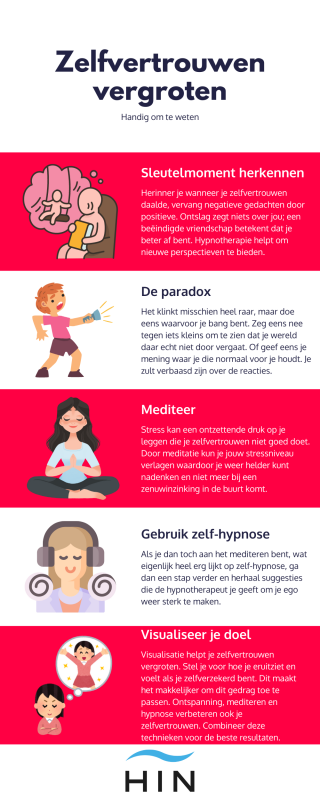
Recognizing key moments
If you can still remember the times when you did feel good about yourself, it is important to figure out what moment or accumulation of moments caused your self-confidence to take a dent. Also consider why this had such an impact and then contrast another positive thought with that negative one.
For example, when fired due to reorganization, this really says absolutely nothing about your ability. It says more about the incompetence of the company that suddenly needed to reorganize. That you were kicked out simply says nothing about you as a professional or as a person.
If a friendship ended, you can also look at it differently. You lost someone who didn't actually love you, while that ex-boyfriend lost someone who loved him/her. Who is actually sad then, not you. Someone who doesn't care about you, you'd rather be lost than rich in the end.
If you yourself are struggling to recognize your key moment and look at it in a new way, you can go back to the moment with hypnotherapy during regression and then work with the hypnotherapist to figure out new ways you can look at the moment.
The paradox
It may sound very strange, but do what you fear for a change. Say no to something small to see that it really doesn't destroy your world. Or give your opinion where you normally keep it to yourself. You will be surprised at the reactions.
Meditate
Stress can put tremendous pressure on you that doesn't do your self-confidence any good. Through meditation, you can lower your stress levels, allowing you to think clearly again and avoid a nervous breakdown.
Use self-hypnosis
If you do find yourself meditating, which is actually very similar to self-hypnosis, go one step further and repeat suggestions the hypnotherapist gives you to make your ego strong again. Examples include:
- I'm smart.
- I do my job well.
- I am judged by what I do, not by how I look.
- I can do anything I put my mind to.
A hypnotherapist can make the suggestions more personal and applicable to your situation.
Visualize your goal
A powerful tool for gaining more self-confidence is to visualize what that looks like. A visualization is a self-hypnosis technique. During self-hypnosis, you go over these questions:
- So what kind of facial expression do you have?
- How is your body posture?
- How do those around you react when you confidently do your thing?
And perhaps more importantly, how does it make you feel to do what's right for you?
Visualizing all this makes it easier to apply these behaviors confidently in real life.
A study using relaxation exercises, meditation and hypnosis to measure the effect on self-confidence, among other things, found that it helped and was a significant improvement for those who participated in the study. So using all the tips at the same time will give you the best results.
Want to learn more about hypnosis and self-confidence? Then check out the Hypnosis Institute Netherlands' training courses and events.
Also join the free master class for an introduction to hypnosis .
Pin also this helpful infopgraphic:
Sources:
http://www.amsciepub.com/doi/abs/10.2466/pr0.1995.76.2.451?journalCode=pr0