
Your nervous system goes throughout your body and is responsible for communication between your brain and your body. It is an important system for what you do consciously, such as grasping something, and for what you do unconsciously, such as breathing, regulating your blood pressure, regulating your heart rate and even regulating your body temperature.
So the communication from your body to your brain and vice versa all goes through your nervous system. If something goes wrong there, for example due to illness or stress or something similar, it can affect many processes unconsciously.
Consider, for example, getting high blood pressure from chronic stress.
Bowel problems when you are emotional.
Or that it's just hard to think when you're sick.
But when is your nervous system really overloaded and what can you do about it? In this blog article, we take a closer look at that.
When is your nervous system overloaded
There are a number of things you can tell when your nervous system is overloaded.
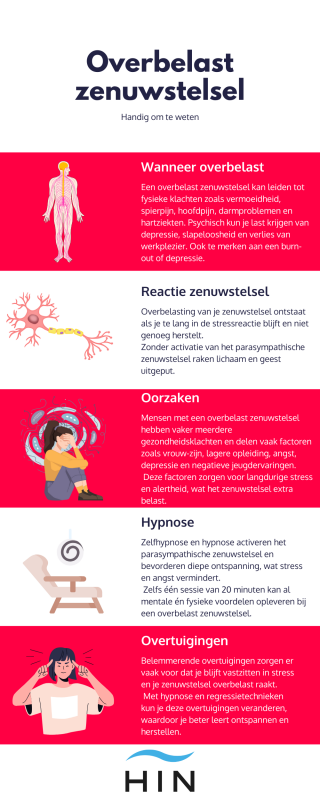
For example, if you suffer from burnout, your nervous system is overloaded. If you do nothing about this, it can have all kinds of consequences, such as excessive cholesterol, type II diabetes, heart disease, muscle pain, fatigue, headaches, intestinal problems, breathing problems and even premature death[1].
That pain and fatigue come from your immune system not responding properly when you have chronic nervous system overload (due to stress, for example). As a result, you get higher inflammatory levels[2] that result in all those physical symptoms.
Psychologically, then, you may experience symptoms such as:
- Depression
- Insomnia
- No more pleasure in work
- Higher absenteeism (source 1).
Other research also endorses that insomnia is the result of hyperalertness due to the overly stressed nervous system[3].
Why does the nervous system respond?
That nervous system overload occurs because your nervous system communicates to your body about whether or not it is time to take action. The so-called fight, flight or freeze (freeze) response.
It doesn't matter whether you're under physical stress, such as when you play sports or fight, or mental stress, such as when you have to give an exciting presentation. In both cases, the sympathetic nervous system is activated and the parasympathetic nervous system is deactivated[4].
This sympathetic nervous system is ideal for quick reactions and quick reflexes. But anyone who practices martial arts knows that this cannot be sustained long-term.
The parasympathetic nervous system helps you relax and recharge so you can get back into the "fight" the next day.
When you are put into "fight mode" by your nervous system, you may notice it by increased muscle tension, (cold) sweating, nausea. Some people may even throw up because of it.
Calm breathing and physical relaxation in turn activates the parasympathetic nervous system, allowing you to relax. This also prevents overloading your nervous system.
However, for some people it is very difficult to relax, even with exercises.
Causes overloaded nervous system
So when you have an overloaded nervous system you face all kinds of health problems. A Dutch study finds that people who have multiple health problems at the same time often have the following factors in agreement:
- More often than not, they are women.
- Lower educated.
- Negative experiences in childhood.
- More suffer from anxiety and depression[5].
Being a woman may be a cause, as women are often still expected to have many caring responsibilities. As a result, women are more often "on" than men, because, for example, they do more in the household and for the children. In addition, they are more often caregivers.
A lower education can be stressful because it gives you fewer opportunities. In addition, the Dutch school system is set up in such a way that it can make you think you are "stupid" when this is not the case at all.
There are plenty of higher-ups who are not even smart enough to drill a hole in a wall to hang a painting.
The knowledge is just different and the limited opportunities can be stressful.
If you have had a negative experience in childhood, or many negative experiences, this also often creates more alertness in general. When you learn as a child that the world is not a safe place, this always creates extra stress outside the home compared to someone who has never experienced anything nasty.
Processing this type of experience can also do much to relax an overloaded nervous system.
Hypnosis against an overloaded nervous system
Hypnosis alone is a good technique for activating the parasympathetic nervous system. Thus, the hypnotic state alone promotes relaxation[6]. One proof of this is how blood vessels respond to hypnosis. These then relax more, than if a person does not experience hypnosis[7].
This is also why self-hypnosis can already do a lot to combat stress. Research shows that medical students who use self-hypnosis suffer less stress and anxiety as a result. In addition, the immune system of students who were `good` at self-hypnosis also functioned better than students who were not so good at it[8].
So it has both mental and physical benefits.
A single 20-minute session focused on relaxation also already helps against chronic stress (causative agent of an overloaded nervous system). It even helped against anxiety and depressed moods. During these 20 minutes, participants listened to a recording that helped them get into hypnosis and gave a guided visualization. In the guided visualization, they were suggested to imagine themselves walking along the beach[9].
If this can already happen with just self-hypnosis and hypnosis involving listening to a pre-recorded guided visualization, go figure what can happen when real hypnotherapy is given to calm the overloaded nervous system.
Changing beliefs that cause stress
Ultimately, it is often beliefs that prevent you from taking a step back and continue to overload your nervous system.
Changing those is very important to change feelings about certain situations and to better indicate boundaries, for example.
We do this with hypnosis by applying regression. With this technique, you go back to the first moment when you felt very clearly, for example, that you were overloading your nervous system. A limiting belief arose and with regression you start to "fix" it[10].
What happened next? Who were there? What were your feelings and thoughts?
As a child, you don't know everything. So if you think about it now, you can better see what alternative "adult" explanations there are for what happened back then.
Next, you need to do something to install a new helping belief to help you relax better.
Again, this includes a variety of hypnosis techniques, such as:
- Empathize with people who were there. Simulate a conversation between those people and your inner child to heal a particular situation.
- A conversation between your present self and your inner child, about that the situation of the past is over and that you can now take very good care of yourself.
- Fast-phobia technique. A technique that helps you get out of the "on" state created by a particular situation.
Also, a combination of these techniques, and the visualizations and relaxation techniques, can be used by hypnotherapists to help people reset their overloaded nervous system so that it can relax again.
A post-hypnotic suggestion is often used to further settle the new belief into the subconscious mind. For example, you might get the suggestion that you notice you can relax much faster after stress. That you can let go of work when you are at home, and that you can let go of home when you are at work.
To check if the hypnosis session has worked in daily life, a follow-up appointment is made. If necessary, adjustments are made and you receive additional therapy if you still notice that your parasympathetic nervous system (the system that provides relaxation and a better immune system) is not activated enough.
Learn Hypnosis
Want to learn more about hypnosis to help yourself (and others) with it? Then come to our free online master class.
Download this free mp3 to experience the power of a hypnotic recording alone.
Or register directly for one of our events and trainings.
You can take the courses at our location, and you can also take the course days live online. Ideal if you are on vacation anyway, or don't even live in the Netherlands and want to take this training.
Click here for our training courses.
Have a question about our training? Schedule a 1-on-1 consultation here.
Also pin this handy infographic as a reminder:
Sources: