

Self-hypnosis techniques are widely used in studies to see if hypnosis can have certain effects. Often, people are also given self-hypnosis as homework to help them hold the treatment well and especially not let go again due to changing circumstances in life.
But what self-hypnosis techniques are out there, and can anyone do it?
Audio file listening
One of the easiest ways to apply self-hypnosis is to listen to an audio file from a hypnotist. A hypnotherapist then makes an audio recording that helps you induce hypnosis in yourself and then relax completely.
Sometimes you can get a personalized tape specific to your problem so you can use that tape to transform yourself into a whole new person. Whether this is to quit smoking, lose weight or overcome fears, reduce pain and even depressive symptoms.
Self-hypnosis with an audio file is one of the easiest ways if you have no other knowledge of hypnosis. All you need then is a place where you can completely relax and sit or lie down. While you listen to the audio file with your eyes closed.
Inducing self-hypnosis
However, sometimes you don't have an audio file you can listen to. In that case, you can also induce hypnosis all by yourself and figure out what to do. Whether you are being hypnotized or hypnotizing yourself it is important to induce hypnosis.
The first step of self-hypnosis is relaxation and rest. Then you can encourage yourself to go deeper and deeper into that relaxation and to focus more and more on nothingness.
For example, you can visualize yourself descending a staircase into a deep basement.
When you have hypnotized yourself properly, you are no longer so preoccupied with the reality around you, but can focus properly on the techniques and what you want to achieve with self-hypnosis.
It's normal to have doubts at first about whether you're doing it right, but just because you're enjoying yourself doesn't mean you have to worry so much about that question. You can always just do it again[1].
The more often you practice self-hypnosis, the better it will be and the faster you can get into the hypnotic state as well.
Visualization safe place
A follow-up step to deepen that relaxation and hypnosis is often to visualize a safe place. At the bottom of the basement, for example, there is then a door and when you open it, you are in that safe place, or you can easily walk to it.
That safe place can be anything, such as a place you've ever been and feel completely comfortable[2]. Or even a place from your imagination that you just love, or who knows even a place you've only seen in a movie.
In that safe place, you can completely relax and just feel good.
Once you're here, many treatments or techniques for solving problems really begin. You can then work on techniques to reduce symptoms, for example.
Visualizing Your Body Clean
When you relax completely, you can get into other fun things, such as visualizing your body and how to replace bad emotions, or feelings here, with good feelings.
Depending on your interest in yoga, for example, you can visualize cleansing your chakras. In the case of a woman receiving chemotherapy for cancer, this visualization was used while she was undergoing chemotherapy. For this she was also given an audio recording for self-hypnosis (source 2), but you can also do this for yourself without an audio recording.
In another visualization, she actually visualized how Pacman ate the cancer out of her body so it was gone. Of course, this is not the treatment for cancer, but it helps you feel better about the treatment and takes the stress out of treatment.
You don't have to have cancer to visualize your body clean. You can also visualize how, for example, a fine light or color cleanses your body of negative emotions.
Self-hypnosis to reduce pain
In a study on the effect of self-hypnosis to reduce headaches , self-hypnosis was used the moment people felt they were getting a headache. They then had to imagine that there was a kind of ruler with numbers from one to twelve. And where on that scale the headache was then, an eight or on the nine for example. Then they could see how this number got lower and lower.
Like being in an elevator, you press a lower number each time until you hit zero.
Another visualization to get rid of the headache is to imagine that the headache is a certain color or shape. While another place in your head, where there is no headache there is another nicer color or shape.
Then you can watch as the color and shape of the headache gets smaller and smaller and the color of the good feeling actually gets bigger and bigger, until the color completely fills the screen of your imagination.
And maybe you have another way to visualize the headache going away. Whatever way works for you, use a way that works for you. It's all good.
This helped eliminate headaches and even make headaches less frequent[3].
Visualizations can also be used for Irritable Bowel Syndrome to self-hypnotize abdominal symptoms away. Metaphors can then be used, such as rivers and how you remove large stones or something blocking the flow of the river, for example. So that you can also in that way suffer less from blockages or something similar in the gut[4].
Repeating suggestions to yourself
In addition to visualizations, you can also repeat suggestions for yourself. This can help you, for example, with self-confidence and behavior change. If you do this at the beginning of your day you can even prime this for the whole day.
You then have some kind of intention about how you want to shape your day or how you want to behave during the day.
This can do something to improve your internal drive (ID) and ego and reduce your superego - society's influence on what you want[5].
Just think about the meaning of success which to yourself, your own ego, can mean quite a bit different anyway from what is socially perceived as success and what your superego can come up with. In fact, your ID, ego and superego are often in conflict with each other and in that case self-hypnosis with affirmations can help you experience inner peace anyway.
For example, a well-known suggestion you can repeat is:
"I'm getting better and better every day in every way."
"I'm good enough."
"I am successful."
"People accept me."
"I'm a winner."
These are just examples, depending on your goals and inner conflicts you may choose other suggestions or affirmations.
These techniques can help you with your concentration, focus on your goals, and feel better emotionally.
The longer you practice with this the less you suffer from your internal conflict between your internal drive, ego and superego (source 5).
Advanced self-hypnosis
If you have knowledge of hypnosis techniques, you can also perform some more complicated techniques. These can then be the techniques you normally practice with a hypnotherapist, such as with regression, talking to your inner child and progression.
These are really techniques for going through transformations and require good knowledge of hypnosis, especially since these techniques are usually supervised during hypnotherapy anyway rather than being done independently.
So I really only recommend this to do if you have taken the training from Hypnosis Institute Netherlands and have experience giving hypnotherapy.
For example, if you become aware of a negative pattern in your life, you can use regression to go back to the first moment when you had a certain feeling that now belongs to that pattern. Then you can see how it came about. You can then view this moment for a moment not from yourself, but neutrally from a third person's point of view. You can empathize with other people to see if you can change the belief you have been given with your current knowledge about life.
Sometimes more than just current knowledge is needed, and that's when you can start the conversation with your inner child. Normally a hypnotherapist helps you with this conversation, but with self-hypnosis you do this all by yourself. You then invite your inner child to let go of a certain defensive behavior and get back into the life of what you have now.
With progression, you can actually plan for the future. Somehow this is somewhat similar to affirmations, but with the difference being that you are going to make some kind of roadmap on how you will reach your goal. This is a technique that comes back in the more advanced training.
So self-hypnosis techniques for beginners are mainly about visualizations to feel good, both emotionally and physically, and repeating suggestions or affirmations to improve self-confidence, for example.
For advanced users, and I'm really talking about hypnotherapists themselves, you can also use more complicated techniques with self-hypnosis such as regression, talking to your inner child and progression.
Want to learn more about hypnosis and be able to hypnotize yourself and others well? Then come to the free online master class for an introduction.
Or register directly for one of our seminars or trainings.
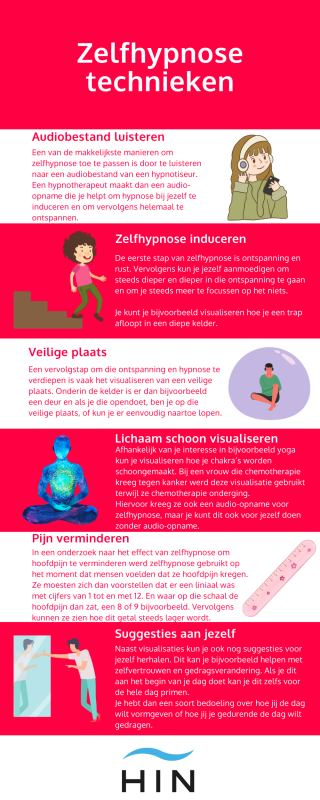
Also, pin this infographic as a reminder:
Sources: