

Manipulating, it's something most of us have tried at one time or another. At least as a child to get that one candy from your mom or dad. Did you also always have more success with either parent? Unfortunately, manipulation is something that can also be used for really "bad" purposes.
To find out if you are being manipulated, in this blog I will go over what manipulation is, how to recognize someone who is manipulating and how to deal with it. In addition, you can use it for yourself as well.
What does manipulation mean?
Manipulation is a belief technique that is actually below the belt. Everyone has goals they want to achieve, but someone who manipulates often tries to achieve those goals through other people.
This sometimes makes it seem like you are getting advice, but actually that person is working with their own interest rather than your interest. Something that is just normal when you are being advised.
Sometimes manipulation is also simply about power. Someone is then often working to suppress you without you immediately realizing it yourself.
Manipulating in a relationship
There are multiple relationships in which manipulation can occur, such as a friendly relationship, within your family or even manipulation by the partner.
The most well-known form of manipulation is partner manipulation.
In addition, siblings can also manipulate each other or children manipulating parents.
In some cases, friendships can be formed because someone wants to make a gain from that friendship. In many cases, once that goal is achieved, the friendship is also often over or diluted over time.
How is hypnosis manipulated?
Someone who manipulates often does so to a certain type of person. For example, if you like to please or take care of people, this may be the reason for a manipulator to begin.
This is because people who like to keep other people happy are sensitive to the following emotions and tactics:
- Debt
- Complain
- Compare
- Lie
- Deny
- Acting like they know nothing
- Pretending innocence
- Foot in the door technique (He who says a must say b)
- Turn over
- Emotional blackmail
- Dodge
- Forgotten
- Acting Concerned
- Bribe
- Blame
- Taking Assumptions
- Sympathy
- Apologies
- Flattery
- Gifts
- Dropping silences in conversations (to make you feel uncomfortable)
For example, if you have made appointments and they are denied, over and over again, chances are you are dealing with a manipulator. This is very annoying because you have to check every time if what he/she says is correct and true.
In addition, evoking shame in the "victim" is a way to undermine self-confidence, making it easier for them to get their way.
Manipulator Psychology
There are a number of factors that contribute to whether and when a person begins to behave as a manipulator. First and foremost, these are mental abnormalities or disorders such as:
- Narcissism
- Borderline
- Sociopath
- Addictions
- Co-dependency
The last factor is actually if you depend on your partner for your self-confidence. This can also be a factor in actually becoming a victim of manipulative behavior.
With narcissism, that person is actually mostly concerned with themselves and their goals. A narcissist also often finds it difficult to empathize with another person unless it can benefit him/her.
People with borderline disorder often manipulate other people around them to do what they want. Usually this is not a conscious choice, as it is with narcissism, but that does not mean it is OK.
A sociopath often has difficulty making emotional connections and basically no conscience. As a result, they have little trouble manipulating people for their own gain.
An addict really only has 1 goal and that is to get his fix. Usually the manipulation begins when the addiction leaves him with no money to pay for his addiction. Then he looks for ways to get money, such as by "borrowing" it. This often starts with the best of intentions, but in severe addictions, it can spiral out of control into manipulative behavior. Even to keep a partner with him who will pay for everything anyway.
Dealing with manipulative behavior
For whatever reason you get manipulated, it's never fun. You usually get gut feelings that something is wrong, but you also don't want to falsely accuse anyone.
Initially, it is important to distinguish between manipulative and non-manipulative behavior.
Manipulative behavior can be identified by the following.
- When someone wants something from you, are they suddenly much nicer or different from normal situations where they don't want anything from you? A major turnaround in the way someone treats you is a sign of manipulation.
- If you don't feel good after giving in to a request or instead give in because you know you will feel guilty afterwards, that is also a sign that you have actually been manipulated. You should be able to sell a no without feeling guilty.
- Does the person become enraged after a little provocation? Then that is also a form of manipulation, namely through intimidation.
- Are you often the savior for someone who is often the victim of "the situation." Beware of this someone who manipulates you will often pretend to be helpless without you or without you they are victims of other people's actions.
What to do if you are being manipulated
If you recognize these four points and fear you are being manipulated, you can conduct a little experiment with the person you think is manipulating you.
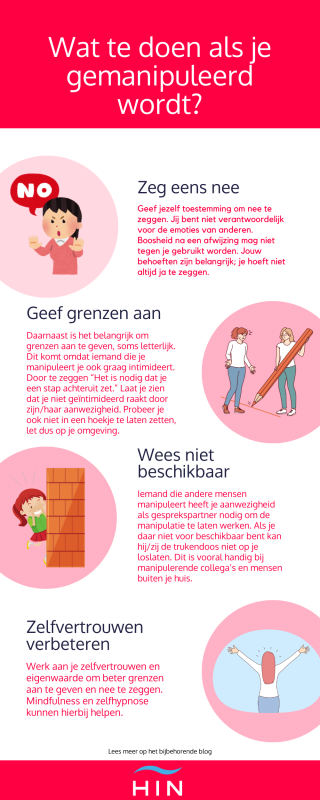
Tip #1: Say no.
Give yourself permission to refuse requests from anyone. You are under no obligation to anyone. In fact, they are responsible for their own response to the no. If someone you manipulate subsequently becomes enraged or sad or whatever, that is a choice they make for themselves. You are not responsible for those emotions.
Understanding is a better emotion after rejection. Sure, sometimes people can be a little angry, but surely that should pass after a few hours. In any case, it should not be used against you.
Starting to say no is sometimes very difficult. Especially if the person does not respond well. Instead of being okay with it, you may then still feel a tremendous amount of guilt. Then keep in mind for yourself that your life and your needs are also important, so you don't have to say yes to everything.
Tip 2: Set boundaries
It is also important to set boundaries, sometimes literally. This is because someone who manipulates you also likes to intimidate you. By saying "It is necessary for you to step back." Shows you are not intimidated by his/her presence. Also, try not to let him/her put you in a corner, so pay attention to your surroundings.
Tip 3: Be unavailable
Someone who manipulates other people needs your presence as an interlocutor for the manipulation to work. If you are not available for that, he/she cannot unleash the box of tricks on you. This is especially useful with manipulating colleagues and people outside your home.
For example, when colleagues or people call you because they want something from you, you can say, "I'm very busy right now, maybe we can talk later.".
Tip 4: Work on your self-confidence
Saying no, setting boundaries and being unavailable is not easy for everyone. If you find it difficult to state your boundaries it may have to do with beliefs you have and perceptions about the importance of yourself.
Therefore, it is also important to work on your own self-confidence and self-esteem to be able to say no steadfastly. After all, chances are that the person will need to hear a no repeatedly, which is sometimes difficult to do.
You can improve your self-confidence in several ways, namely with mindfulness and with self-hypnosis.
Improve self-confidence with hypnosis
In self-hypnosis, for example, you can repeat hypnotic suggestions to yourself or visualize saying no and setting boundaries.
For example, you can use the following suggestions:
My needs are worth as much as anyone else's.
I have my own life and that comes first.
I only owe something to myself and no one else.
These are just a few general suggestions. A hypnotherapist can help you make suggestions that apply to your beliefs and self-confidence.
Another technique you can use is visualization.
You then relax before you begin, which should also be done before using the suggestions, closing your eyes and then visualizing how you say no. You also visualize possible reactions of the person you are saying no to and how you then react to that. For example, how you walk away if he/she is unreasonable. By visualizing this, your self-confidence to actually do this already increases a lot.
Want to learn more about mental techniques for dealing with difficult situations? Then come to a seminar or workshop and, of course, check out the training courses offered by the Hypnosis Institute Netherlands.
Also pin this handy infographic as a reminder:
Sources:
https://www.psychologytoday.com/blog/toxic-relationships/201704/are-you-being-manipulated
https://www.powerofpositivity.com/things-say-to-manipulator/