

Self-confidence is something most people want to have, but can you have too much self-confidence and is that bad for you? It all depends on the situation and how you deal with moments when it appears that you had too much self-confidence. So continue reading this blog to learn more about how too much self-confidence can affect your life.
The pitfalls of too much self-confidence
Self-confidence is good; too much self-confidence can cause you to make mistakes. That's not necessarily a bad thing. It's ultimately about how you deal with those mistakes and what you do with them in the future.
For example, I know the story of Jans who had just started his own business as a consultant. At the very first client, he was super happy. He knew what he was doing and when he was able to give an offer he had estimated that he would spend about 2 hours with the work.
Nothing could be further from the truth. In total, he spent as many as 7 hours on the job, which meant he ended up earning almost 4 times less per hour than he had thought. Oops! Fortunately it was not an hourly bill, because then this could have immediately earned him a bad name. Because it would still make the difference in expected price and price paid very large.
So too much self-confidence can cause you to make misjudgments about your own abilities.
Things can also go wrong, like the self-confidence of the cruise ship captain who hit an island off the Italian coast, causing the ship to capsize and dozens of people to die. Fortunately, most people do not have jobs where lives are at stake, if they do, it is important to manage your sense of self-confidence well and learn from mistakes.
Another good example is that almost everyone rates themselves above average. So having too much self-confidence is not something that only a few suffer from. Many people suffer from it regarding their work with the idea that they are better than average, other people suffer from it again while driving, have the idea that they can drive better than the average road user.
Specialists in particular can suffer from overconfidence. According to the Volkskrant article, doctors who were sure their diagnosis was correct were still wrong in 40 percent of cases. That's almost half of their diagnoses.
The pluses of too much self-confidence
Now don't think that too much self-confidence is always bad. In fact, you also need this overdose of self-confidence to cope with setbacks in life. If, for example, you are one of those doctors who makes a wrong diagnosis and you lack self-confidence, this can cause you to quit your job, even though you can often still make the right diagnosis in the right time and you are right in 60 percent of cases.
You also need this dose of self-confidence to learn from your mistakes. Of course you are shocked when you make a grave mistake, but sufficient self-confidence also makes you dare to learn from your mistakes so that you don't make them next time. This is very important, so too much self-confidence is not necessarily a bad thing.
When does too much self-confidence become arrogance?
Too much self-confidence can become bad, though, if, for example, you don't take responsibility for your mistakes. Suppose you are that doctor who still made a mistake, then you can hardly say that the patient is guilty of you having given the wrong diagnosis. This is because by doing so, you shift the responsibility to the patient and thus you also shift the learning moment to the patient.
Especially if nothing is your fault when things go wrong, but you are able to always and only blame others for events in which you too played a role you have a problem.
People may then find you arrogant, for example, because you act as if nothing is your fault, which can be frustrating for people who have to work with you. As a result, you may experience workplace gossip and eventually even harassment.
So too much self-confidence is really only a problem if you don't take responsibility for your mistakes and don't want to do anything to prevent mistakes in the future.
Too much self-confidence: what do you do with feedback?
So you've made a mistake once and then what do you do? The tendency may be to just stay in bed sick for a day, letting colleagues or other people fix the problem or forget about it. However, this is not going to help you in the future.
It is important to learn correctly from things that have gone wrong. Did you lose your story during a presentation? Then how do you make sure it doesn't happen again in the future.
Questions and answers on feedback
If you have made a mistake, it is important to ask yourself the following questions:
- What prompted the mistake?
- What did I learn from the mistake?
- How can I avoid the mistake in the future?
By asking these questions, you are actually analyzing the situation that led to the mistake. The reason for the error of, say, a misdiagnosis is that the doctor may not have inquired enough about the patient's symptoms.
In the entrepreneur's case, his assessment skills were just not good enough yet due to lack of experience.
The learning from error, for example, is then that the doctor learns that patients save important complaints until the last minute. The entrepreneur has learned that work takes longer than he thought after all.
In the future, the doctor's mistake can be avoided by asking more questions of the patient and seeking clarification on complaints. The business owner may also choose to still work hourly billable hours until he has an average of the time needed to perform a particular task.
Only then will this business owner have visibility to make the right offer, and then this business owner will be better able to be successful in the long run.
Really preventing mistakes in the future
The how question is very important. This is because it means that you need to change your behavior to avoid mistakes. However, changing behavior is something that is sometimes scary.
Having too much self-confidence and shifting mistakes onto other people can sometimes also be a sign of a lack of confidence that you can change. That is why it is important to practice changing behaviors.
Behavior is often the result of beliefs and emotions you hold. In fact, these beliefs are important to your emotional response to a particular event. Therefore, to change behavior, such as an emotional reaction, it is first important to change beliefs.
Changing Beliefs
Beliefs you have can be about what is right and wrong, for example. Suppose you are a doctor you have taken an oath promising to do your best to make people better. Of course you can make mistakes even if you do your best, but because of that oath you probably have the belief that it is very bad if you make mistakes.
In some cases, this can cause fear of failure.
If you are just that entrepreneur, you may have beliefs about how professional it actually is if you make mistakes. This may cause you to think, for example, that it is better to deny mistakes and blame them on someone else, because then no one can say you are a bad entrepreneur.
This is precisely why it is important to change beliefs that are about mistakes. This can be done, for example, with hypnotic suggestions that you can repeat during self-hypnosis, such as:
"Making mistakes is human."
"You can learn from mistakes."
"When you take responsibility for your mistake, people often find you more professional," says Dr. K. K., a professor at the University of Chicago.
A hypnotherapist will first help you find your beliefs and then give you suggestions that apply to them. These are just examples.
Practice changing behavior
Changing behavior after a mistake you can change and you can practice that mentally, for example with a guided visualization. For a guided visualization, a hypnotherapist will have a conversation with you about your self-confidence, making mistakes and how you feel about them. Then you can be given a visualization that applies to your beliefs and fears, such as:
"A patient comes in with a vague complaint. You examine the physical complaints and still ask about complaints that are playing under the skin. When you get a vague answer, you ask further questions. This breaks the ice with the patient and he dares to tell you more than initially. You feel that you are finally getting somewhere. You hear complaints that are actually much more serious, but that the patient was afraid to tell you at first. Because of this, you immediately know what is going on, and to whom you can refer your patient or how best to help him/her."
This is just an example of a guided visualization in which new behaviors are mentally practiced. In your case, things may be very different.
So by handling criticism well, too much self-confidence is definitely not a problem. It only becomes problematic if you don't want to learn anything from your mistakes because you already know everything anyway.
Want to learn more about hypnosis? Then come to the free master class or check out the Hypnosis Institute Netherlands' courses.
Also, pin this infographic as a reminder: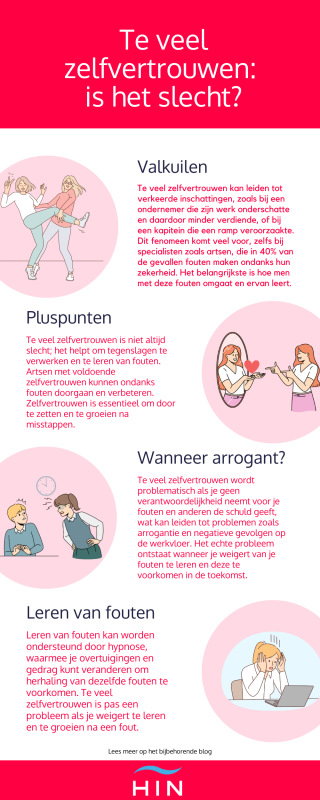
Sources:
https://www.psychologytoday.com/blog/perfectly-confident/201801/overconfidence
https://www.volkskrant.nl/archief/lake-wobegon-effect-waarom-we-onszelf-enorm-goed-vinden~a3347557/