Hypnosis can play a big role in addiction treatment. There are all kinds of substances that people can be addicted to, this is then often achieved with drugs, alcohol or behavior.
However, over time this can cause all sorts of problems, so people often want to quit anyway.
But how do you stop an addiction? This is far from easy. This is where hypnosis and hypnotherapy can play a supportive role.
Caution! Always see a doctor if you want to quit a drug or alcohol addiction. This is because your body can also become addicted to certain substances so stopping all at once can be dangerous. Always stop under the supervision of a doctor. They can help you, for example, with tapering off or medication to support you in quitting your addiction.
Hypnosis and drugs
Hypnosis can be very helpful in overcoming drug addiction. In a case of a woman who needed $500 daily for her cocaine addiction, self-hypnosis helped.
For this, she used a self-hypnosis recording to quit smoking, but then came up with the word "smoking" every time she heard the word "snorting coke." She listened to the recording for four months, three times a day, and was then able to quit her coke addiction.
Nine years later, she still had not had a relapse[1].
In her case, this was quite special, as she had not otherwise sought other help.
You can guess that it can go faster than 4 months if you do enlist additional help and not just use self-hypnosis. Also, this is not always wise because you can also become physically addicted to drugs. So always consult with your doctor about your plan of action.
In another study in which methadone addicts, who still used heroin occasionally, participated in group hypnosis, it was found that it helped them quit heroin altogether. After 2 years, 80% of the participants had still stopped using heroin, but some of them were now receiving benzodiazepines (medication).
Which is a lot better than heroin use anyway.
In this study, participants received 1 hypnosis group session per week for 10 weeks[2].
The studies on hypnosis and quitting drugs are very small. So you can't generalize the results to everyone yet, but it does show that hypnosis can be incredibly powerful.
If a self-hypnosis tape alone helps against cocaine addiction and group hypnosis can help you quit heroin use, what can happen when you go into hypnotherapy? Or if someone in addiction treatment works with you individually with hypnosis and cognitive behavioral therapy?
Hypnosis and alcohol
With alcohol addiction, counseling is very important because you become physically addicted as well. Then withdrawal symptoms can be very intense and even deadly. So always do this under the supervision of a doctor. They can give you medication so you don't suffer from delirium or seizures.
Hypnosis has been used for decades to help people quit drinking. Miller was already using hypnosis to help people get rid of alcohol addiction in the late 1950s. A total of 24 people participated whose addiction had lasted from 3 to 34 years. While in hypnosis, participants were suggested to relive the ill effects of alcohol, such as the hangover and cumbersome feeling of a "hangover." This allowed participants to stop. Only three of them started drinking again anyway. One person of the three was still able to be helped with additional hypnotherapy[3].
If you have quit alcohol or drugs, self-hypnosis can be used to prevent relapse. One way to do this is to improve self-confidence. A study involving veterans who had quit drinking or drug addiction found that self-hypnosis can be used well for boosting self-confidence, calmness, reducing anger and impulsivity. Especially if the veterans listened to the self-hypnosis recording at least three to five times a week[4].
In a clinic in Norway, Ericksonian hypnotherapy was applied to see how it does compared with motivational interviewing. In addition to group therapy, participants received five hours of individual therapy.
Hypnotherapy did as well as motivational interviewing to help people quit their alcohol addiction. A year later, hypnotherapy was found to do even marginally better than motivational interviewing in preventing relapse into alcohol addiction[5].
Knowledge of hypnosis can be invaluable to addiction treatment providers. Especially for people who do not respond well to standard treatment.
Hypnosis and drug addiction
If you've ever suffered from anxiety or been given anesthesia to take home to recover from surgery, short-term medication may have inadvertently caused you to become addicted to it anyway.
So how do you stop without getting mad at your doctor for not wanting to prescribe you more?
As with other addictions, hypnosis can then play a role. Suggestions can be used to reduce cravings for the drug.
Consider, for example, the feeling that oxazepam, for example, does relax you nicely, but on the other hand, it makes you do nothing at all. By the way, this feeling can also be achieved without medication, but with, for example, meditation, yoga or even a nice massage.
There may also be underlying psychological issues why you want to continue taking certain medications, for example. Perhaps you no longer think about certain concerns you have under the influence of the medication, but they resurface when the medication wears off.
In this case, you can use hypnosis to find out what beliefs are causing these concerns and what is preventing you from addressing the worry. This can already do much to eliminate the worry, or to take the steps to reach a solution.
Hypnosis and eating addiction
With eating addiction , there are often psychological factors that contribute to overeating. Cognitive behavioral therapy is then a way to deal with those factors in a different way, this can be supplemented and reinforced with mindfulness and hypnosis.
Hypnosis can help with a virtual gastric band to at least better recognize the feeling of being satisfied and be more aware of nutrition. In addition, hypnosis can help with self-acceptance, reducing cravings for food and emotion eating[6].
As with other addictions, eating addiction can look at the underlying causes and beliefs. With hypnosis combined with cognitive behavioral therapy, much can be done to process or change those causes and beliefs.
Hypnosis and behavioral addiction
By behavioral addictions, you can think of anything you can do yourself that might make you "happy," but which then gets completely out of control and then makes you unhappy.
Consider sex addiction, gambling addiction, gaming addiction, shopping addiction, crush/relationship addiction and even work addiction. When you start out it feels really good, but over time you can run into financial, social or health problems.
Even then, it is important to achieve the goal, feeling good, that got you addicted to certain behaviors in a different way.
For masturbation addiction, the swish technique can also be used. This has also been used with twenty-somethings who had become addicted to masturbation. In this technique, the behavior you no longer want is replaced with other behavior. So if you get the urge to masturbate you can replace it by drinking a glass of water, doing some push-ups or going for a walk. This can already be very helpful in stopping this type of behavioral addiction[7].
Gambling addiction is usually treated with cognitive behavioral therapy, you can also do this with hypnosis and self-hypnosis which works just as well as cognitive behavioral therapy on its own. Researchers indicate that self-hypnosis can be a good addition to normal therapy to stop gambling and can add value in shorter interventions[8].
Hypnosis in addiction treatment
There are quite a few addictions that people can suffer from, and each one has its own challenges. With one addiction there may be a physical challenge, while another addiction may have a psychological challenge.
In all cases, hypnosis can provide significant support in stopping addiction and preventing relapse.
Therefore, knowledge of hypnosis can greatly help someone working with addicts or former addicts to provide additional support to individuals during difficult times. In this way, you ensure that the coin can actually be given with X days clean.
Want to know exactly how hypnosis works and see if you can help people suffering from addictions with this? Then come to the free online master class.
Or register directly for one of our seminars or trainings. The training is hybrid which means that the training is available both live online and classroom on-site.
Ideal if you can't attend class for a change, or live on the other side of the world 😉.
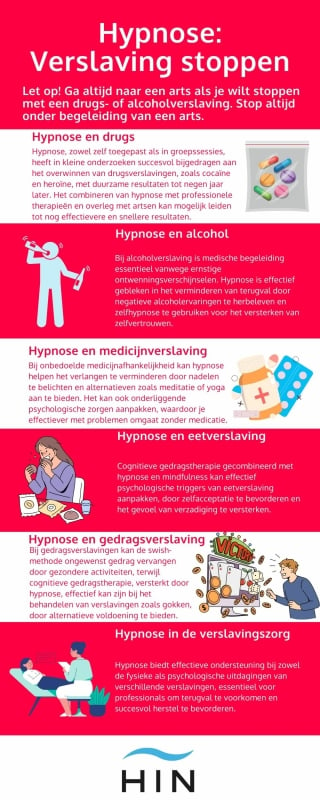
Also pin this handy infographic as a reminder:
Sources: