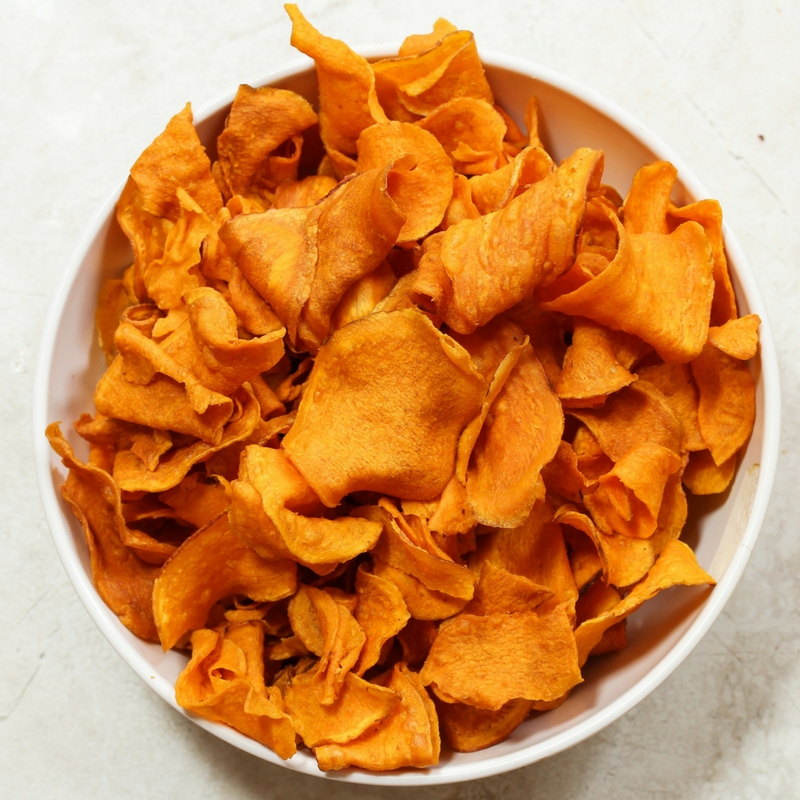
Eating is something most people enjoy doing. It keeps you alive and it can provide pleasure. Delicious smells and tastes that you start to enjoy even just thinking about them. Food also plays a major role in social occasions, associating food with conviviality. All ingredients that can have an addictive effect on people prone to addictions. An eating addiction can happen just like that.
Read more about what eating addiction is and what you can do to get rid of it in this blog.
What is an eating addiction?
To determine if you are suffering from an addiction , it is good to know when scientists find that someone is suffering from an addiction. Addiction is characterized by scientists as behavior caused by a neurological defect.
In addiction, for example, people have difficulty generating dopamine in a normal way and therefore need more and more of the addictive good to experience that feeling of happiness.
Meanwhile, some scientists believe eating addiction exists.
Generally, overweight people are blamed for poor dietary and lifestyle choices. Problems with metabolism are also often blamed for explaining obesity in someone.
It is now also clear that an eating addiction can cause you to suffer from obesity and that an addiction can also very well be mental and need not be caused only by neurological and physical characteristics, as with alcoholism and drug addiction.
If you suffer from an eating addiction, you often crave food. This means that you are already thinking about what you are going to eat while you are at work, for example, or that you cannot focus when you are actually craving something tasty.
Research conducted in the U.S. also shows that people who have a high score on an eating addiction questionnaire are more likely to think and feel like eating than those with a lower score regarding having an eating addiction.
The only difference with, say, drug addiction is that people do not anticipate in advance that eating will make them feel happier. This may be because people are often aware that eating too much and too unhealthy food is not good for you. After a binge eating, with then actually suffer from feelings of guilt about the behavior.
If you think you can only suffer from an eating addiction if you also binge eat, you are wrong. People who do not binge eat can also suffer from an eating addiction, according to research.
Eating addiction test
Precisely because eating addiction is not always easy to recognize, there is also a lot of testing for eating addiction. I have extracted a few statements from the Yale Food Addiction Scale that you can use to check for yourself whether eating may already be an addiction in you. When answering the statements, keep in mind the last week and whether or not the statement is true for you.
- I find that when I start eating certain foods, I end up eating more than I intended.
- Some foods I keep eating even though I'm not hungry.
- I eat until I feel nauseous.
- I worry about eating certain foods and not eating other foods.
- I am often tired and lifeless because I eat too much.
- If certain foods are not in the store, I go far to get those foods.
- Sometimes I eat instead of working or spending time with friends and/or family.
- Sometimes I eat so much that I feel guilty afterwards and suffer from other negative emotions.
- I sometimes avoid professional and social situations because I fear eating too much.
- I sometimes feel anxious or have other withdrawal symptoms when I stop eating certain foods.
- I sometimes eat certain foods to prevent emotions such as anxiety and agitation.
- I actually feel more like eating certain foods when I try to stop eating them.
- I have trouble doing everyday things, like working and maintaining social relationships, because of how I deal with food.
- For the following statements, keep the last year in mind to check if the statement applies to you or not.
- The amount of food I eat causes negative feelings such as depression, self-pity, anxiety or guilt.
- The amount of food I eat is causing or has made physical problems worse.
- I keep eating the same food and eating the same amount whether I have emotional problems or not.
- I had to eat more each time to get the same good feeling from food as when I started using food for happiness.
- I want to eat certain foods less or stop eating them.
- I have been trying to eat certain foods less or no longer.
- I have had success in reducing or even stopping eating certain foods altogether.
As you can see, there are many parts of your life that can be affected by an eating addiction. First and foremost are your own feelings and your own body. Daily functioning can also be interrupted by an eating addiction. Especially if eating makes you unhealthy, unhappy and less social than you were, it is important to do something about it.
Treating eating addiction
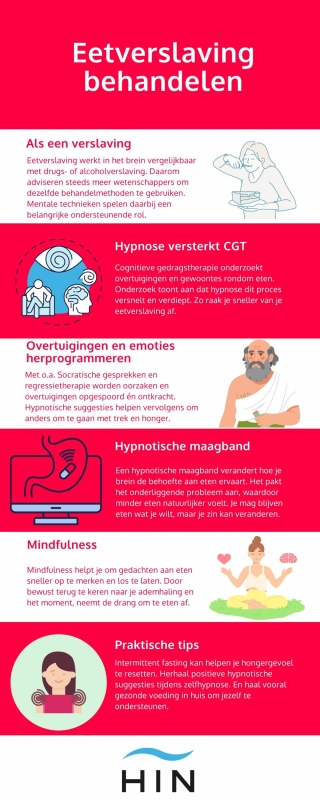
Scientists now increasingly recommend that someone with an eating addiction should be treated like someone with a drug or alcohol addiction. Mental techniques can support such treatments.
Hypnosis as a solution to eating addiction
An important technique used with addictions is cognitive behavioral therapy (CBT). In this therapy, experiences and beliefs about food are examined and you can find out if your beliefs are logical or not.
Research shows that hypnosis enhances the effect of CBT. This means that hypnosis gets you rid of addiction faster than using cognitive behavioral therapy alone.
One way to find out and dispel beliefs about food, for example, is with Socratic conversation, which is a CBT technique.
In addition, a hypnotherapist can also help you with regression therapy to find out if a particular event is the cause of the eating addiction.
Hypnotic suggestions about nutrition and dealing with hunger are also one way a hypnotherapist can help you overcome an eating addiction. You can also use these during self-hypnosis. A hypnotherapist can put these together for you based on your own problems and thoughts with food.
Hypnotic gastric banding
Another way we help people at Hypnosis Institute Netherlands who suffer from overeating and are struggling to lose weight is by placing a hypnotic gastric band.
The hypnotic gastric band addresses the underlying problem of why you overeat or suffer from an eating addiction. By eliminating that problem, it becomes much easier to lose weight. You may even continue to eat what you feel like, only your appetite may have changed after the procedure.
Mindfulness as a solution to eating addiction
Another way to think about food less often is to be mindful. Mindfulness helps you to be in the here and now with your thoughts. Especially during an addiction, it is appealing during work or during an outing with friends and family to only think about the moment of eating.
Mindfulness allows you to recognize those thoughts more quickly and get back to being in the here and now with your attention. For example, you name the thought and emotion you are having and then focus back on your breathing and the moment you are in.
Tips against eating addiction
There are a few tips you can already apply to suffer less from your eating addiction.
Tip 1: Intermittent fasting
Fasting helps your body quell feelings of hunger and reset you a bit in terms of feeling the need to eat. By consciously not eating for a few hours, you can also become more quickly aware of the positive things about not eating all day. For example, you tend to have more energy.
In doing so, you'll often notice you're full faster afterwards. It is best to start with not eating for a few hours and build up to 5 hours. By doing this on the weekend, you can avoid being cranky at work because you need to kick the sugar and food cravings.
Tip 2: Repeat hypnotic suggestions
During self-hypnosis, you can already repeat hypnotic suggestions to get over the feeling of cravings more easily and to eat only when you start to feel really hungry or haven't eaten for several hours.
For example, you can repeat the following suggestions:
I have to do my whole life with this body, therefore I have to take good care of it.
Nutrition does not make me happy.
When I'm full I don't have to eat my plate empty.
If I get hungry I can drink a glass of water first.
Tip 3: Get healthy food is home
An eating addiction can be difficult to overcome. To help yourself, you can banish bad foods, such as pizza and potato chips, from the house and only bring in healthy foods, such as fruits, vegetables (and vegetables you can eat raw) nuts and fish. At least then you'll get more healthy foods.
In addition, vegetables can make you feel less hungry because vegetables still the sensation of hunger, while sugar triggers hunger.
Want to learn more about mental techniques to overcome addictions? Then check out Hypnosis Institute Netherlands' training courses or come to a master class.
Also pin this handy infographic as a reminder:
Sources:
http://link.springer.com/article/10.1007/s12152-010-9069-1
http://www.sciencedirect.com/science/article/pii/S1471015312000116
http://www.tandfonline.com/doi/abs/10.1080/10640266.2014.857515
http://www.tandfonline.com/doi/abs/10.1080/02791072.2010.10400686
http://www.midss.org/sites/default/files/yale_food_addiction_scale.pdf