


Impulsivity is something everyone has to varying degrees. Generally this does not cause problems, but sometimes it can still happen. For example, if you very impulsively quit your job when you don't have the financial means to do so at all.
Do you suffer from impulsivity more often instead of enjoying it? Then read on.
What is impulsive?
Being impulsive is a character trait. Some people are very impulsive and other people want to plan everything and know where they stand. If you are impulsive you can react quickly to internal signals and to external signals. For example, you may act quickly because you have a particular thought or feel emotion, or you may react impulsively because of something happening in your environment[1].
For example, if your friend is angry one time you make it up immediately instead of starting the conversation and coming to a solution.
Impulsivity can affect your work, relationships and school performance.
If you are too impulsive, you may have problems with aggression and abusing narcotics.
In addition, too much impulsivity is often also a symptom of ADD, ADHD, borderline and antisocial disorder. And impulsivity also occurs in people who suffer from kleptomania, pyromania and problematic gambling (source 1).
When you suffer from addictions, you can also deal with them impulsively, even after you have kicked the habit.
Do you have long-term goals? If so, impulsivity can make it harder to achieve those long-term goals[2].
What is impulsive behavior?
Impulsive behavior is often seen as inappropriate behavior. It is behavior that often does not fit a particular situation.
What is interesting is that if you think you are impulsive, according to scientists or people observing you, it does not have to be so. In those tests, people often have to not perform a certain behavior or delay certain behavior, then if this does not work out well it is seen as impulsive.
This does show that everyone has somewhat of a unique idea of what impulsive behavior really is.
In any case, you tend to take thoughtless action, you are insensitive to consequences of certain behavior, and your behavior is inappropriate for certain situations.
At school, for example, you find it difficult to pay attention or you suddenly start talking through the teacher or something similar.
You can also suddenly blurt something out, such as a Freudian slip[3].
Or if you don't feel well, instead of doing something about it you quickly grab a drink regardless that it may give you a hangover the next day[4].
Impulsive behavior becomes problematic at:
- Aggression
- Restlessness
- Interrupting Others
- Easily distracted (source 3)
The likelihood of impulsive behavior is increased with changes in your brain, genetic factors, environmental factors and if you have had childhood trauma[5].
Impulsive behavior in adults
Impulsive behavior in adults may indicate problems such as ADHD. A study comparing impulsivity in adults with and without ADHD found that adults with ADHD were more likely to make clumsy choices, more likely to lose focus on a task and more likely to not plan well[6].
When young adults exhibit hostile and impulsive behavior, it can also be a precursor to the development of antisocial disorders or borderline. Young adults may then also take more sexual risks[7].
If you have never actually suffered from impulsivity and you suddenly notice that you are impulsive more often, this may be a signal of incipient depression[8]. It is then important to seek help ahead of time so that you do not fall into the hole called depression.
Impulsive behavior borderline
Impulsivity is one of the characteristics of people with borderline disorder. In addition - if you suffer from borderline - you may also suffer from restless feelings, anxiety about your identity, troubled thoughts and problems with personal relationships.
Especially when you are young and suffer from borderline, you also suffer a lot from impulsivity, but as you get older, impulsivity also decreases in people with borderline. Unfortunately, the other problems do remain[9].
Dealing with impulsive behavior
Impulsive behavior comes in part from thoughts that offer an "alternative. These are thoughts that you can often suppress, but if you suffer from impulsivity, you have difficulty with this[10].
It is particularly important to seek help if your impulsivity causes you to suffer from:
- Suicidal thoughts
- Abuse of medication or drugs
- A manic period
- A depressive episode (source 5)
One way to suffer less from impulsivity is to apply mindfulness. In particular, this can help you be more aware of what thoughts you are having and better able to control them. This helps, for example, with your focus and to not think of "alternatives.
In addition, research shows that mindfulness can also improve your self-confidence. This combination of mindfulness and increased self-confidence helps against impulsive buying or getting an impulsive shopping session, among other things[11].
Hypnosis to reduce impulsivity
Hypnotherapy is also used to help people who have been addicted reduce their impulsivity and prevent relapse. Research shows that hypnosis helps to reduce impulsivity, reduce cravings for drugs and reduce the likelihood of relapse[12].
If you suffer from impulsive behavior where you become aggressive or destroy things, hypnosis can also help you.
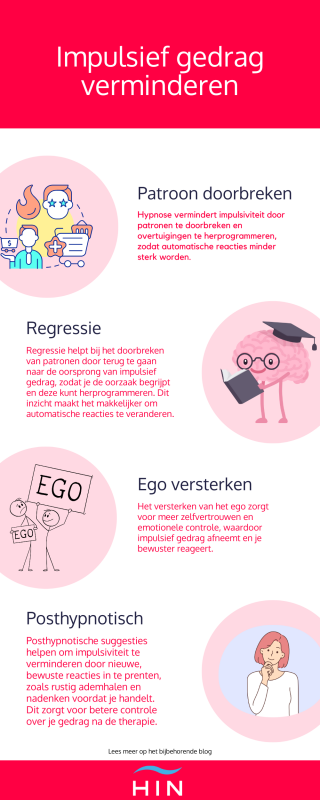
In that case, for example, you can get a regression. During a regression, you go back to the first moment when you became aggressive about something, for example. This allows you to identify, among other things, what is now causing you to suddenly act so impulsively.
In addition, you can check what beliefs are causing you to act out instead of dealing with the problem in a constructive way. You can then change those beliefs.
In the case of uncertainty, you can also receive suggestions to help you strengthen your ego[13]. These are suggestions that you can repeat such as:
"My development is always ongoing."
"Failure is not failure, but a learning opportunity."
"I am aware of my thoughts."
"I can do anything."
These are just examples. Depending on your problems with impulsive behavior, you may receive other suggestions to help you suffer less from it.
In addition, you can also receive post-hypnotic suggestions about your behavior after hypnotherapy. This may include, for example, that when you get a certain idea, first take a breath and determine the pros and cons of the idea. Only then will you actually do something or not do something because, on second thought, it wasn't such a good idea after all.
Changing the pattern of impulsivity is also something you can do with hypnosis. This is because if you have been able to figure out at what times you cannot control your impulsivity well, then you have figured out a pattern. This may involve certain situations or even certain emotions that cause you to do thoughtless things.
For example, you can visualize this pattern and then play this "movie" backwards or even cut it up and play everything in an illogical way. This also makes the pattern more illogical for your unconscious, making you less likely to react impulsively to certain situations or feelings.
Want to learn more about hypnosis and how it can help people? Then come to the free online master class.
Or enroll in one of our training courses. Great for your personal development and fun if you want to get started as a coach or therapist.
Also pin this handy infographic as a reminder:
Sources:
[3] https://www.webmd.com/mental-health/what-is-impulsivity#:~:text=Impulsivity%20is%20the%20tendency%20to,necessarily%20a%20sign%20of%20trouble.
[6] https://www.cambridge.org/core/journals/journal-of-the-international-neuropsychological-society/article/abs/impulsive-behavior-in-adults-with-attention-deficit-hyperactivity-disorder-characterization-of-attentional-motor-and-cognitive-impulsiveness/ABE45BCD13B1D830CA39FEF9605C6B53