


As a parent, you actually let go of your child ever so slightly from just about birth. First, you literally have to hold your child, nurture him so he can grow. Then your child can walk and each time your child walks a little further away from you.
And your child may be making very different choices than you. Unfortunately also unwise choices, and you want so badly for your child to do well that you try to rectify all those choices with the cloak of love.
But sometimes that's just not doable.
Your child, especially if they are an adult, also has a will of their own, and that can clash with your will.
So if you have a child who gets lost in addiction, is it helpful to let go of your addicted child, your addicted son or daughter?
In this blog, we will explore this and whether hypnosis can help you with this.
Dealing with adult addicted child
If your child is addicted, this can be very difficult, because you still want the best for your child. It is also difficult because an addicted adult child can be unpredictable and wreak havoc on your entire household (if he still lives at home, or visits unexpectedly on a regular basis).
All while still having a life of your own with commitments and things you want to do for yourself.
Before you know it, all of your time is devoted to your child, when you expected that at the age he/she is now, you shouldn't have to.
Parents deal with adult addicted children differently. There are actually 2 camps.
Camp 1: Holding
Camp 2: Letting Go
When parents hold their child, so to speak, they try to control their drug use . In this way, they hope to improve their child's life and themselves.
The advantage of holding can be that you still experience feelings of control, but the disadvantage is that this "holding" can also create a lot of stress and pressure on parents.
Parents who let go then hope for the best and that the child will independently seek help for his/her problems.
Letting go can bring sadness, because your child cannot live up to his/her potential and there is nothing more you can do about it. At the same time, it can bring some relief because you recognize for yourself that it is not your problem, but your child's.
In the process, letting go allows you to take better care of yourself again and have more focus on your own well-being[1].
What is junkie behavior
After all, having an addicted child is not nothing and can have a lot of negative impact on your life. It creates feelings such as:
In addition, it can affect you so much that you can no longer do your job well and have to work less, so it also affects your finances[2].
The sadness is there not only because you see your child not living up to his or her potential at the time, but also because the bond between you and your child deteriorates because of addiction[3].
This is due in part to addict behavior. So-called junkie behavior.
Financially, you can get into double trouble, as an addict can also manipulate parents to get money that way, or destroy (expensive) items under the influence.
That manipulation may very well be emotional. For example, "parenting" can be blamed for addiction rather than the child's own choices.
Behaviors you may encounter are:
Verbal abuse: Yelling, cursing, criticizing appearance, intelligence and education.
Financial damage: Theft of belongings or money. Damaging stuff. Demanding money for stuff. Taking out loans that parents have to pay.
Physical violence: hitting, kicking, pushing, spitting, throwing things at parents.
Emotional abuse: Undermining parental self-confidence, with bullying, for example. Making parents feel unstable. Threatening to harm themselves or parents.
This can also take place simultaneously.
Boys are more likely to use physical violence, while girls are more likely to use emotional violence.
The longer an (adult) child uses drugs, the more likely it is to spiral out of control into junkie behavior toward the parents.
Also, many parents note that there are 2 versions of their children. This is also a way of dealing with substance abuse and aggressive behavior. The version in which they recognize their child, when sober, and the version in which the child is suddenly totally different and aggressive. Then all the behavior the child then shows is blamed on the drugs being used.
That alone does not solve the problem.
Usually parents release their child when the child is a danger to them, such as because the child has hit the mother or started fighting with the father.
Don't blame yourself
Many parents blame addiction on other problems, such as ADHD, or even blame themselves. For example, because they themselves have suffered from drug or alcohol addiction[4].
What's important is that your stress and grief are also recognized in your family. After all, an addict makes it difficult not only for themselves, but also for those around them[5].
Letting go can be the solution
Of course, 2 things can happen when you release your child when they have an addiction.
- He/she continues on the same path and nothing changes.
- He/she realizes that rock-bottom has been reached and changes his/her life (possibly without you there even though it will be healthy).
Belgian research shows that there are certain moments in life that cause a person to quit an addiction, namely:
- Having a negative experience with drugs.
- Becoming a father or mother (recognizable to me ) .
- Rockbottom Reach.
- Losing friends and family (due to distance, for example, or death from drugs).
After situations like this, people are often more willing to seek help anyway than if they did not experience this type of situation[6]. Therefore, letting go of your child also provides a chance for recovery.
In addition to pointing the door, you can also give your child a brochure of organizations that help people overcome addiction. At least then you haven't left him or her empty-handed.
Hypnotherapy for coping
Having an adult addict can feel very tough. After all, you don't really have control over your child anymore, and so there's pretty little you can do about it.
Hypnosis can help you cope with stress, find a place for your emotions and practice stating your boundaries.
Research shows that parents who have anxiety about their child's future (in this case due to a mental disorder) can benefit from hypnosis. Hypnosis helps to reduce stress and suffer less anxiety about your children, among other things[7].
A hypnotherapist will always have the conversation with someone first. In this conversation, a parent can talk more about the child, the child's problems, and what makes that a problem for the parents and its impact on the parent's life.
This all gives a hypnotherapist tools to use during therapy, such as being able to ask about certain emotions and experiences, as these are often the result of certain beliefs.
Like why you have the conviction to continue to care for your child at the risk of your life.
How logical is that really?
There are multiple ways to identify and change limiting beliefs. For example, you can find out what the positive intention is behind a limiting belief and whether you can't achieve that positive intention in another way.
At the Hypnosis Institute Netherlands, we always assume that you do something to get better at it.
Sometimes that may not work, but a problem has often been a solution to something else first.
Visualizations
In addition, visualizations can help "practice" reactions if your child comes to you for something while high on drugs or under the influence of booze.
This helps to not fall back into old unhelpful patterns in situations like that, but to provide clarity about your feelings to your child and about consequences if the behavior is not changed.
They can also practice setting boundaries and offering alternatives, such as giving numbers of hypnotherapists who specialize in addictions, or providing information about rehab clinics or something similar.
Anchoring calm feelings
Now you may think that in the moment when your child is no longer himself, it is difficult not to react from emotion. That's why a hypnotherapist can also help by anchoring calm feelings .
This means that if you find that you are upset with your child, you can evoke calm feelings with a small movement so that you can maintain peace of mind during stressful situations.
Learn Hypnosis
Do you want to help yourself, your child or others? If so, knowledge of hypnosis can be incredibly valuable. Come to the free master class for an introduction.
Or register for one of our events and trainings.
Have a question about our training? Click here for a 1-on-1 consultation.
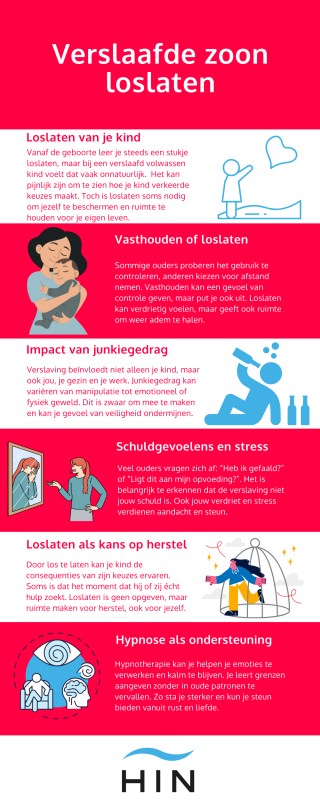
Also pin this infographic as a handy reminder:
Sources: