
Moving, forget it. Delivering quality, nope. Being able to be focused, it only seems that way. If you suffer from burnout, you just went on after being overworked and didn't slow down, with all its consequences. Having a burnout is terrible and it is also difficult for many people to get rid of it and not have a relapse.
Hypnosis can help you recover from burnout, read how here:
What is burnout
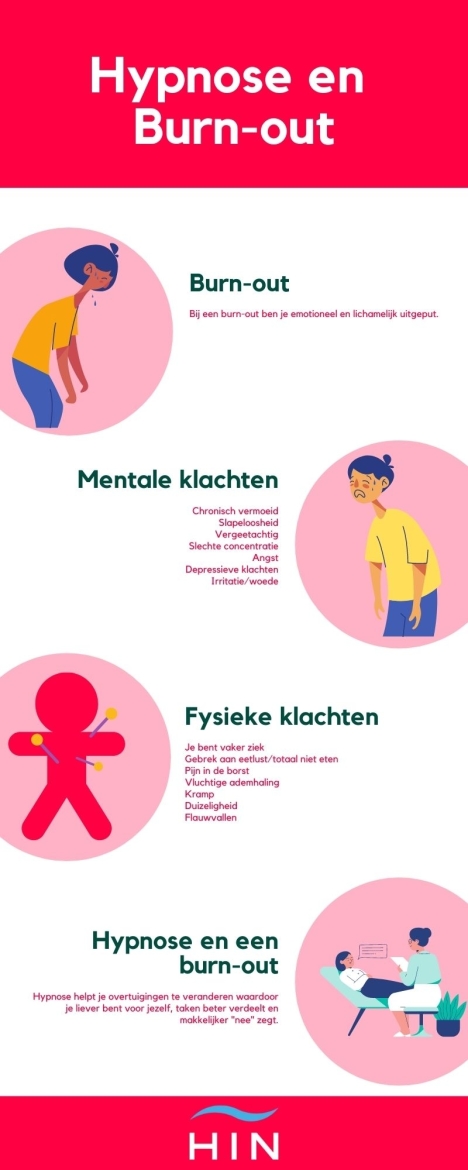
If you suffer from burnout, you are emotionally and physically exhausted. You often become cynical and a bit disconnected from this. For example, you then no longer feel connected to the work you do, even though you still feel that you should be the best at it. Burnout can make you feel like you're not getting anything done well and, as a result, frustrated because you're not achieving your goals.
There are many stories going around that when you have burnout you notice it because you suddenly can't get out of bed.
Unfortunately, burnout is something that creeps in. The moment you can't get out of your bed you've probably been suffering from burnout symptoms for a long time, but you're just super bad at listening to your body.
Recognizing burnout
Okay, so when burnout creeps in, what do you recognize that creep in? It's important to make a checklist of sorts for yourself to see if you suffer from the following mental symptoms:
- Chronically fatigued
- Insomnia
- Forgetful
- Poor concentration
- Anxiety
- Depressive symptoms
- Irritation/Ager
Then you may also suffer from more physical complaints. For example, you may suffer from:
- You're sick more often
- Lack of appetite/total inability to eat
- Chest Pain
- Volatile breathing
- Cramp
- Dizziness
- Fainting
Recognizing cynicism and disconnection
In many cases, at first you don't experience the physical and mental stress reactions at all, but more of little things that indicate you are in the process of burnout.
For example, you don't like your work anymore and as a result are more often late or you really feel like (very much like) just leaving. Over time, you try to avoid work, and sometimes this lack of joy can spill over into your private life so that you don't even want to see your family and friends anymore (so then you do suffer from those depressive symptoms).
You start suffering from negative feelings. First and foremost, you are very strict with yourself. You must be able to do everything and meet every deadline, no matter how strict you make this to yourself. As you become more overworked and develop burnout symptoms, you can also become stricter towards your colleagues which translates into not trusting them anymore and you get the idea that you are all alone.
Those negative feelings often also cause isolation.
If you run into the "not getting out of bed anymore" then you just get angry when someone talks to you. (So irritating when you are disturbed while you are working!)
Recognizing the feeling of failure
You may now be thinking that this feeling should be very recognizable, but for true go-getters (a trait most people with burnout have), this is not always the case.
For example, you don't feel like a failure, but rather that the goal is actually useless. Why actually do what you are doing?
That irritation when people talk to you also has to do with the feeling of failure. You often already feel that you are not efficient and effective. Then when people start talking at you, this feeling only gets worse, because after all, their talking disrupts your efficiency.
Your to-do list keeps growing instead of getting smaller.
How hypnosis helps prevent complete burnout
Now that you know roughly what to recognize burnout from, you may also know how to stop it. Namely, be less hard on yourself. Divide tasks better and just say "no" once in a while, after all, that prevents that growing to-do list.
If you are a perfectionist and a giver, however, this is something you find very difficult to do. This has to do with beliefs you have about yourself and how the world works. Hypnosis helps you figure out these beliefs and change them, enabling you to avoid burnout, work on your recovery and suffer less or no relapse.
Be less hard on yourself
Being less hard on yourself, for example, is very important in recovering from burnout. A hypnotherapist can help you find out why you are being strict with yourself. This can be done, for example, with a Socratic conversation or with regression. The Socratic conversation is actually a why-talk in which you are constantly asked why you do things the way you do them. This often gets you to the core of your beliefs and you can even get to the root of the belief, which helps to change the belief again.
Another way to get to the root of your beliefs is through regression. With regression, you go back to the moment in your life that is the basis for a belief. Why did you become a perfectionist? Why do you find it difficult to say no? These types of beliefs often arise early in our lives, think elementary school age, and therefore regression can provide surprising results.
Knowing your beliefs and their basis also makes it easier to change them so that you change your behavior.
This can include repeating hypnotic suggestions during self-hypnosis, such as:
"I get to do my work over a longer period of time."
"I get to take the time to do my work."
"I get to delegate work and ask for help."
These suggestions are mainly about dosing and dividing work. By repeating or listening to these suggestions during self-hypnosis, you will more quickly allow yourself a daily schedule that allows you to work only 8 hours instead of 10 or 12 hours a day and allow for private time. These are just examples of suggestions. If you have other beliefs, a hypnotherapist can help you determine suggestions that fit your problems.
Sensing and indicating limits
Sensing limits is very difficult if you suffer from perfectionism and fear of failure. So in that case, you can make the checklist and check if you suffer from the warnings your body and mind are giving you, but if you recognize them, how do you deal with them?
To help you sense boundaries and then monitor your limits, hypnosis can also help. With a guided visualization, you will learn to recognize the boundary, what you can do to calm yourself and then how to signal to those around you that your boundary has been reached.
For example, guided visualization can go the following way:
"You're at work and in the flow, feeling great for the first time in ages. A colleague knocks on your office door and walks right in. You notice that this irritates you, before you immediately start snapping at your colleague you take a few deep breaths and consciously relax your muscles. Your colleague asks or says he has extra work for you. Work that you really can't have. You take another breath and relax your muscles. Then you say "Sorry, but I already have to work overtime and am busy enough. You'd better give this work to X from department A. After all, I notice that I am starting to get sick and adding extra work right now is a bad idea." Your colleague understands your explanation and takes the work back. This gives you a relieved and happy feeling and you can get on with what you were doing."
In this guided visualization, you teach yourself to calm your body and, in doing so, simultaneously calm your emotions. You will learn how to recognize your emotions and thus recognize your limit. In addition, you can now imagine how to say "no" in a polite way and that this can be very convincing and also gives you peace of mind. Saying no to another is saying yes to yourself. In addition, in this visualization you also learn how to stop giving.
These are just a few examples on how hypnosis helps you deal with burnout. Want to learn more about mental techniques that will help you with this? Then come to a playshop or read the book Break Free. In it you will learn all kinds of techniques for standing up for yourself and making your own choices.
Also pin this handy infographic as a reminder: