

Self-care is incredibly important. It's actually about everything about your health, both physical and mental. You can think of self-care as being your own best friend. Just as you would take care of a friend, you really should take care of yourself.
Self-care meaning
The meaning of self-care is that you pay attention to improving your well-being. So this can be done in multiple ways, such as paying attention to your diet, exercise, relaxation and sleep.
It's even about improving your connection with people around you, or even your pet, because that just makes you feel good.
You would think that everyone subconsciously does self-care, but unfortunately that is not the case. Many people are still being lived.
- You are lived by your work.
- You are lived by your family.
In any case, you are no longer choosing your daily activities well for yourself, and before you know it, you are exhausted and spent.
It is important to practice self-care for your own well-being and even to prevent premature death[1].
There are some things that make it difficult to take good care of yourself, namely:
- Not knowing how to make health a habit.
- Resilience after a stressful life event (to regain self-care).
- The influence of culture on self-care choices (think of caregiving tasks being placed mostly on women).
- Self-care if you have a mental problem (think depression and anxiety).
- Self-care if you are chronically ill.
- Influence of others on self-care.
Self-care tip 1: Make a habit of self-care
On January 1, many people sign up at the gym and decide to do "everything" differently from that point on.
That alone often doesn't help you make self-care a habit. Then, when something stressful happens that temporarily needs your attention, it can be difficult to pick up "everything" again afterward because it's not really a habit of yours.
It's not for nothing that in February the gyms are already a lot emptier than in the first week of January.
Instead, it's better to bring something new into your daily routine every 30 days.
For example, consider starting to take 1 green smoothie every day. You can take those for example for breakfast, or snack at 4 o'clock (instead of the cup'a soup).
Once you've done this for 30 days, it's much more natural for you to keep it up. Even during stressful moments.
Then you can add another habit, such as starting or ending each day with a walk or even running or another sport.
After 30 days, you start to feel it as a lack if you don't do this. The habit is then in your system.
Then you could say that every day you send a friend or family member at least one message on whatsapp. Even if it's just to keep abreast of their life and give them an update on your life. Before you know it, your weekends will be full of fun activities that will ensure you recharge yourself.
Or, if, on the contrary, you already spend too much time with family and friends, you decide to apply more mindfulness and think more carefully before saying "yes" to something. Guarding your boundaries is also a form of self-care.
Relaxation is also important to bring into your self-care routine. Like having 15 minutes every day to "do" nothing at all. Maybe just hang out on the couch, maybe meditate, or read a book for a while. As long as it's something NOT to do, but something that allows you to recharge yourself.
Self-care tip 2: Self-care activities
To give you some ideas for self-care a small list of fun self-care activities:
- A spa day.
- Going to the beautician.
- Yoga.
- Fitness.
- Running.
- Meeting with friends.
- Cooking your own food and nothing from packets (so it's nice and healthy).
- 8 hours of sleep.
- Pajama Day.
- Walking (in nature).
- Playing soccer with friends (or at a club).
- A fun read.
Self-care tip 3: Awareness of your culture
Maybe you read all these great forms of self-care and think to yourself "Yes, but I have to take care of my children/parent/partner."
Then take a moment to think very carefully. For example, if you are a woman, it may be that everyone thinks it's perfectly normal for you to take on all sorts of caring responsibilities. But fathers can also take care of children. If you have brothers, they can also take care of your parents. Your partner is an adult and can also take care of himself or herself.
So if it's because of your culture (and yes, even Dutch culture still suffers from this), it's time to state your boundaries and point people to alternatives.
A hypnotherapist can help you make it easier to set your boundaries and point out alternatives to people around you who demand your attention.
Self-care tip 4: Self-care despite your depression
Depression or other mental problems can make it very difficult to take good care of yourself. Feelings of hopelessness and that there is no point can throw a spanner in the works.
If you've been following me longer you know that I don't believe in having depression. After all, it's not something you can hold on to; it's something you do.
In fact, depression can also be identified by your behavior, and your behavior also affects the resolution of depression.
Depression can be treated without medication with cognitive behavioral therapy, but recent research (2021) has also examined whether just modifying actual behavior also works against depression, and it has been found to do so.
In this study, for example, people with depression had to engage in fun activities and improve their self-control[2].
Self-control can then include, for example, that you continue to pay attention to healthy eating, regular exercise and regular relaxation. Despite the fact that depression makes you prefer to do nothing at all and eat only comfort food.
Fun activities may include meeting up with friends or even going to an amusement park one day.
So somewhere consciously not doing your depression, but pretending to be normal is also a way to still get rid of your depression.
If you're struggling with this, a hypnotherapist can help you get back to a happier life (even though you may not be able to imagine it right now).
Self-care tip 5: Self-care despite chronic illness
A chronic illness can also make self-care more difficult. For example, if you suffer from fibromyalgia , exercise can become difficult, yet it is important to continue to do so.
The key then is to find a form of exercise that suits you. For example, swimming can be popular for illnesses that cause a lot of pain.
A hypnotherapist can help you shift your focus from what you can't do, to what you can all still do. That way, self-care becomes a lot easier.
Self-care tip 6: Self-hypnosis
Relaxation is also an important step in self-care, and with self-hypnosis you not only create relaxation, but you can also transform unconscious beliefs that hinder you in self-care.
There are multiple forms of self-hypnosis. If you have learned self-hypnosis from a hypnotherapist, you can put yourself in the hypnotic state and use the time to actively repeat certain affirmations, such as:
"I get to take time for myself."
"People get to help me."
"I am my own best friend."
These are just examples. If you go to a hypnotherapist because you find it difficult to apply self-care, you may be given different affirmations that better fit the cause of your lack of self-care.
Another form of self-hypnosis is listening to an audio recording that helps you get into hypnosis and do certain hypnotic exercises that strengthen self-love, for example, making self-care easier.
Click here for a free self-hypnosis recording for experiencing more light and love.
Self-care tip 7: Resolve your shit with hypnosis
Here's the most important tip, though. Tension and stress often arise from unconscious beliefs we have about life and how the world works. These beliefs often originate in our childhood and therefore they do not always make sense.
And you're not even aware of it!
But they can have a big impact on your life.
A hypnotherapist helps you find and remove the beliefs that cause stress. In the end, that is surely the best form of self-care.
Learn Hypnosis
Do you want to help yourself and others with self-care? Then knowledge of hypnosis is helpful.
Come to our free master class for an introduction.
Or register directly for one of our trainings and/or events.
Click here for our training courses.
Have a question about our training? Schedule a 1-on-1 consultation here.
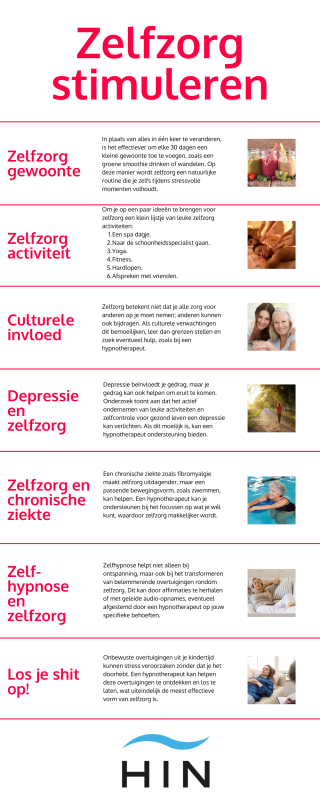
Also pin this handy infographic as a reminder:
Sources: