


Have you heard this so often, too? Or worse yet: do you ever say this to your clients yourself? “Just let it go…” “You just need to let go of that tension for a moment…” “Let that fear go…”
I’ll set you straight right away: it doesn’t work at all.
And in this article, I’m going to explain in great detail why all that “letting go” hype is pure nonsense, why you’re completely missing the mark with this approach, and (more importantly) what you actually need to do to truly help your client transform. Because believe me, once you understand this shift, you’ll start achieving results that will blow your clients’ (and your own) minds.
Watch the video:
Why “Letting Go” Is an Illusion
Let’s start at the beginning. Why is “letting go” such a misguided suggestion?
It’s very simple. When you tell someone to let go of their fear, stress, or insecurity, you’re suggesting that they have that feeling. As if it were a tangible object they’re carrying around in their pocket.
I’ve written a great book on this topic (highly recommended, by the way—if you don’t have it yet, buy it right away!): It’s Not About Having, It’s About Doing. In it, I explain exactly why that shift from “having” to “doing” is the absolute key to change.
Look, take this example. Suppose I’m holding a pen in my hand. How do I let go of it? Simple. I open my fingers, gravity does its job, the pen falls to the ground, and I’m no longer holding onto it. Why is that possible? Because that pen is a thing. A physical object.
But fear? Fear isn’t a thing. Fear isn’t a pen you can just set down on the table. You can’t grab hold of fear, so you can’t let it go either. If your client says, “Yes, but Edwin, I really do have fear!” then I say, “No, no, no—you don’t have it. You’re doing it.”
This isn’t some silly semantic trick. This is the foundation of how our brain and nervous system work.
From “having” to “doing”: The magical shift
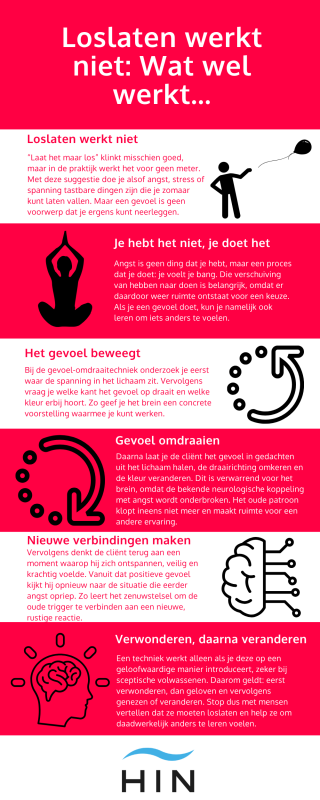
Fear isn’t a thing; it’s a state of being. A feeling. And“feeling”(yes, you heard that right) isn’t a noun either—it’s a verb: to feel. You feel afraid.
Now you might be thinking, “That’s all well and good, Edwin. We’re just calling it something else now, but that fear is still there.”
That’s right. But this small shift in language triggers something magical in your client’s brain. Suddenly , a choice emerges .
If you have something, you’re a victim of it. You’re stuck with it. But if you ’re doing something, you can decide to do something else. After all, you can also feel something else.
And don’t make the mistake of saying, “Okay, then we need to look for safety.” Because where exactly is that safety? Have you ever actually seen safety lying around? Is it maybe in the corner of the room? Under the couch? Behind the closet? No, of course not. Because safety, too, isn’t something you can “have.” You can, however, feel safe.
Once we stop treating emotions as “things we need to let go of” and start seeing them as processes and strategies that we “do,” the path to real change opens up. And from that active state of feeling, amazing techniques suddenly become possible.
Research also shows that dealing with problems in this way is more helpful than “suppressing” them[1].
The “Flip the Feeling” Technique: How Does It Work?
If feeling is an active strategy of the nervous system, then we can also reprogram that strategy. One of the most powerful ways to do this is the “feel-flip” technique.
Please note: just like with all techniques, this doesn’t work exactly the same way for everyone at all times. But if you use the right approach and “sell” the technique to your client in the right way (because yes, you have to be able to sell your interventions—I’ll come back to that in a moment), the results are phenomenal.
How does this strategy work in practice?
When your client feels anxiety, they experience it in a specific way. The nervous system sends signals. That feeling is located somewhere in the body—for example, as a lump in the throat or a knot in the stomach.
Step 1: Locate and determine the direction of rotation
Ask your client exactly where that tension or anxiety is located. Suppose it’s in the chest. Then ask: “If that feeling were to spin, how would it spin? Does it spin forward, as if you were falling backward? Or does it grab you by the throat and spin backward?”
The brain simply has to respond to this. This is because the nervous system always has a specific kinetic direction in which energy flows. Suppose the client says, “It’s spinning backward.”
Step 2: Show Your True Colors
Ask now: “Suppose it had a color—what color would it be?” Let’s say the client answers, “Red.”
What are we doing right now? We’re guiding the brain. At this moment, the client is already in a light state of hypnosis. Why? Because they’re actively hallucinating a color and a direction of rotation in conjunction with a physical sensation. That’s fantastic, because now we’ve got a handle on things.
Step 3: The Turnaround
Now give the following instruction: “Okay, imagine that we’re taking that feeling away for just a moment. We’ll reverse the direction. Instead of backward, let’s have it move forward now. And we’ll change the color. Let’s make it blue. And now let that blue energy spin very quickly in the opposite direction.”
What happens in the brain? The brain gets completely confused. The brain had established the neurological link: fear = a red light spinning backward. Now, suddenly, a blue feeling is spinning forward. The brain thinks: “Wait a minute, this doesn’t add up. This isn’t the neurological highway of fear. This must be something else.” The old association is immediately interrupted.
Visualizations also have a very powerful effect on emotions[2].
Step 4: The Positive Association (Resource State)
Next, have the client think back to a moment when they truly felt completely at ease—totally relaxed, safe, and empowered.
Let him fully step into that moment. “Associated,” as we call it. That means: seeing through your own eyes, hearing what you heard back then, smelling what you smelled, and letting that wonderful feeling flow through your entire body. Assign a color to this feeling as well. Let’s say: radiant yellow.
Step 5: Neurological Reprogramming (Collapsing Anchors)
While the client is deeply immersed in that warm, comfortable feeling, guide them to recall the situation that previously caused their fear, while maintaining that sensation in their body.
What’s happening neurologically? The brain rapidly forms a new connection (a “highway”) between the old trigger and the new, comfortable feeling. The old fear connection is overwritten. If you do this correctly a few times in a row, you train your nervous system to automatically feel good and calm in that previously “scary” situation from now on. The fear simply can’t be triggered anymore!
A lot happens in the brain when you reinterpret something, as in this exercise[3].
Why You Need to Learn to “Sell” Your Strategies
Now I can hear you thinking: “Edwin, this sounds fantastic, but if I suggest this to a client who’s been struggling with a severe anxiety disorder for twenty years, won’t he just think I’m crazy?”
And you’re absolutely right about that! If you just blurt out of the blue, “Hey, let’s flip your fear around and give it a blue tint!”, your client won’t feel taken seriously at all. And rightly so.
With children, by the way, this works like a charm. You don’t have to explain anything to them. They still have vivid imaginations and go along with it right away. But adults? They have barriers, skepticism, and doubts.
That’s why you need to learn how to sell a technique. We devote a great deal of attention to this in our training programs. After all, we always work according to a very important principle:
- Marvel
- Beliefs
- Healing
You can only achieve healing or change if the client believes in it. But to make them believe, they must first be filled with wonder. You must bypass their critical mind by letting them experience something they cannot explain. Only then is their mind open to the suggestion that change is immediately possible.
The trick is to present and introduce these techniques in such a way that the client thinks, “Wait a minute… what’s happening here?” As soon as that sense of wonder sets in, resistance melts away, and the nervous system can integrate the new, healthy patterns at lightning speed.
Stop trying to let go; start feeling differently
So, dear therapist, coach, or practitioner: let’s agree, starting today, to remove the word “letting go” from our vocabulary. It doesn’t help your client; it only frustrates them because they’re trying to do something that’s physically and mentally impossible.
Stop trying to “let go.” Instead, help your client feel differently. Give them back control over their own internal processes and strategies.
Of course, you can’t learn these kinds of techniques in five minutes just by reading a short text. In our training programs, we easily spend an entire day on this to ensure you master it thoroughly.
Because (especially in the beginning) it’s much easier to go through this with an experienced therapist guiding you through it than to try it on your own at home on the couch. But you’ve got the basics down now.
Start experimenting with it. Apply it, test it out, and see what happens when you make the shift in language from “having” to “doing.”
Learn this technique
You’ll learn this technique through the Hypnosis Institute of the Netherlands’ training program. Wondering if this knowledge is right for you? Come attend a free masterclass on hypnosis.
Or register directly for one of our events and trainings.
Have a question about our training? Schedule a 1-on-1 consultation here.
Pin this handy infographic as a reminder:
Sources:


Debbie
on July 22, 2026