

Does this sound familiar? You wake up feeling great, but then your email or vibrating phone suddenly makes you feel anything but good—and instead, you start feeling stressed or tired?
Let me tell you one thing right away: there’s nothing wrong with you.
We’re simply ordinary people trying to adapt to a completely abnormal world. And that adaptation? Sometimes we just can’t seem to get it right. With all the consequences that entails. We’re all walking around massively overstimulated, burnouts are everywhere, and we constantly wonder why everyone else seems to have it together—except us.
Let’s take a moment to dive deep into our minds to understand where that mental block comes from. Because once you understand how it all works, it brings a tremendous sense of peace.
Watch the video:
Our medieval brain in a hypermodern world
To understand why you sometimes feel so incredibly tired or overstimulated, we need to go back in time. And no, not to your parents’ youth, but way, way back: to the Middle Ages. We’re talking about the period between 500 and 1500 AD. For a thousand years, the world remained more or less the same.
Do you know how many stimuli the average person was exposed to back then? If you compare that to today, it’s staggering. The amount of stimuli a person in the Middle Ages had to process in an entire year is what we process in a single day these days. Sometimes even in just a few hours.
Our external world has changed at breakneck speed, but our biological hardware (that wonderful brain inside your head) is hopelessly behind. In fact, we’re still walking around with a brain from prehistoric times or the Middle Ages.
That brain is designed to scan for immediate danger, search for food, and socialize with a small circle of acquaintances. It is certainly not yet adapted to the tsunami of data that is poured over us every second.
Of course, every generation adapts a little bit to the times. That’s evolution—and it’s wonderful. But technology and the flow of information are moving so incredibly fast these days that our biology simply can’t keep up.
According to research, we have to process about 34 gigabytes of information per day these days[1]. That’s an insane amount. Of course, we don’t do all of this consciously, but your mental filters are working overtime 24/7 to make sense of all those impressions.
So when people say to me, “Edwin, I’m so incredibly overstimulated,” I think: Is that any wonder? It’s more of a miracle that we’re all still standing upright.
From a hundred fellow villagers to the whole world
The biggest problem with that abnormal world isn’t even just the bright light of your smartphone ( which, by the way, secretly makes us pretty dumb, but that’s beside the point). The real poison lies in the way we compare ourselves to everyone else.
Let’s go back to that medieval village for a moment. You lived there with about a hundred people. That was your whole world. You knew Jan the baker, Piet the blacksmith, and Annie in cottage number 3. There was no phone, no radio, no television. There was no news at all!
Yes, every once in a while, a troubadour would come by. He’d run from village to village, singing the news. That was a huge event. But the rest of the time, it was quiet. The most exciting news of the week was how the neighbor’s swollen toe was doing. That’s it.
Because your world was so small, it was very easy to see yourself reflected in others. You knew exactly where you stood in the hierarchy of those hundred people. And yes, that could be pretty annoying if you were at the very bottom of the ladder. Then you just had a lousy life—period. But at least you knew where you stood.
So, what’s the story?
Now we have social media. We no longer compare ourselves to the hundred people in our immediate circle. No, we compare ourselves to hundreds of thousands of people all over the world.
- On average, we receive between 4,000 and 10,000 commercial messages per day telling us that we aren’t good enough unless we buy their product.
- We have 24-hour access to global news, which generally presents ninety percent misery.
- And we’re constantly seeing the absolute highlights from complete strangers.
It’s an unfair battle. Your groggy morning self, sitting on the toilet, simply can’t compete with the tightly curated, successful illusion of the world flashing by on your screen.
The Illusion of the Front Page: What I Learned in the Basics
We all tend to focus on the surface of other people’s lives and compare that to our own inner selves. And that’s devastating[2]. You see that 20-year-old in his super-expensive car, you see entrepreneurs who seem to be making millions, couples who’ve been blissfully cozying up to each other for twenty years, and kids who always listen and get nothing but A’s. Everyone is amazing. Everyone is successful.
But you don’t see what’s behind the scenes.
Before I started this work and was dubbed the “hypnosis king,” I worked in construction for ten years. I was in the foundation business. During those ten years, I visited the homes of at least hundreds of families. And I can tell you one thing from that time: it’s exactly the same everywhere.
When you walk into a construction site as a construction worker, people initially show their best side. They put on a facade. They’re friendly, welcoming, the place is neatly tidied up, and everything seems perfect. If you’re there for even just one day, they effortlessly maintain that facade.
But I was right at the core of it all. I often wasn’t there for just one day, but for six weeks straight. And believe me: after a week or two, that mask is guaranteed to slip. Then you see how things really are behind that shiny front door. Then you hear the arguments, you see the stress, and you sense the uncertainty.
There, with my feet in the mud of the construction site, I learned my most important life lesson: everyone faces challenges. Everyone has insecurities. No one—and I mean absolutely no one—really knows exactly how it all works. Whether it’s about relationships, raising children, or running a business: we’re all just winging it.
The liberating insight: I struggle, you struggle, we all struggle
And you know what’s great? That’s not a depressing thought. It’s actually a huge relief!
Once you realize that we’re all in the same boat, that no one has been given the ultimate manual for life, and that everyone is just fumbling around on the sidelines, a huge weight is lifted off your shoulders.
People may pretend on the outside that they’ve got it all figured out, but when you really get to know them, you see their struggle.
Sometimes people come up to me and say, “Yeah, but Edwin, you’re the king of hypnosis. You’ve been doing this for twenty years. You’ve got everything perfectly under control; you must never have any problems or insecurities.”
That always makes me laugh out loud, and I say, “Well, come walk over to my wife for a moment—she can rattle off a laundry list of things you could improve on in no time. And if you ask my kids, they’ll effortlessly add to that list.”
Of course I struggle too! Sure, I’m sometimes insecure about things. Obviously! Who isn’t? The fact that I know how the brain works and how to break patterns doesn’t mean I’m immune to being human. It’s not rocket science; it’s just reality.
Stop comparing yourself to others and choose compassion
My most important advice to you, therefore, is this: stop immediately comparing your inner self to other people’s outer appearances.
If we could compare what’s inside all of us (that is, how we really feel, what we think of ourselves deep down, and what we worry about in bed), that entire hierarchy would look completely different.
Then you’d realize that the guy in his Lamborghini might actually be terrified of being found out, and that the “perfect” mother constantly feels guilty.
The world today is especially tough on young people. They look up to dropshippers, influencers, and young crypto millionaires and think they ’ve failed if they don’t own a mansion by the time they’re 23. It’s total nonsense.
Instead, just look around at your own peer group. Look at the ordinary people around you.
Everyone tries to adapt to this abnormally fast-paced world in their own way. And everyone fails at times and in certain situations. And that’s perfectly fine. In fact, that’s exactly what makes us human.
Once you realize that, you’ll see the world through a completely different lens. It fosters a tremendous amount of compassion and empathy toward your fellow human beings. Instead of feeling jealous or inadequate, the next time someone is really blowing their own horn, you’ll think: “Gee, it seems like they’re just going through a rough patch too and are just trying to hold their own.”
We all struggle. And that’s totally okay. Be a little kinder to that medieval brain of yours, put that phone down a little more often, and accept that “just doing something” is secretly the norm.
How Hypnosis Helps You Take Back Control
Rationally, you know you should stop scrolling, but your subconscious is stubbornly programmed to scan and compare stimuli.
Hypnosis breaks this pattern in one fell swoop. By putting your brain into a state of deep focus[3], you shift the spotlight back onto yourself instead of the outside world. You reprogram your inner filters, allowing those thousands of commercial stimuli and other people’s false sense of success to effortlessly roll off you.
You’ll no longer just consciously choose peace of mind—your subconscious will actually feel it, too. That’s how you take back control of your own attention and stop letting things drive you crazy.
Do you want to help yourself and others? Then knowledge of hypnotherapy is incredibly useful. Come to the free masterclass to get started.
Or check out our calendar for our events and training courses.
Have a question about the training? Schedule a 1-on-1 consultation here.
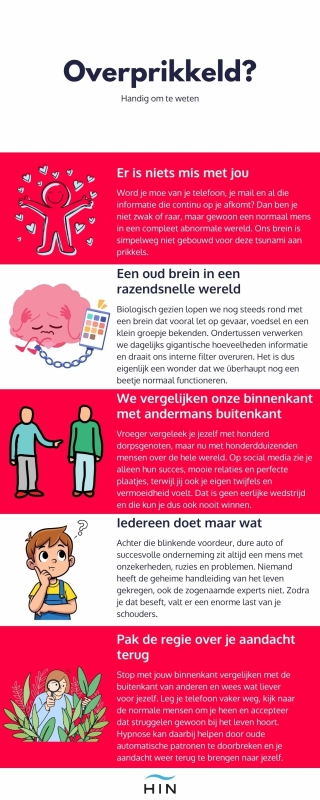
Also pin this handy infographic as a reminder:
Sources: