


You know that feeling? Something is waiting for you to solve, but you keep putting it off. Maybe it's that conversation with your boss, that medical complaint you've been running with for weeks, or those relationship problems you just don't want to deal with. You probably think you'll deal with it later, when you're "ready.
Except that later never really becomes later, right?
You probably recognize this. We all do it. Avoiding problems feels like the easiest option. It gives peace of mind, at least for a while. But what actually happens if you keep doing this?
Now you may be thinking, "Yes Ed, I know I procrastinate, but it's not that bad. But is it really? Because what many people don't know is that this avoidance behavior is literally detrimental to your health. People with anxiety disorders (and there are hundreds of millions of them worldwide [1]) are 72 percent more likely to have cardiovascular disease [1]. These conditions, by the way, are the leading cause of death worldwide, accounting for nearly 18 million deaths a year [1]. An analysis of 46 studies shows that anxiety is linked to 41 percent greater risk of death from cardiovascular disease [1].
Why am I telling you this? Not to scare you, but because avoidance is really not a neutral choice. You don't just do it, you do it with consequences.
Of course, the question is: why do we keep avoiding things if it causes so many problems? And more importantly, how do you get rid of it?
The latter can, and hypnosis plays an interesting role in it. Not because it's a panacea, but because it helps you look at those patterns differently. Because you don't have avoidance behavior, you do it. And what you do, you can do differently.
Why are you doing this in the first place?
You now know that avoidance is harmful, but why do you keep doing it? That's a good question and, frankly, a tough one. Because if we are so smart, why do we do things that are bad for us?
The answer lies deeper than you may think.
Fear does strange things to you
Avoidance behavior is almost always done out of fear. That sounds logical, but it goes deeper than you think. In fact, your brain has a built-in alarm system that is constantly on the lookout for danger. The problem? That system doesn't know the difference between a tiger and an awkward conversation with your supervisor.
Avoidance is actually a form of flight in our primal fight-flight-freeze system [1]. Your brain thinks, "Danger! Get out! And it does, even if it's about something not at all life-threatening. For example, people avoid situations where they fear rejection or criticism. Some even become so shy that they start avoiding social situations completely.
Fear of failure also plays a big role. If you are a perfectionist (and let's face it, who isn't a little bit?) you often struggle to get started at all. You think, "What if it's not good enough? And so you just don't do anything at all.
What your parents taught you (without knowing it)
This is where it gets interesting. Avoidance behaviors are often learned at a very young age. Children who grow up with parents who are distant, critical or uninvolved are more likely to develop the idea that they are not okay the way they are. They learn that the world is an unsafe place.
But the opposite can also cause problems. Overprotective parents can unconsciously encourage avoidance behavior. Just look at daycare centers and schools that increasingly ban "dangerous" activities such as climbing and frolicking. Children no longer learn trial and error, literally and figuratively.
A parent who is anxious-avoidant himself will have less incentive to seek out frightening situations. Logical, but the child does not learn to cope with challenges.
The addiction to relief
Here's the real problem. Avoidance gives you temporary relief. It feels good to not have to deal with that problem for a while. You put your emotions on pause [1] and that briefly gives you a sense of control.
This relief acts as a reward for your brain [1]. As with other addictions, your brain thinks, "This felt good, we're going to do this more often. The problem? You're not solving anything. It's like taking a painkiller for a broken leg. The pain is gone for a while, but the leg is still broken.
Indeed, the stress you are running away from only increases. This creates a vicious cycle: the longer you avoid, the bigger the problem becomes, the harder it becomes to deal with it after all.
The way it is. You do avoidance because it gives short-term relief, but in the long run you only make it harder on yourself. The question is: what are you going to do about it?
What are you doing to yourself if you keep avoiding?
Now you know why you do it. But what actually happens if you keep doing it? Because that avoidance has consequences, and they are usually a lot bigger than you think.
Let's face it: if you avoid a problem, it doesn't disappear. It grows. It's like rolling a small snowball down a mountain. At first it seems harmless, but before you know it, you have an avalanche.
Your body holds the account
Imagine your body is an accountant keeping track of everything. Every time you avoid something, that bookkeeper makes a note: "Problem not solved, stress added." That stress means more cortisol, the stress hormone coursing through your body.
The crazy thing is: you may feel momentarily relieved because you've put off that call again, but your body knows better. Prolonged stress makes you less resilient. It disrupts your natural recovery process. Your dopamine system becomes dysregulated, which increases the risk of depression and addiction. And your amygdala, the part of your brain that alerts you to danger, becomes hyperactive, making you more likely to experience anxiety.
Is this what you want? Probably not.
Avoidance makes you sicker, not healthier
Here's where it gets interesting. You avoid health problems because they make you anxious, but in doing so, you actually make yourself sicker. Chronic stress from avoidance leads to:
- Obesity and diabetes
- Cardiovascular disorders
- A weakened immune system
- Sleep problems and depression
Plus, your brain is becoming increasingly fuzzy from that constant stress. Making plans? Tricky. Keeping an overview? Forget it. You get overwhelmed by information you would normally be fine with processing.
Relationships suffer from what you don't do
Take a look at your relationships. Maybe you recognize this: you avoid that difficult conversation with your partner. You keep your mouth shut to keep the peace. You think you're being sweet, but actually you're shortchanging your relationship.
Because what happens? You ignore your own needs to keep the other person happy. Your relationship becomes more superficial because you never really show the other person who you are. You develop an anxious or avoidant attachment style, which blocks intimacy. The result? Loneliness, even when you have people around you.
At work, you dig your own grave
That conflict with your colleague? That feedback you need to give? That presentation you're dreading? If you keep avoiding these situations, you develop a pattern. You start avoiding anything that reminds you of that one conflict.
The result: you become socially isolated at work and your career opportunities disappear. You start doubting your own abilities . You sleep worse, have less energy, look tired - often the first reason for calling in sick.
Ultimately, this leads to burnout, depression and totally undermined self-confidence. And that tension? You take that home, where it causes new relationship problems. Do you see the circle?
The beauty is: you do all this. That also means you can stop it.
How hypnosis can help you stop running away
Now of course I'm a hypnotist, so you might think, "Of course Edwin thinks hypnosis is the solution. But let me be honest: It's not a panacea. I've seen plenty of people who thought one session of hypnosis would solve everything, and it usually doesn't.
What hypnosis is good at, though, is addressing those automatic reactions in your head. You know, those moments when your brain says, "No, we're not doing this," before you've even had a chance to think about it yourself.
What actually happens during hypnosis?
Forget what you see on television. No one is going to walk like a chicken because I say so. Hypnosis is actually quite common - it's that state you're in when you're absorbed in a good movie or daydreaming on a long drive. You're still there, but different.
The interesting thing is that about 95 percent of what you do happens automatically. You don't think about walking when you go from the couch to the kitchen. Your legs just do that. Avoidance behavior works the same way - it happens automatically. And automatic things you can change if you know how.
Why does avoidance work?
Back when I worked in construction, I had a colleague who couldn't stand heights. Logical problem if you have to work on roofs, you might say. He tried all kinds of things - forcing himself, getting used to it slowly, you know the drill. Nothing worked.
After a hypnosis session, he could just go up on the roof. Not because hypnosis is magic, but because we addressed that automatic panic button in his head. Instead of "height = danger," his brain got a different message: "height = just doing work.
Daydreaming and hypnosis are similar in that your attention is directed inward. The difference is that during hypnosis you are consciously working with those inner programs.
Reaching the subconscious mind
Your brain doesn't like change. It takes energy, and you need energy to survive. So when you consciously try to change - "Starting tomorrow, I'm not going to avoid! - your subconscious says: 'Ho ho, we'll do it the way we always do it.'
Hypnosis moves past your conscious resistance, so to speak. You are relaxed, your critical voice is softer, and then new ideas can come in. Not because you have no control, but because you have less resistance to change.
Real examples of how it works
I had a client who had avoided social situations for years. Every invitation was stress. We went back during hypnosis to where that started - a humiliating experience at school where everyone laughed. Not fun, but at the heart of the problem.
Through positive suggestions and reliving that situation from a new perspective, that automatic panic disappeared. After one session, she went to her sister's birthday party. "I suddenly didn't understand why I was being so difficult about that," she said later.
This may sound too good to be true, but it happens regularly. Another client with fear of flying said, "After one visit, the fear of flying was gone. I entered the plane completely calm.'
Now I don't want to claim that this always happens so quickly. Sometimes it takes longer, sometimes it doesn't work. But the point is: if you understand that avoidance is an automatic pattern in your brain, you can change that pattern.
Because you don't have avoidance anxiety - you do avoidance anxiety. And what you do, you can learn to do differently.
So what can you do?
Well, now that you know avoidance won't do you any good, what will? Because it's one thing to understand that you're doing it, but how do you stop?
Let's face it: you're not going to unlearn it overnight. Avoidance behaviors are often ingrained for years, so don't expect miracles. But you can start. And it doesn't have to be spectacular.
Recognize when you're doing it
First, you must realize that you are doing it at all. In fact, avoidance behavior is often very subtle. You don't even notice it.
Consider for yourself: do you often say you are "too busy" for certain things? Do you bend conversations when they go in a direction you don't like? Do you grab your phone when you feel uncomfortable? These are all ways of avoidance.
It can also simply be procrastination. That tax you've had to do for weeks. That dentist you've been due for months. That conversation with your partner that you just don't get around to.
Start small
Here it comes: you don't have to climb Mount Everest right away. Pick one thing you've been putting off for a while and just do it. Not now, but today.
A simple trick is the five-minute rule. Set an alarm clock for five minutes and begin. Often, starting is the hardest part, and once you get going, you'll naturally keep going.
I once had a client who had been putting off an awkward conversation with her sister for months. She was afraid of arguments, of emotions, of everything. 'Call her now,' I said during the session. 'Not tomorrow, not next week. Now.' She did and the call was settled in five minutes. All those months of worrying for nothing.
Hypnosis can help
Hypnosis is not a magic formula, but it can be a big help. Why? Because all your avoidance patterns are in your subconscious mind. You do it automatically, without thinking about it.
Hypnosis helps break those automatic patterns. It's like being able to reprogram your brain. Research shows that hypnosis is effective for several complaints involving avoidance, such as irritable bowel syndrome and chronic pain.
But don't get any funny ideas. You are not being hypnotized against your will and you are not doing crazy things. You are just deeply relaxed and your subconscious mind is open to new ideas.
When to seek professional help
Sometimes you can't do it alone. And that's fine. If avoidance controls your life - if it prevents you from functioning normally at work, in your relationships, or with your health - seek help.
Don't wait too long. On average, people walk around with depressive symptoms for more than six months before they finally seek help. That's six months too long.
The great thing is: once you start, you often find that it's less scary than you thought. That goes for those tricky conversations, but also for seeking help. The first step is always the hardest.
What will you do next?
So, now you know. Avoidance doesn't work. It may feel good in the moment, but you only pile more problems on yourself. And those problems? You don't have them, you do.
Look, I could tell you so much about why you're doing this, how it came about, and what the consequences are. But at the end of the day, if you don't do anything about it yourself, you're only going to keep doing it. And that's what it's all about: doing.
You can now choose two things. You can click away from this article and get back to what you should really be solving. You can do that, too. It's your life. But you now know what will happen if you keep doing that.
Or you take ownership. You realize that you are doing it - that avoidance, that procrastination, that looking away - and therefore you can do something else. That's the opportunity you always have. At any time.
Hypnosis can help with that, for sure. Not because it's magical, but because it helps you look differently at those patterns you've been doing for so long. It gives you insight into why you do what you do, and more importantly, it lets you experience that you can do things differently.
Start small. Tackle one thing today that you've been putting off for too long. It doesn't have to be a big thing. Five minutes is enough to get started. But do it.
For what is the alternative? Looking away for another week, another month, another year? By now you know what happens next. And you also know that those problems won't go away on their own.
You're doing it anyway, so you might as well do something else. Something that does help you move forward instead of holding you back.
Now is the time. Because tomorrow you're going to do the same thing you did yesterday unless you do something different today.
Learning hypnosis to stop avoiding problems
Have you been avoiding problems for a long time? Then I have good news for you. In fact, during the training you are required to bring in problems to practice with. So the ideal training to clear up problems for a while. (Do start small, after all, you are practicing with beginners).
The point is that knowing hypnosis and hypnotherapy helps you solve problems and help other people with them. Want to learn more about hypnosis? Come to our free online master class.
Or register directly for one of our events and trainings.
Have a question about our training? Schedule a 1-on-1 appointment here.
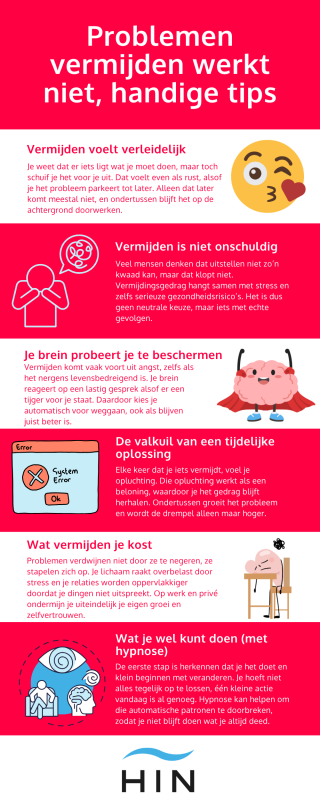
Also pin this handy infographic as a reminder:
References
[1] - https://www.frontiersin.org/journals/psychology/articles/10.3389/fpsyg.2024.1411835/full




Joke
accessed10 Feb 2026