

Do you brood often? Then you're certainly not the only one. In fact, on average, we spend as much as 2 hours and 18 minutes a day brooding, representing 14% of our waking time. This statistic, stemming from research by American Talker Research, highlights a universal challenge: the constant stream of thoughts that preoccupy us.
Generation Z and millennials in particular experience that brooding can quickly turn into anxiety and depression, with many feeling most anxious when they are alone or trying to fall asleep.
Worrying about money is among the top 3 worries that causes fretting. (So, you can use that one as a tongue twister 😉)
Do you recognize this feeling of constant worry? You struggle with insecurities and wonder why you worry about certain issues. This blog article explores the three main sources of worry that concern us the most, namely:
- Money
- Family
- Your to-do list
You get concrete tools to deal with it effectively, giving you more control over your thought processes.
Peaking in modern times
Worrying is of all times, but the nature of our worries has certainly changed. We live in a world of unprecedented choices: where do you want to live, what study suits you, what career will you pursue? These seemingly endless options, combined with the constant comparison via social media, create a breeding ground for uncertainty and doubt.
The pressure to make the "right" decisions and live a "perfect" life can be overwhelming. Not surprisingly, most concerns are about concrete, everyday issues that directly affect our quality of life.
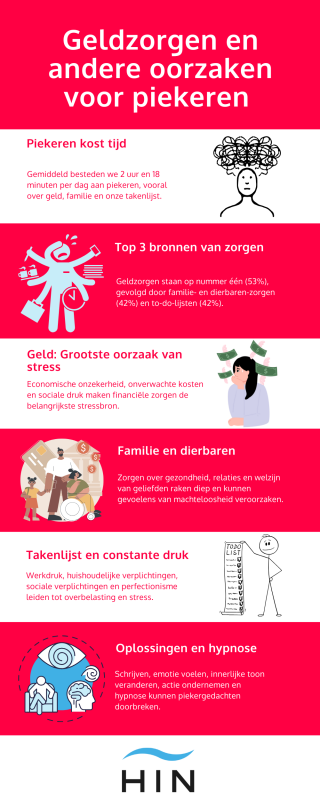
According to the aforementioned Talker Research survey, money is the top source of anxiety (53%), followed by worries about family and loved ones (42%) and an equal percentage worrying about tasks and to-do lists (42%). These numbers speak volumes: our worries are often rooted in fundamental needs and obligations. Let's take a closer look at these top 3.
Money worries: the winner for fretting (53%)
Financial insecurity is a major source of stress, and with 53% of respondents citing it as their biggest concern, it is clear that fretting about money is a broad-based phenomenon. Current economic conditions, such as inflation and rising energy prices, contribute to this.
Examples include:
Economic uncertainty: Surging markets, inflation and the fear of recession can lead directly to stress about purchasing power. People worry about whether their salaries are still enough to make ends meet.
- Unexpected expenses: A broken car, an unexpected home repair or high medical expenses can have a major impact on financial stability.
- Long-Term Planning: Worrying about retirement, the mortgage, children's college expenses or building up enough savings for the future. The pressure to ensure financial security is intense.
- Social pressure: The feeling of having to meet a certain standard of living, influenced by advertising and social media, can lead to pressure to make or spend more money than is wise.
Money worries and the impact on your life
Money worries can lead to sleep problems, irritability, and even physical symptoms such as headaches. Researchers even indicate that they can lead to depression[1]. They can strain relationships and make it difficult to enjoy leisure activities.
Family & Loved Ones: In second place (42%)
Loving our family and friends inevitably brings with it concerns. Whether it is the health of your parents, the future of your children, or the stability of your relationship, fretting about family touches the deepest layers of our emotions[2]. At 42% of worry is a powerful factor in our daily lives.
There are several reasons for this, consider:
Health: The fear of loved ones becoming ill or suffering is a universal concern. This includes both physical and mental health.
- Child welfare: Parents are concerned about their children's safety, school performance, social development and future happiness. The pressure to deliver "good parenting" is enormous.
- Relationships: Conflicts with a partner, siblings, parents or friends can cause a lot of emotional stress. You want everyone to be happy and for ties to remain strong.
- Elder Care: As parents age, concerns about their independence, loneliness and the need for informal care come into play .
Worrying about family and your life
These worries are often heavy because they relate to issues that are not completely in our control. They can lead to feelings of helplessness, guilt or intense sadness.
In women, it can also lead to stress and depression symptoms. This is according to Russian research[3], a country with a similar society to the West (despite political differences).
To-do list at number 3 (42%)
The daily deluge of tasks, both at work and at home, can be overwhelming. Not surprisingly, 42% of people are stressed about tasks and their to-do lists. This feeling of constant pressure and the fear of forgetting something are common sources of brooding moments.
Causes
- Overwhelm by work: A high workload, tight deadlines, unclear expectations and too many projects at once can lead to feelings of failure and exhaustion. Digital communication for work also contributes to this[4].
- Household duties: The constant stream of household duties (cleaning, shopping, cooking, administration) can feel like a bottomless pit, especially alongside a demanding job or family.
By the way, being a housewife is not always the solution against these complaints, Turkish research shows[5]. So for women who think the "tradwife" trend is the solution against stress, unfortunately it is not.
- Social Commitments: Balancing work, family and a social life can lead to an overcrowded schedule, where you feel like you are falling short.
- Perfectionism: The tendency to want to do everything perfectly causes tasks to take more time and energy than necessary, leading to procrastination and even more stress.
Impact on life
The pressure of tasks can lead to burnout, difficulty concentrating and a constant inner dialogue of "I still have to do this."
Practical tips for peace of mind
Now that we've identified the main sources of worry, it's time for concrete steps. Worrying is totally unhelpful. It exhausts you without actually solving problems. So how do you get rid of it?
Herewith some ways to deal with it.
- 1. Write it off:
Grab a notebook and pen, or open a blank document on your computer. Write down everything that is bothering you. This helps organize your thoughts and keep them from spinning around endlessly in your head. Once it's on paper, you create distance from the worry and clarity in your thoughts[6].
- 2. Feel the emotion behind the thought:
Choose one of your brooding thoughts, for example,"Oh, I can't" or"I have so much to do." Close your eyes and try to feel what emotion is associated with it. Is it fear, frustration, helplessness? Acknowledging the emotion will give you insight into the core of your worry.
- 3. Change the tone of your inner voice:
This is a particularly effective and playful technique from Talker Research. Our brooding thoughts often have a negative, heavy tone. Try consciously changing that tone:
- Amplify the absurd: Imagine your brooding thought being spoken in the voice of Donald Duck, Mickey Mouse, or some other crazy figure. The heaviness disappears, and it no longer feels unpleasant at all.
- Experiment with accent: If you have a thought in your own "standard" accent, try repeating it in a different, funny dialect. Think "It all won't work out" in an exaggerated Hague or flat Amsterdam accent. The charge comes right off.
By changing the tone, you gain control over your thoughts and the fretting often stops on its own. It's training, but works to your advantage.
- 4. Action-oriented thinking:
For concerns you can influence, create an action plan. Break down big problems into small, manageable steps. For money worries, this might be creating a budget. For tasks, start with the most difficult task first. Taking action, no matter how small, reduces feelings of helplessness.
- 5. Set boundaries and learn to say "no.
A lot of stress comes from having too much to handle. Be realistic about what you can handle and have the courage to say "no" to extra commitments that increase your stress level.
- 6. Seek support:
Talk to a confidant about your concerns. A friend, family member or even a professional (hypnotherapist) can give you a different perspective and help you deal with difficult emotions. You don't have to do it alone.
Avoid these mistakes in (money) worries
While we all want to deal with money worries and other stressors, we often unintentionally make mistakes that perpetuate fretting:
- Hoarding thoughts: Forcing yourself not to fret is counterproductive; the thoughts often come back stronger.
- Procrastination: Not addressing problems in the hope that they will go away on their own usually leads to more stress in the long run.
- Isolation: Isolating yourself from others and keeping your concerns to yourself can lead to loneliness and exacerbate feelings of anxiety.
- Focusing on uncontrollable factors: Worrying about things beyond your control, such as world politics or the weather, is wasted energy. Learn the difference between what you can and cannot influence.
Hypnosis and more peace of mind
In addition to the aforementioned techniques, hypnosis can be surprisingly effective in calming a busy head. After all, that busyness is caused by your beliefs about how life works and how you are "supposed" to function in it.
But if this only causes you problems, do your beliefs make sense?
With hypnosis and hypnotherapy, you gain access to your subconscious, where the beliefs that create mulling patterns are stored.
You can then use hypnotherapy to change those beliefs so you can break through the fretting.
Many people experience more inner peace, better sleep patterns and fewer stress reactions after a session. For those struggling with recurring worries, hypnosis can be a powerful tool to regain inner peace.
Learn Hypnosis
Do you want to help yourself or others stop fretting and money worries? Then knowledge of hypnosis is indispensable. Come to our free master class for an introduction.
Or register for one of our events and trainings.
Wondering if the training is right for you? Schedule a 1-on-1 consultation here.
Also, pin this infographic as a reminder:
Sources:
[2] https://www.cambridge.org/core/journals/global-mental-health/article/factors-associated-with-depression-anxiety-and-satisfaction-with-life-among-malaysian-parental-caregivers-of-adolescent-psychiatric-patients-a-crosssectional-study/09B7B7A7A7891AC36E0911D5CBA5F8B4