As a hypnotherapist, you can get all kinds of clients with different problems. Even people with a form of autism can come to you, because they are troubled by their condition or just suffer from issues that people without autism also suffer from, but just can't get out of without help.
So how can you, as a hypnotherapist, help people with autism? In this blog, I take a closer look.
Autism in children
Autism in children can be very annoying. For example, some children have difficulty learning social skills and may have behavioral problems. For example, they may be violent, have obsessive thoughts or behaviors and experience mood swings.
This is all very exhausting, and it also reduces the sense of self-efficacy and self-confidence in children with autism.
Therefore, a hypnotherapist can help children with autism in multiple ways because there are multiple problems to solve.
One problem regarding awkward behavior is that autistic children, for example, may bite their fingers to deal with stress. In a case study of a 16-year-old boy with autism who received hypnotherapy to stop this, it was found that not only did it help stop these awkward behaviors, but there was also an improvement for social skills and an improvement in being able to influence thought[1].
This particular case also used music, including music made by the boy himself, to help him move forward. It was also found that after a year and a half, the changes were still sustained[2].
Hypnosis for children with autism includes the use of Ericksonian techniques[3]. In these, you use the client's interests and abilities, as in the study with the 16-year-old boy where musical talents were used.
Thus, the focus of hypnotherapy for children with autism is on what the child can do rather than everything the child cannot do because of autism.
As with all people, children with autism are also unique. One person with autism is not like another person with autism, and you need to take that into account when providing hypnotherapy.
Fortunately, an individual approach to hypnotherapy is the standard 😊.
Adapting to the child's language level is also important. With children with autism, there can be an interesting paradox in this. For example, their vocabulary may be much greater than that of children of the same age, but how they use language in social situations may again lag behind how children of the same age do so. Finesse in your how determines how to use language with children with autism as a hypnotherapist is helpful then.
For example, if a child has asperger's (a form of autism), he or she may have difficulty with the give-and-take aspect of conversations, i.e., going back and forth and connecting. Abstract language, sarcasm and humor is also something they find difficult to recognize or work with.
Working with metaphors is an important means of reaching solutions in many hypnosis sessions, but with autism, this is something that works for one child but not another. This is then something you need to pay close attention to, and especially when introducing the metaphor, you need to make the connection to what the metaphor is being used for very clear (source 3).
For example, with a child who was absolutely crazy about fishing, the metaphor of the fish was used to adapt in social situations, just as a fish should adapt in salt and fresh water. And how this adapting is a way of the fish to survive. Just as humans adapt in certain situations in order to survive.
Also, thoughts of children with autism are very black and white. It is all or nothing, a gray area, so to speak, does not exist. So if there are areas in life where what you could do is pretty gray, it's important to give concrete examples about the options they have.
With emotions , for example, you can clarify that there are gradations and give anger or fear, for example, a number and how the behavior is at a certain number. This allows them to recognize the process of anger, which can slowly escalate, earlier and use techniques to stay calm (source 3).
Autism in adults
The problems that children with autism have can also recur in adult life. In addition, adults with autism may have difficulty with change. Having a fixed daily structure is very important for people with autism. If something changes in that, because someone cannot be there for the person, for example, due to illness or death, it is very difficult for someone with autism.
For regulating yourself, hypnosis and self-hypnosis in people with autism can be helpful. For example, if you normally perform certain actions to calm down in stressful situations, but cannot do so for a while (such as at work), then a moment of self-hypnosis in which you visualize yourself performing the actions can still have the calming effect[4] without bothering people around you.
So as a hypnotherapist, you help people determine what is helpful to use with self-hypnosis in stressful situations so that people with autism can take control of themselves.
So hypnosis does not cure autism, but it ensures that it does not get in the way of functioning as well as possible in society, in that after hypnotherapy a person with autism can deal with certain features of autism in an alternative way.
Repetitive behaviors can even be used to induce hypnosis in people with autism, as this is something that also induces a kind of trance for people with autism and is something they can focus on completely. Then the person can be asked to focus on the feeling they get from it and stop the behavior, possibly in stages, reaching the hypnotic state without tapping, hand movements or anything like that.
Then the hypnotist can point out that the person thus has control over this feeling, even without performing external behaviors to do so.
It is also very important to strengthen the ego of people with autism while they are engaged in hypnotherapy, so that they trust their own thoughts coming forward and so that they can properly choose which life events they do and do not want to share during therapy (source 4).
Hypnosis for asperger's
People with asperger's actually suffer mostly from not understanding social processes well. For example, they may have difficulty with humor, making eye contact and having a conversation.
For people with asperger's, the skill of being able to think about their own thoughts, so-called meta-cognitions, can help them get a better handle on their problems[5]. This can be done playfully with digital voices, but this is also definitely something a hypnotherapist can help with.
In fact, hypnosis can also help with mindfulness. A way to be more aware of your thoughts and feelings and do something with them.
For example, a hypnotherapist can help a person with asperger's become aware of certain thought patterns, and then if these are obstructive thought patterns, because they are negative, for example, learning to rethink can already do a lot to be less bothered by them.
Autism is something that many people carry with them throughout their lives, and hypnotherapy can be used with both children with autism and adults with autism to help them suffer less from autistic traits.
For example, self-hypnosis can be used to implement autistic ways of coping with stress in your mind, so that people around you are not affected and so that a person with autism just feels good.
In this way you prevent social problems in people with autism, because they no longer show unusual reactions to stress, but perform within themselves. This can already make a lot of difference in, for example, keeping work and keeping social relationships good.
If you want to learn more about hypnosis and how it can help people with all kinds of problems (including autism) get the most out of their lives, come to the free online master class for an introduction.
Or register for one of our seminars or training courses, which you can take live online or classroom. Live online classes involve live instruction from a professional studio and with plenty of one-on-one assistance to help you absorb the material well.
Classroom classes also have multiple instructors and assistants to help you properly absorb the material and master techniques so that you can properly help yourself and especially other people with hypnosis.
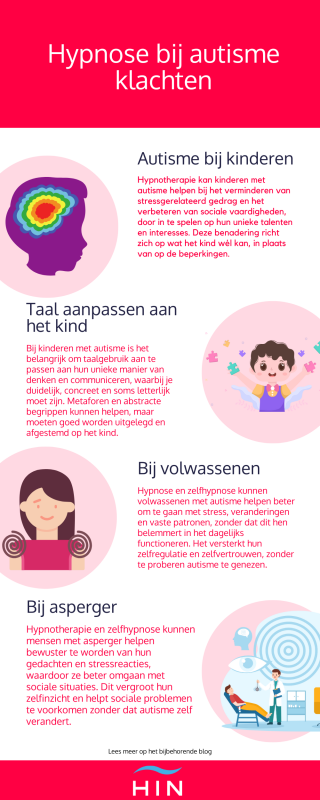
Also, pin this infographic as a reminder:
Sources:
[1] https://www.researchgate.net/profile/Iinger-Vandvik/publication/23248820_Hypnotherapy_in_Child_Psychiatry_The_State_of_the_Art/links/0f31752eb9e7f3dc16000000/Hypnotherapy-in-Child-Psychiatry-The-State-of-the-Art.pdf