A while ago, I suddenly saw a question in the community about whether hypnosis can be used for people who are hard of hearing or even people who are deaf. A very good question, because usually when I hypnotize someone I ask that person to close their eyes. Then if you can't hear anything, the rest of the treatment is quite difficult.
Deaf people are the same as hearing people, only the way they communicate is different. In general, deaf people are as mentally healthy as hearing people. And just like hearing people, deaf people can suffer from mental problems. The help that deaf people can get then depends on the abilities of the caregiver and whether he or she can also communicate in the language of the deaf person with a problem, such as sign language or speaking clearly, not mumbly in any case, if the person can lip read. While there is increasing attention to hearing-impaired or deaf people in the world of mental health, it is not yet perfect[1].
So time to delve into hypnosis for people who are deaf. Does it exist and how does it work?
Hypnosis with Sign Language
As far back as the early 1990s, it was researched whether you can put people into hypnosis with sign language, and if so, whether that hypnotic state is different from people who can close their eyes to go into hypnosis.
This study found that there was no difference in hypnosis between hearing and deaf people. Objectively observed, the two groups were equally hypnotized, and when you asked the deaf and hearing people, they were also similarly hypnotized[2].
So the good news is that it certainly can 😊.
I just can't sign language, so I've never done this. Therefore, this article is entirely theoretical for me.
Other research shows that putting people into hypnosis if they are deaf can be done if they can lipread or if the hypnotist has a special chair, which can vibrate or something similar, for that purpose and the hypnotist also uses touch to induce the hypnosis, for example, by petting the patient and using pantomime[3].
You may wonder about the hypnotized person's attention then, since the deaf person does have their eyes open. Here it is important to realize that a person in hypnosis has focused attention.
In hypnotherapy, your client - if he or she can hear - focuses on your voice, but if the deaf person focuses only on your lips or gestures, that is also focused attention.
You should also pay attention to other things to see if your deaf client is in hypnosis. After all, you don't have the twitching eyelids as an indication now, but you do have the body posture and relaxed facial expression, breathing and the like[4].
Hypnosis for deaf children
Children can benefit greatly from knowledge about hypnosis. About how visualizations help them deal with problems. How they can imagine something as a metaphor for something else, like anxiety, and how they can use self-hypnosis to be mentally stronger.
This was taught in 1995 with sign language self-hypnosis to deaf children ages 9 to 11. These children were suffering from warts or myoclonus, a muscle disease in which muscles suddenly contract. This was to help them cope with these conditions. In the study, the person teaching the therapy to the children could sign language and a sign language interpreter was always present[5].
Hypnosis for a deaf woman who wanted more self-confidence
Guided visualizations can also be used with deaf people. After all, what you "say" the deaf client can interpret and imagine. In the case study, the woman is given a guided visualization in which she can imagine her ideal self, hug that ideal self, and she is given the post-hypnotic suggestion that after her hypnosis she will realize that that ideal self is already part of her, that that is her potential[6].
Hypnotherapy for multiple personalities in a deaf woman
This may sound a little crazy, but this woman did not suffer from psychosis, which means you can use hypnosis to solve this problem. She was put into hypnosis by progressive muscle relaxation and by the gestures for the letters R-E-L-A-X (relax, relax) being made in front of her eyes all the time. Because those letters were used and because this was done right in front of her eye it allowed her to enter the hypnotic state because it concentrated her field of vision to a relatively small point.
A bit like induction, where you have to look up at your hand.
This helped in treatment to have an encounter with the "other person" in her[7].
Deaf people can thus be put into the state of hypnosis, and this can help treat conditions. In the process, then, you can also teach deaf people how self-hypnosis works and how to use visualizations to address problems.
Hypnotherapy at the dentist for a deaf-mute woman
There is also an account of a dentist who induced hypnosis in a deaf-mute woman. Using bills, pantomime and touch, he performed arm levitation on her the first time to hypnotize her and then be able to treat her.
The next time, he was able to put her into hypnosis by touching her shoulders and using his way of breathing and relaxing his shoulders to show her that she could relax. Because she was already more familiar with the state, she then managed to reach the hypnotic state without arm levitation, allowing her to undergo treatment at the dentist with less anxiety[8].
Hypnotic suggestions for deafness
You have direct suggestions and indirect suggestions to give as a hypnotherapist, and research also shows that deaf people respond to them just as well as people who can hear[9].
This means that if your client can lipread or if you know sign language, you can use the same techniques you normally use with people who can hear.
How cool is that?
I do have to say that I see in science mostly that people who are deaf can be brought into hypnosis and can learn self-hypnosis for visualizations. In the case study of the woman who wanted more confidence, you do see that the suggestions given during visualization are the same as you would give to someone who can hear, but in sign language.
So the signs that something is possible with them are very hopeful.
Using your voice in sign language
You might say that with sign language you can't really do anything with the tone of your voice or the way you give the suggestion, but that's so not true. Melissa Barns has also given hypnotherapy to deaf people and in a video on YouTube about hypnosis for deaf people, she also encourages people to watch the sign language interpreter to show how even her tone is transmitted in sign language. This is an American sign language though, so I don't know about the Dutch version. I assume this can be used in a similar way.
For example, in the video you can see that when her voice becomes softer and more relaxed, the sign language interpreter takes over this feeling you then get from that voice in his whole body posture. This is then something that the deaf person also adopts.
Gestures also suddenly become much calmer, whereas if you are excited, you will see that reflected in the gestures becoming more active and "fierce.
So if your client can lipread and you don't need a sign language interpreter, it can be helpful to incorporate the tone and relaxation you want to convey with your voice into your facial expression and body language as well[10].
By the way, this is also something we are working on at the HIN if you have hearing clients, because during the preliminary interview, for example, people do see you and your body also has a lot of influence on your voice. Your body posture and facial expressions are also important in getting rapport with your client.
If you want to learn more about hypnosis, without sign language in this case, and how it works, come to a free online master class.
Or sign up for one of our seminars or trainings - super inspiring for yourself and to help others.
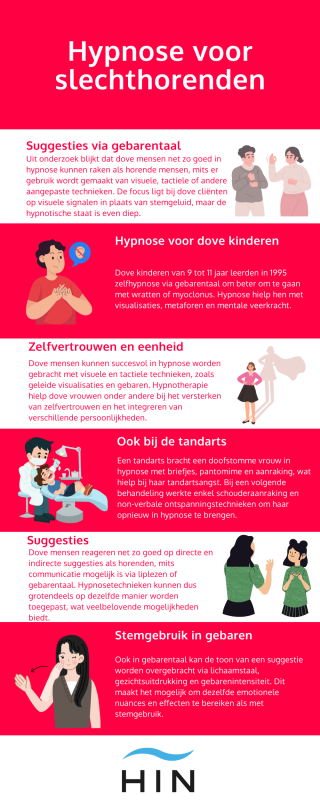
Also pin this handy infographic as a reminder:
Sources: