


EMDR therapy stands for eye movement desensitization and reprocessing therapy. This form of therapy was developed in 1987[1]. It is mainly used with people who suffer from PTSD (post traumatic stress disorder), especially if it is related to violence or war[2].
How does EMDR therapy work?
But how does this form of therapy work and what do the eyes have to do with it? It is a therapy that you do on your own with the therapist, usually twice a week for six to 12 sessions. Some people need fewer sessions, and you can also do a session every day if you feel more comfortable.
It is primarily used against PTSD or other disorders resulting from an impressive experience where the memory has not been properly processed. It involves the emotions, thoughts, beliefs and physical sensations you had during the traumatic moment. These memories can be triggered, causing you to suffer from symptoms of PTSD or other disorders.
This therapy focuses directly on your memory and tries to change it so that you are no longer bothered by the symptoms.
This uses eye movement and other left-right rhythms, such as with tones or touches (taps). While you then focus on the memory, the movements and left-right distractions reduce the vividness and emotion of the memory. In addition, the idea is also to think of more pleasant memories in between. So you do this alternately.
The interesting thing is that with EMDR therapy, you go into a kind of trance to make the memory less intense. Just as with hypnotherapy you also induce a certain trance.
EMDR therapy stages
There are stages that are gone through in therapy. As with other forms of therapy, first some questions are asked about the client's history and life. In this, we look at what memories, if any, need to be made less vivid, triggers and goals in the future.
The client then receives explanations or preparation for therapy. The memory that needs to be made less intense is figured out and then the actual therapy begins. Afterwards, an evaluation takes place to see if it has been effective (source 1).
EMDR therapy benefits
This form of therapy has several benefits. One benefit is that people who suffer from psychosis in addition to PTSD can be treated with this therapy (source 2).
This is in contrast to hypnotherapy, which absolutely should not be used with people suffering from psychosis.
- Applying EMDR therapy soon after the traumatic event (within 48 hours) can prevent you from suffering from PTSD[3].
- You don't need medication for this form of therapy.
- You suffer less from negative emotions.
- You better see what true information is[4].
EMDR therapy disadvantages
This form of therapy does not give you new insights, but only makes you less bothered by unpleasant memories of events.
Recalling these memories can cause clients to suffer from nightmares and migraines[5].
You can sometimes need lots of sessions, up to twelve. With hypnotherapy, three or four sessions are often enough.
Over time, you may still suffer from your problem again[6].
EMDR therapy is similar to hypnosis
EMDR therapy is similar to a hypnosis technique we use at HIN to promote new desired behaviors.
In this technique, unwanted behavior is paired with a negative emotion, such as the emotion that triggers the unwanted agitation, and the desired behavior is paired with a positive emotion.
For example, I once helped a woman who ate a cookie or grabbed something from the refrigerator every time she came into the kitchen. She actually didn't like this, because it made her overweight. So she wanted to snack less.
Then we figured out that the desired behavior was to take a moment to sweep or mop the floor when she came into the kitchen. We linked that mopping to a positive emotion.
She then proceeded to visualize these two behaviors with the negative emotion at snatching and the positive emotion at sweeping. These were alternated faster and faster until she got to the point where it's just more fun to mop or sweep.
When I spoke to her later, she had indeed stopped snacking and her kitchen had never been cleaner.
Now this technique in hypnosis has been used for something other than PTSD, but it shows that the EMDR technique can be adapted for other problems as well.
Hypnosis and PTSD
Because PTSD is no fun and because it has a great impact on life, multiple treatments are offered and researched. The effectiveness of hypnosis to treat PTSD has also been researched.
A meta-study shows that hypnosis helps treat PTSD and remains beneficial even in the long term[7].
Hypnosis and EMDR therapy
In addition, hypnotherapy has also been compared with EMDR therapy in people who suffer from stage fright, such as before they play their music to an audience. In both groups, anxiety was significantly reduced and performance on stage improved[8].
Both hypnotherapy and EMDR therapy are also recommended for trauma to get rid of it quickly[9].
In both cases, work is done to strengthen the ego and self-confidence. In the case of hypnosis, the client's positive traits that they want to further develop can also be examined.
Researchers also indicate that hypnotherapy can be a good complement to EMDR therapy. The knowledge of hypnosis can be integrated into EMDR therapy[10]. In that case, in the phase of explaining treatment, you explain not only how EMDR works, but also what to expect with hypnosis.
In fact, there are many misconceptions about hypnosis that you can then dispel immediately, such as the idea that people lose control or cannot remember anything about the treatment because they were in hypnosis at the time. Even when you are in hypnosis you are aware of what you are doing and you are in control. Therefore, clients can be reassured that they will never do anything against their will.
In addition, clients can use self-hypnosis in addition to EMDR therapy to boost their sense of self-confidence.
So it is not that using EMDR therapy excludes other forms of therapy. Hypnotherapy can be very well combined. This can give you a win-win situation.
Only if the client suffers from schizophrenia or psychosis can hypnosis not be used and EMDR therapy must be used on its own.
The combination of EMDR therapy and hypnotherapy also often provides faster treatment[11].
This is because with hypnotherapy in mind, a safe environment is created. This is a visualization that clients can call upon to calm down. When this is well made and helps to calm down, EMDR therapy can begin. Then, when emotions do get too intense, the client can go to that nice place in their mind for a moment to calm down and get back to therapy.
In addition, hypnotic affirmations can also be put into EMDR treatment such as:
- I am strong and I trust myself.
- I can have my feelings and still be in control.
- I go to the depth I am comfortable with.
- No one judges me[12].
These are just examples, depending on your trauma or problem and beliefs, you can get other affirmations that will help you solve the problem.
EMDR therapy treatment
Thus, treatment for PTSD or other anxiety disorders can certainly be done with EMDR therapy, in addition, it is not always a question of whether another form of therapy is better, but rather whether combining another form of therapy provides improvement.
In any case, research shows that EMDR therapy combined with hypnotherapy or hypnosis techniques helps treatment be successful faster. In doing so, hypnosis also helps keep anxiety away in the long run.
Hypnotic visualizations, suggestions and affirmations can help make the process easier by allowing the client to feel more confident and experience a greater sense of control.
Want to learn more about hypnosis and how it can support other therapies? Then come to the free online master class on hypnosis.
Or enroll in one of the Hypnosis Institute Netherlands' training courses, which are conducted online to ensure the continuity of your flow. In addition, there is sufficient assistance available for one-on-one attention.
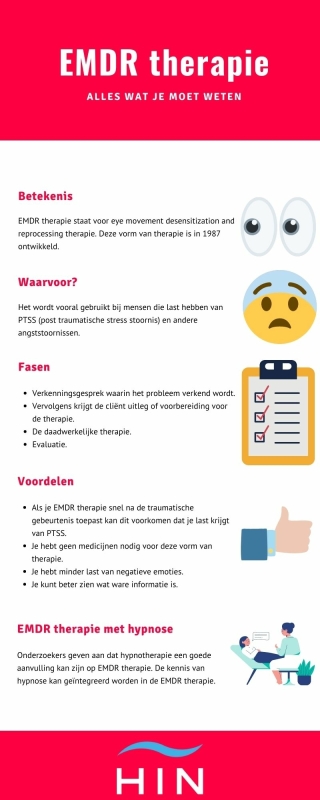
Pin this infographic as a reminder:
Sources:
[4] https://foundationsevents.com/wp-content/uploads/innovations-in-recovery/presentations/francine-shaprio.pdf
[9] https://psychotherapy.psychiatryonline.org/doi/abs/10.1176/appi.psychotherapy.2001.55.4.531?utm_campaign=TrendMD_APA3month_Dec2018&utm_source=TrendMD&utm_medium=cpc
[10] https://psychotherapy.psychiatryonline.org/doi/pdf/10.1176/appi.psychotherapy.2001.55.4.531 (page 532)