

Today we are going to talk about a topic that many people would rather close their eyes to. We're going to talk about the harsh reality of change. Because let's face it: why do some people really never get rid of their fear?
You would think: you do a session, you grab that hypnosis, and hup, gone anxiety. But that's not how it works for everyone. There is a group of people who stay stuck, and today I'll explain to you exactly why that happens. And believe me, it's a hard laugh.
Also watch the video:
The story of the 1,200
Let me take you back to a moment in my practice years ago. I received an application from the community. They had someone who had been on benefits for decades because of a severe phobia. The congregation was desperate and wanted me to help him.
I thought, "You know what? I'll throw in an amount I don't think they'll ever do." I asked 1,200 euros for one session. I really thought they would laugh and toot the horn. But guess what? A few days later: agreed.
At that point, ladies and gentlemen, it should have rung a bell with me. But it barely rang at all. I just thought, "Yummy, this is going to be great."
I went to see the man. He was somewhere in his fifties. He opened the door, looked at me and said the first thing that set the tone for the whole afternoon: "Gee, so you're that Edwin guy who came to help me get rid of my phobia for a while? Well, I can tell you: you're not going to succeed."
Boom. Down 2-0 before I even put my bag down.
The stack of reports as a shield
What happened next was fascinating and profoundly sad at the same time. He arrived with a whole pile of reports. Reports from psychiatrists, psychologists, agencies ... you name it. A bulky dossier explaining in great detail why he had his "phobia" (as he called it) and why, above all, he could not get rid of it.
He used those reports as a kind of armor. He had gained official status as "unsolvable." And you know what the problem is? If you identify yourself with your diagnosis, then the cure is your worst enemy. Because who are you anymore when that fear is gone[1]?
The hidden agenda of 'salvation'
During our conversation, the click did get better. We actually got along quite well. But then the penny dropped. He said, "Do you know why the municipality is sending you? They want me off the benefit. If you 'fix' me, then I have to go back to work. Then they won't have to pay me anymore. That will save them tons of money."
And there was the core. This man was in his 50s. His last occupation? Paving contractor. Imagine this: you're 55 years old, your body is basically used up from hard work, and you've been on welfare since you were 19 because of your agoraphobia(fear of the square).
If I helped him get rid of his anxiety in one afternoon, what would be his reality? Then he would have to get back on the road after forty years. Then he would have to work his knees in the sand again, working the rampage until retirement.
The fear of having to toil again was many times greater than the fear of staying inside. The phobia had become his safe haven. This is what is the function of worry and fear for many people[2].
The pain of the missed years
But there is something much deeper at play, something many people overlook when they talk about change. Imagine if I had succeeded. Imagine if I had "healed" that man that afternoon and he had walked to the marketplace whistling. What do you think would have happened to his psyche then?
He would look back on his life. He would realize that he had been inside since he was 19. Forty years of missed vacations. Forty years of missed relationships. Forty years of missed opportunities, career paths and adventures.
If one session with Edwin Selij had been enough to set him free, the inevitable question would be: "Why didn't anyone come when I was nineteen? Why did I throw away forty years of my life?"
That realization, ladies and gentlemen, is unbearable for most people. The pain of the past, the pain of missed opportunities, that jumps on your neck as soon as the fear dissipates. For this man, it was safer to hold on to his fear.
The fear was something he was used to. Those 40 years of "safety" were worth more than confronting a devastated past. Healing in his case would have been a psychological sledgehammer blow.
Fear as a protective mechanism
This applies to many more people than you think. Fear is often not the problem; it's the solution to another, bigger problem.
Maybe you have panic attacks. They're terrible, I know. I've had them myself, I know the agony, the sweat, the feeling of your heart jumping out of your chest. But ask yourself: what is this panic protecting you from?
Imagine no more panic attacks. What should you do then? Should you then break off that relationship that has actually been suffocating you for years? Should you then finally take that step toward that job you're terrified of? Do you then have to confront the outside world that might condemn you?
Sometimes fear is easier than reality. It's a symptom you can deal with. You can numb it a little, you can talk about it to the psychologist, you can learn to deal with it a little. But the real problem? You don't dare to deal with that. It's too big, too difficult, too confronting.
Your problem is not your problem
I've made videos and recorded podcasts about this before: your problem is not your problem. The panic attack is just the alarm going off. But we're so busy trying to turn off the alarm that we forget to look at where the fire actually is.
People who never get rid of fear are often those who refuse to look at the fire. They just want the sound of the alarm to stop. They want a pill, a trick, or a "magic" hypnosis session that takes everything away without them having to look in the mirror themselves.
But change requires willingness. The willingness to deal with the real problem. Are you willing to deal with why you created that fear in the first place? Are you willing to take responsibility for your life again, even if that means facing past mistakes?
The choice: Stay put or get up?
Don't get me wrong: You can get rid of it. Anyone can get rid of anxiety. But you have to want it on a deeper level than just saying, "I want to get rid of this unpleasant feeling." You have to be willing to give up the secondary disease gains, the benefits your anxiety unconsciously offers you.
The man from the community? That one never got rid of his phobia. And somewhere I understand. For him, the price of freedom was too high. The price was surrendering his safe bubble and confronting forty lost years.
But you? You have a choice. Maybe you're not 55; maybe you're 20, 30 or 40. Maybe you haven't lost forty yet. Do you want to wait until you do? Or are you willing to say today, "Okay, that panic is a symptom. What's underneath it? What am I really running away from?"
The gain of your anxiety, is it worth it?
It's a tough message, I know. But I'm not here to talk you down. I'm here to help you liberate. And liberation begins with truth.
If you find that you've been struggling for years and nothing seems to help, consider this: what is this fear getting you? What do you not need to do as long as you have that fear? And are you willing to give that up?
If the answer is "yes," then hypnosis is the most powerful tool available. Then we can move mountains. But if the answer is "no," then even the best therapist in the world can't help you.
Did you find this an interesting angle? Let me know in the comments.
Go for that radiant smile, but dare to look at the shadow first.
Learning hypnosis to resolve anxiety
Do you want to help people get rid of their fears? If so, knowledge of hypnosis is indispensable. Come to the free master class for an introduction.
Or register for one of our events and trainings.
Have a question about our training? Schedule a 1-on-1 consultation here.
Also pin this infographic as a handy reminder: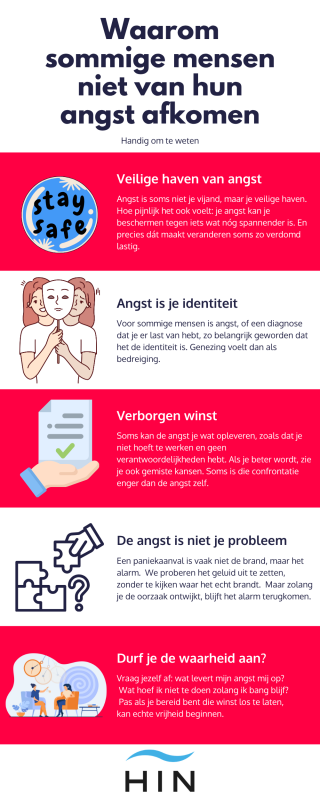
Sources: