


You have people who cry over everything, but you also have people who cannot cry for one reason or another and are troubled by this. Having a blockage to crying can be very irritating, because sometimes a big cry is just what you need to give yourself some air.
In this blog article, we explore the benefits of crying, where blockages that prevent you from crying come from and give you tips on how to break the blockage.
Benefits of crying
Crying has all kinds of benefits, and they are sometimes different than you might expect. For example, if you cry in a social setting, such as with friends, it can strengthen the bonds between them. This is because it can evoke empathy in your friends for what makes you cry.
But there are also situations in which crying causes people to think negatively of you and find you needy[1]. Therefore, the context in which you cry does matter for when you give in to it or not. This is because the positive effects of crying for yourself can be negated if your environment does not respond well to it. This is why many people prefer not to cry at work.
Crying not only provides empathy. It also triggers "caring for others" in people who see you crying. This caring for another includes feelings of wanting to protect, and it can even reduce aggression in someone close to you[2].
Looking purely at the benefit to yourself, crying is also a form of self-care. It is a way to calm down when you are actually all over the place. This is why some people start crying when they are actually super angry. Crying can improve your mood and make you feel relieved.
Crying also regulates your physical response to stress. In fact, crying does this in the same way as when you start cursing to express a strong emotion or when you get aggressive to express a strong emotion and then feel relieved and good.
However, stress is not always the cause of crying. You can cry over small things or very big things in life, and those things can be both positive and negative.
People can cry at all kinds of strong emotions, such as joy and sadness.
Contributing factors
Those personal benefits are not always there. Also, as mentioned above, it often just depends on where and with whom you are to experience the positive effects of crying.
In addition, it also depends on your personality. For example, people who have an extroverted personality are more likely to notice that crying is more cathartic than people who are, for example, very preoccupied with how they "should" be (source 2).
If you suffer from mental problems, such as depression or suffer from anxiety, crying can actually cause you to not feel relieved at all, but rather an even worse mood.
What does contribute is that you are someone who can bond normally . So if you have a good bond with your parents, chances are you will experience relief when you cry for a while.
Need to cry about something you have control over? If so, crying often helps you feel better. If you are crying because you actually feel powerlessness, then crying again does not help.
Origin of cry blockage
Mental problems such as depression can make you unable to cry. This does not mean that if you cannot cry then you are depressed, it is just one contributing factor.
It may also be that you have had many cues in your life that crying is "not done" and that you have unconsciously acquired a belief that crying makes no sense and so you don't cry. For example, it may be that your parents did not react well when you cried, and so you have taught yourself not to.
Happiness can change the way you attach throughout your life, and if you feel secure in your relationships, it helps you experience the benefits of crying(source 2).
Breaking Crying Blockade
Many people want to be able to cry because it helps them improve their self-esteem. They think they are a warmer person when they can cry, than when they cannot (source 2).
But now that you've read all this information about crying, you've probably already realized that being able to cry or not actually says nothing about how hot you are as a person.
You can be just fine being ready for other people without crying.
However, a crying blockage can also actually be a blockage of an entirely different problem. In fact, some people report that they were unable to cry until a particular problem was solved or a particular insight was gained, which allowed them to cry again and the relief of crying was felt (source 2).
A hypnotherapist can help you break through problems that cause cry blockage.
As mentioned, there are a number of possible causes, and for each of those causes, hypnosis can aid in resolution.
Unable to cry due to depression
Depression is super annoying, especially when crying doesn't help you move forward. Fortunately, hypnotherapy can do a lot to treat depression and then get back to experiencing the benefits of crying.
Research shows that hypnotherapy is as good as cognitive behavioral therapy (now the standard), for treating depression and preventing relapses into depression[3].
Unable to cry through beliefs
I myself have been a non-huiler for a very long time because of my beliefs. In fact, most beliefs are formed in your childhood, and during that time my grandfather died. During the funeral, men actually did not cry.
This gave me the conviction that "no matter what," as a man you are not going to cry.
So I wasn't expressing my emotions in a healthy way at all, and because of this I actually ended up with all kinds of problems, such as depression, which I then solved with "remedies" that couldn't be gotten through the doctor.
Not at all convenient.
Being introduced to hypnosis has completely changed my beliefs and now I can cry.
So how does hypnotherapy do it?
There are a variety of techniques for this. In most cases, a regression is performed to the first moment when you felt "I'm not allowed to cry." These are often moments in childhood, such as in my case my grandfather's funeral.
Then a hypnotherapist helps you reinterpret this moment, but with your adult knowledge. Depending on the event, this can go very differently.
Sometimes it's a way to realize the event is over.
Sometimes it's a way of realizing that as a child you didn't know at all what other people were thinking. For example, by empathizing with other people who were there at the time.
Sometimes it's a way to talk to your parents (even if they are already gone).
A hypnotherapist will help you do all this in your mind and continue this until the "I can't cry" feeling goes away.
You might even burst into tears 😉 .
Not being able to cry because of your way of attachment
As mentioned, poor attachment can keep you from crying because you never got the signal from your caregivers that it was going to help you move forward.
In this case, a conversation with the inner child will probably be needed to help you become well attached again or to realize that you are already well attached.
To realize that you do now have a partner with whom you can cry out for a while and who does offer comfort, rather than saying "pull yourself together."
Unable to cry blockade release with hypnosis
With all this knowledge about crying, what may be causing it and how hypnosis helps you clear a crying blockage, you will already be a lot further ahead.
Want to learn more about hypnosis and how it can help you and others move forward? Then come to the free online master class.
Or register right away for one of our events or trainings.
During the events, you already get many fun exercises and demonstrations that can give you many insights and completely transform you into someone who can express their emotions when needed.
In the training, you will learn the techniques to help other people remove blockages. These can be all kinds of blockages, such as a crying blockage, exercise blockage, smoking blockage, health blockage.
You can take the training in class and online. Ideal if you are not local for a change, or even live on the other side of the world altogether.
Click here to learn more about our training programs.
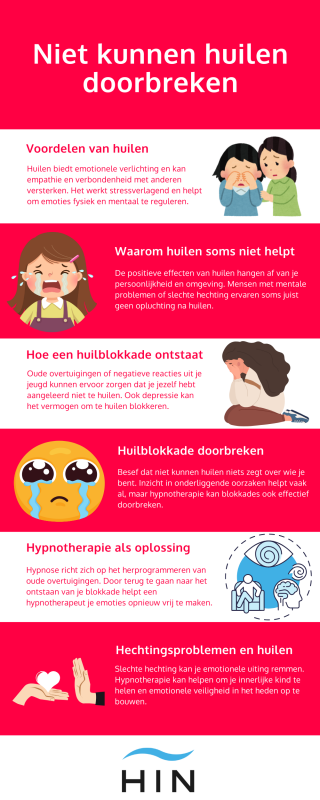
Also pin this handy infographic as a reminder:
Sources: