Mental garbage people dump their mental dregs on you. It's like a garbage truck.
You're standing on the street somewhere. The garbage truck approaches, it backs up toward you. You remain standing. It stops. You remain standing. That bin goes up. You remain standing. And then wham, all the garbage lands on you. It's in your clothes and on your skin, so you take a shower, but it doesn't help.
This is a shame because it would not have been necessary.
A step aside would have prevented all of this. You didn't have to do that much to avoid it, but you have to do something.
But now with people. They come running, you know them, and you stay put. They stop in front of you. You remain standing. Their mouth opens and there comes the mental complaining, whining and squealing. They have lost it, but you go home with it. Their mental garbage is inside you.
Mental garbage people who complain, whine, nag and squeal. You know them, yet you stand your ground.
Tips for being less bothered by people who are always complaining
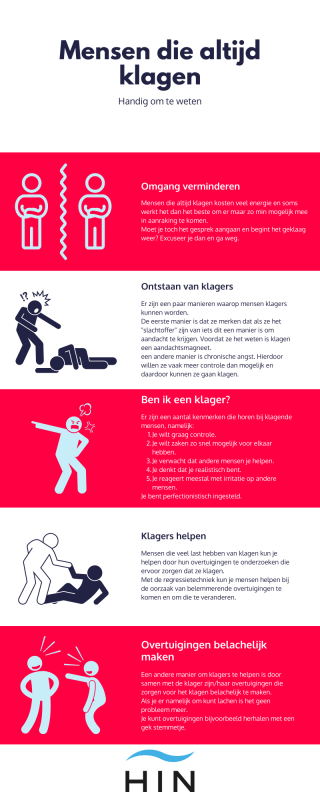
It's very interesting because what can you do? You can mentally step aside or literally walk away. Only you have courtesies, so literally walking away is not something you can do quickly. Co-workers, neighbors or family who unfortunately are mental garbage people, it's hard to walk away from that.
So then mentally step aside. You can dissociate. Let it go, let their dregs crash next to you. Then it won't do anything at all.
People sometimes ask how you deal with negative people, well:
Tip #1: Don't deal with it.
This is sometimes easier said than done.
Tip #2: Almost don't deal with it.
Anyway, because what you deal with you get infected with. So as little as possible, because you can't escape it at times.
Is it structural? Then you have to ask yourself a number of things, such as do I want to be among those people? Am I not a mental garbage collector myself? This may be a little harsh, but what you deal with, you get infected with and then you can become like that yourself. Then it is helpful to deal with other people.
If this doesn't work, then you need to step up mentally.
You can literally let it pass. Someone tells you something and you hum and nod a little. Just pretend you're listening, but you don't hear anything. People generally don't like this, but people who run around bitching for the sake of bitching are often long happy to have someone to bitch to. If you hum then, they should take that for granted as well.
You can also reframe it all the time; people find that annoying, too, and then they automatically start avoiding you. On the contrary, when people complain about the weather, you say you like the weather or you point out the positives.
Tip 3: Excuse and leave
The third strategy is to run away with some excuse. You have to go to the bathroom, you have an appointment, doesn't matter what.
You can do this. It helped me to positively reframe all the time and then they started avoiding me. I found this wonderfully peaceful. I don't feel like complaining because time can only be spent once, then it's gone. If you spend it on whining it is an awful waste, because you could have spent it on fun things.
Sometimes, of course, you have problems of your own. Then, of course, you want to be able to complain about that, but I really try to minimize this. It gives you very little, so why do it?
What can it bring you? Attention, connection or something else? If you don't do it, will you still get that attention and connection? I struggle with that, when people try to get it that way. So I'm going to reframe it positively.
Or you're somewhere and it's lame to reframe because you're on a visit or something. Then hmming and chuckling along is more convenient. This is then to protect yourself from even more whining. I am only very sporadically in such places.
Jim Rohn is a motivational speaker who said, "If you don't like where you are right now, change it. You're not a tree." Freely translated: If you don't like where you are right now, change it. You're not a tree.
Also listen to this podcast:
https://www.buzzsprout.com/195236/1344322-mentale-vuilnismensen
Why does someone become a complainer?
As mentioned, you might ask why someone becomes such a mental garbage person? Chances are they grew up with people always complaining and so that is what they do as well. After all, children often copy their parents' behavior.
Or they have ever discovered that complaining or indicating that you are a victim of something gets you attention. We are social people and attention is something we need. You can get attention in several ways. Namely by being pathetic, because then you get pity. Or by being good at something. A good storyteller, someone who can explain something well. Of course, the latter takes more effort than being pathetic. Because then you also have to develop a skill.
This is exciting, which brings us to the third reason why people can turn into complainers, or why people can be annoying. They are afraid. Chronic anxiety can cause people to micro-manage, complain, worry a lot and whine. This often causes people with chronic anxiety to have disturbed relationships with their environment as well[1].
Do you have mental garbage in your life that is because of attention or habit? If so, the tips above can help you gain the understanding that this is actually causing less attention in the long run.
How do you know if you are a complainer yourself?
You can also check for yourself whether you are a complainer or not. Then take a moment to check if these statements are true for you or not.
- I like to be in control.
- If I want something done, I want it done as quickly as possible.
- I expect other people to help me.
- I'm not complaining, I'm just being realistic.
- Annoyed is how I react to most things.
- I am a perfectionist.
Recognizable? Then chances are you're a complainer.
How do you help a complainant?
You can avoid mental garbage people, but if they actually ask you for help (or you now think you need help yourself) there are fortunately ways to help them stop complaining.
Hypnotherapy, for example, is one such way. If you are a hypnotherapist, you often dive into your client's beliefs first. You can do this during a preliminary conversation of sorts, or you can have a little conversation while your client is already in hypnosis. Then it may surface, for example, that complaining is a way of getting attention or feeling more in control.
With regression, you can check where the feeling came from that complaining has become the best way to get attention. Is this something you can check with regression? Regression is a hypnosis technique that helps people realize when they were first "bothered" by a particular belief. Often these are moments in early childhood. You may have seen how your complaining mother always got attention anyway or something similar. It's different for everyone.
Then you can help the person interpret this moment differently, making the belief that complaining makes for good attention - which is just really not always the case - go away.
Making fun of the belief together
In addition, you can ask why someone complains or whines so much, especially if it's your family. If that person is very honest, an answer like, "I'm afraid I won't get attention otherwise." might come out. Then you can suggest ridiculing that belief.
For example, you start repeating the following sentence together in the craziest ways possible: "I'm afraid I won't get attention otherwise." For example, while jumping around or something. Make it as fun, funny and ridiculous as possible.
You will learn to apply these two techniques, among others, in the Hypnosis Institute Netherlands training program.
Are you curious about hypnosis? Then take a free webinar on hypnosis. In the webinar, Edwin Selij explains exactly how to do hypnosis. You can sign up for the next session here.
Want to learn and see more than just hypnosis? During a seminar, I also give demonstrations of the above techniques. So please come to a seminar.
Are you a coach, psychologist or even a psychiatrist or want to be one? Then hypnosis can be a great addition to techniques you can use to help people. Register for one of our training courses.
Also pin this handy infographic as a reminder: