

Misophonia is a condition in which you dislike everyday sounds that other people may make, for example, the smacking when someone chews food. The clacking of pumps on a parquet or stone floor. The tapping of someone working on their computer. Even the breathing of your partner sleeping next to you can drive you crazy and irritated. Furious people with misophonia can become enraged by these kinds of sounds around them.
Because this adds all kinds of complications to your life, in this article I will go over what misophonia is and what you can do about it.
What is misophonia
In misophonia, negative thoughts and emotions are triggered by soft sounds. Misophonia is not always recognized as a "disease," but it can certainly make your life more difficult. It is also recommended by scientists to classify misophonia as a discrete mental disorder.
Maintaining relationships is difficult because everyday noises keep pissing you off. Even if you hold back, the tension can be felt in the air, and this can drive partners and friends away. Moreover, it can also cause disrupted family relationships.
Living in an apartment and being able to hear your neighbors can also cause irritation. A story by an Englishman who shared his experiences with misophonia on the Internet also showed that it can cause anxious feelings because you have to return home after work and then you are confronted with the noise again.
The symptoms of misophonia
In 80% of cases, people who suffer from misophonia dislike sounds related to food. 60% of cases also involve sounds that are repeated over and over, such as someone walking, typing, chewing and the like.
The reaction to the sound may be aggression toward the source of the sound. This can be as little as something as small as sternly looking at someone you think is making too much noise while chewing. In nearly 30% of people who suffer from misophonia, you can also tell something from the sound, and a Dutch study found that just over 16% of participants could also become physically aggressive from the sound. Five of the 42 participants had beaten their (ex) partner because of a sound they made. This, of course, is very problematic.
In the Dutch study, on the contrary, it was clear that anxiety had nothing to do with it, but that may not have emerged due to the small sample size, since the experience of the Englishman mentioned above did indicate that the condition could cause anxiety.
Participants did indicate that it could cause stress if they anticipated sounds that unexpectedly came through to them anyway. So they did feel stressed by the thought that they might hear unexpectedly with the sound they associated negative emotions with anyway.
In the process, they also worried about losing control of the situation.
You can also choose to go away so that you are not "bothered" by the noise. Of course, this is the way to have no social life at some point. So still no real solution to the problem.
Undergoing. You're at someone's house eating smack and just acting like nothing is wrong, when in fact you're annoyed to death. Surely that's going to create tension again....
Block out the noise, for example, if you are bothered by the sound of your upstairs neighbors, you can choose to turn on music so you don't hear them or sleep with earplugs.
Mimicry is also a symptom of misophonia.
Sometimes you may also experience anger or irritation while seeing the activity that causes the sound. For example, when someone is eating, but you don't hear it.
Cause of misophonia
The cause of misophonia can often be found in childhood and adolescence, especially with family relationships at that time, or a relationship with your pet. On average, symptoms begin during the 13th year of life.
Girls are also more affected by misophonia than boys. Doctors do not yet know why it happens, but it is already certain that there is nothing wrong with your hearing. They assume it is something psychological or physical. Physical in the sense that the sound triggers parts of the brain to have an automatic reaction of hatred, irritation or something similar.
There are also people with misophonia who believe it comes from disrupted family relationships. For example, if you disliked a family member who smacked a lot, you may later develop a pestilential dislike for smacking. It's as if your brain made a link to the action rather than the person. This all happens unconsciously.
Studies on tinnitus also show that tinnitus can cause misophonia.
Treatment of misophonia
Misophonia is currently treated primarily with cognitive behavioral therapy (CBT). This form can be enhanced if the therapy takes place under hypnosis.
In addition, stress also seems to have an impact on emotions at sound. Therefore, regular exercise and adequate sleep are recommended to at least keep stress to a minimum.
Because tinnitus can also cause misophonia, tinnitus therapy is also sometimes recommended for people with misophonia and tinnitus.
Cognitive behavioral therapy and misophonia
Cognitive behavioral therapy looks at the beliefs you have about yourself, the world and others. It also looks at how your behavior and influences what you think and feel.
For example, your beliefs can affect the feeling of disgust when someone smacks while eating. This belief is often irrational. The therapist must then demonstrate to you
By performing CBT while under hypnosis, you are more open to the changes and the effect of the therapy is greater.
Hypnotherapy against misophonia
Hypnotherapy often includes CBT, but in addition there are other techniques that a hypnotherapist can use.
Hypnotherapy attempts to give you more influence over the subconscious mind. Precisely because the hateful reaction to certain sounds is subconscious, because consciously you do realize that it's a little weird, hypnotherapy can be a good solution.
A complaint of people with misophonia includes lack of control over the situation. To do this, they first sprint into the past to moments when the "patient" did have control. This does not even have to be related to the sound. Among other things, this serves the realization that the person does have control on many other things in life and does certain things for that purpose. For example, staying calm if you accidentally dropped something or if your child/partner/friend did. After all, everyone drops something from time to time.
They then look at times when sound was a problem and which of the techniques they use in other situations can also be applied to these situations.
Visualizations can also play a major role. For example, the visualization that when they hear the sound they can turn it "off" or at least softer with some kind of volume control.
In addition to the sound button, they can visualize precisely how to turn certain emotions on or off. For example, after they are triggered by a smacking sound or something similar they feel irritation. Then they can convert it with a button or something else to calmness, joy or sociability or whatever emotion fits the context in which the sound is produced.
You will also receive self-hypnosis exercises to reinforce the therapy. Thereby, this can also help you in situations where you actually face the sound that triggers you.
In short
Misophonia is a disorder in which you are violently irritated by sounds people may make, such as smacking, walking on heels and typing. This can cause you to avoid places where you can expect these kinds of sounds or become aggressive about them. Needless to say, none of this is good for your social life.
Therefore, it is also receiving increasing attention in science, but so far mainly to indicate that it should be recognized as a disorder. Therefore, there are as yet no scientifically proven treatments for misophonia.
Because researchers believe misophonia is primarily a psychological problem, this disorder is currently treated primarily with CBT and hypnotherapy. In hypnotherapy, the focus may be on feeling in control and reducing the perception of the sound and more control over emotions.
Want to learn more about what hypnosis can do ovor you and others? Then come to the free online master class.
Andbe sure to check out the Hypnosis Institute Netherlands' events and trainings.
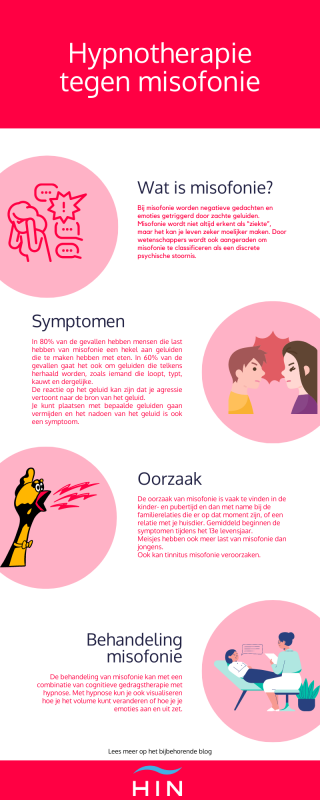
Also pin this handy infographic as a reminder:
Sources:
http://www.misophonia-uk.org/dealing-with-misophonia.html
http://www.hypnosisdownloads.com/testimonials/noise-sensitivity
http://journals.plos.org/plosone/article?id=10.1371/journal.pone.0054706




Steve Writers
on March 3, 2026