

Does "poop anxiety" sound like something out of a comedy sketch, or perhaps a shy joke among friends? For many, however, it is an uncomfortable and very real reality. You are not alone in experiencing this deep reluctance, or even panic, at the thought of pooping outside the safe and familiar environment of your own home.
Maybe you recognize the symptoms, but didn't know the term yet.
This phenomenon, officially known as coprophobia, is more than just a little embarrassment. It is a specific phobia that can be deeply rooted and trigger physiological responses in your body.
In this article, we dive deeper into exactly what coprophobia means, explore its psychological and physiological causes, and show you how to break through this hindering fear .
Discover why your brain sounds the alarm in "strange" situations and how your body blocks as a result.
What exactly is poop anxiety?
Coprophobia, or simply poop anxiety, is a deep-seated and irrational fear of defecation. This can be the fear of the act itself, the fear of seeing feces, the smell, or the thought of defecating in front of others, even if they are in another room.
There is even an extreme case of someone who could only poop or pee if there was no one else in the house[1]. That, of course, is very troublesome.
Although it may sound strange, this is a common, albeit often hushed up, phobia that can significantly affect daily life.
For example, I've heard stories of girls who didn't do number 2 for an entire school trip, even blocking their bowel movements for days as a result. Or a boy who just kept number 2 inside during a festival. As a result, it suddenly became a fartfest in the car on the way back anyway (he did make it to his own safe toilet for the real thing), but on the way back the relaxation began, because he was in an environment with friends with whom he felt safe.
So men and women can have this fear.
This is no mere posturing.
Like other phobias, such as fear of heights or spiders, it involves an involuntary, intense reaction of your body and mind to a situation perceived as threatening. You are by no means alone in this experience. Many people struggle with this, often without knowing exactly why or how to name it.
At its core, phobia is a fear beyond normal privacy needs.
The fear is also disproportionate to the actual threat.
It can cause you to avoid certain places or situations. For example, you can let a festival pass you by, or so a very nice school trip, or even a business trip. As a result, you miss out on all kinds of opportunities in your life.
Sin!
Why your brain sounds the alarm on poop anxiety
Our brains are primarily programmed for survival. It constantly scans the environment for potential threats. In a familiar environment, such as your own bathroom, your brain feels safe and relaxed. You can surrender to natural processes without thinking.
However, as soon as you enter an unfamiliar or "threatening" situation, such as a public restroom, your brain automatically begins to scan "danger.
The psychological causes of coprophobia are often related to:
- Lack of privacy: Public restrooms with thin walls, gaps, or the presence of others can cause a feeling of exposure. You are afraid that people will hear, smell, or even see you.
- Fear of judgment: A deep-seated fear that others will judge you for the sounds or smells associated with defecation. This may stem from previous, perhaps unconscious, negative experiences or upbringing.
- Loss of control: Relief is a natural but also intimate process. In an unsafe environment, it feels like losing control, which contributes to feelings of anxiety.
- Hygiene anxiety: Although this can be a separate phobia (mysophobia), fear of germs or unsanitary conditions in public restrooms can amplify poop anxiety.
Your brain interprets these stimuli, namely: the strange noises, the smell of strangers, the lack of privacy, as a signal of insecurity. It puts your body into stress mode, triggering a cascade of physiological responses.
Stress and your bowel movements
When your brain sends the signal "danger," your body switches to what is known as "fight-or-flight" (or "freeze") mode. This is an ancient survival mechanism designed to get you ready for action. But this response also has a direct effect on your digestion and defecation process.
- Adrenaline and cortisol: Your body pumps around stress hormones, such as adrenaline and cortisol. These hormones divert blood away from "non-essential" functions, such as digestion, to your muscles.
- Muscle activity: The stress response causes muscles throughout your body to tighten[2]. Specifically, the muscles around the pelvic floor and anal sphincter muscle may contract involuntarily, making defecation physically difficult.
- Bowel activity slows: Under stress, peristalsis (the wave motion of your intestines that moves food) often slows or stops. Your intestines "lock up" because your body prioritizes immediate danger response rather than digestion and excretion. This is at the heart of what is often described as stress bowel movements that stop or are very labored.
After all, it's hard to fight or run while you're pooping.
But at the same time, you just want to poop and because you can't, you get more stressed.
This means that the harder you try to defecate, the more your body may strain, which actually worsens the blockage. It is a vicious cycle of anxiety and physical helplessness.
Situations in which people suffer from poop anxiety
Although coprophobia can occur basically anywhere you feel unsafe, there are some situations that people with poop anxiety often find particularly challenging:
- Vacations and travel: New surroundings, unfamiliar toilets in hotels, campgrounds or along the highway. The routine and privacy of home are completely missing.
- Festivals and events: Think of the infamous Dixis or temporary toilets at large outdoor events. Hardly privacy, often dirty, and the constant presence of people waiting.
- Workplace or school: The shared restrooms, the awareness of colleagues or fellow students nearby, and the fear of being "caught" visiting the restroom.
- Public transportation: Toilets on trains, buses or airplanes, where sounds and movement can exacerbate anxiety.
- Visiting others: The home of friends or family, where you feel less comfortable than at home, and you fear people will hear you.
In all these situations, it is the elements of lack of privacy, control and the fear of judgment that fuel the phobia and activate the stress response.
Practical tips for acute poop anxiety
The good news is that you can "fool" your brain and relax your body again. The key is to deactivate the stress response and create a sense of security, even if the environment does not immediately provide it.
Here are some practical tips you can apply when poop anxiety strikes:
Breathe deeply:
- Sit quietly on the toilet.
- Close your eyes or focus on a fixed point.
- Breathe slowly and deeply through your nose, expanding your abdomen.
- Then breathe out slowly and completely through your mouth, as if blowing through a straw.
- Repeat 5-10 times. Deep breathing activates the parasympathetic nervous system, your body's rest and digest mode.
Visualize your safe place:
- As you breathe, vividly imagine yourself at home, on your own familiar toilet.
- Visualize the colors of your bathroom, the sounds (or silence), the smell.
- Feel the safety and privacy you experience there. Your brain reacts strongly to images; when you change the image, your feelings change with it.
Acceptance and normalization:
- Remind yourself: pooping is as normal as breathing. Everyone does it.
- Try to recognize and let go of thoughts of shame or judgment. They are part of the phobia, not reality.
- Accept that the fear is there, but that it is not dangerous.
Sound masking (if possible):
- If sounds are a trigger, consider running noise from the faucet, or listening to soothing music or white noise through earbuds. This can create a sense of privacy.
Avoid these coprophobia mistakes
When dealing with coprophobia, people may develop unintentional behaviors that actually perpetuate or exacerbate the fear. Be aware of these common pitfalls:
- Avoidance: The constant avoidance of situations where you need to relieve outside stress. While this provides short-term relief, it confirms to your brain that the situation is actually dangerous, reinforcing the phobia.
- Food/drink restriction: Some people will eat or drink less when traveling or attending an event to minimize the need for relief. This can lead to physical discomfort and health problems, and does not resolve the underlying anxiety.
- Secrecy and shame: Many remain silent about their poop fear out of shame, leading to isolation and feeling alone. Talking about your fear, however, can be the first step toward relief.
- Focusing only on the physical: Approaching anxiety as if it were purely a physical problem, without paying attention to the psychological components, will rarely lead to lasting change.
Overcoming poop anxiety
Coprophobia is an invisible but very present fear that can affect your life in unexpected ways. We have seen that it is a complex interplay of psychological triggers and physiological responses, where your brain links a feeling of insecurity to a natural bodily function. From festivals to vacations, the fear of defecating outside your familiar environment can limit your freedom and cause stress.
Remember, you're not the only one struggling with this. More importantly, it's not an insurmountable problem.
By becoming aware of the mechanisms behind poop anxiety and applying practical breathing and visualization techniques, you can regain control of your stress response.
Are all these practical tips not working? Then hypnotherapy can also help. Under the guidance of a specialized therapist, you enter a deep state of relaxation (hypnosis), where you can access the subconscious part of your brain - exactly where irrational fears are often anchored.
In this relaxed state, it is possible to release fearful associations around defecation and replace them with new, safe and neutral thoughts. Hypnotherapy focuses on breaking the vicious cycle of anxiety and physical tension.
This can be used to investigate where this anxiety comes from, and update the beliefs created by an event,[3] allowing you to relax for your bowel movements outside the home.
Several studies show that hypnosis shows positive results in other specific phobias (such as fear of flying or vertigo). It can also help with coprophobia by "reprogramming" your brain and normalizing the toilet visit experience.
Learn hypnosis to help people (or yourself) with poop anxiety
Do you want to help people overcome their fears? Then knowledge of hypnosis is incredibly helpful.
Sign up for our free master class for an introduction.
Or register directly for one of our trainings or events.
Have questions about the training? Schedule a 1-on-1 consultation here.
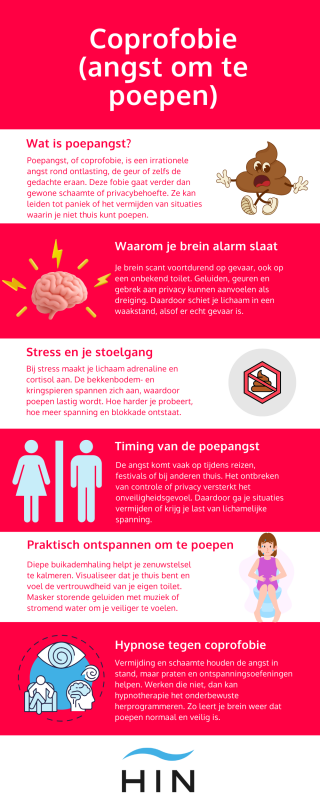
Pin this image as a handy infographic:
Sources: