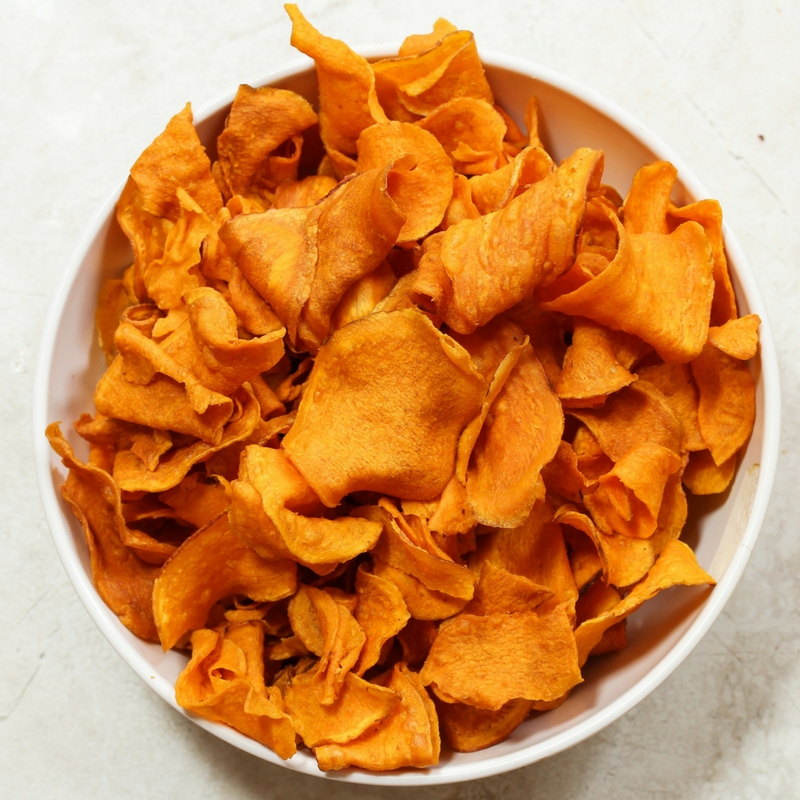

When you're at a party do you notice that you're the one eating the most chips, right? Those tasty chips are just impossible to resist. You only half follow conversations and in order not to let it be noticed that you really like chips after all, you keep an eye on the rest of the people. As soon as someone takes a chip, you take one too. You will indeed lose the conversation for a while, but after the chip you can at least say something back and resume the conversation.
Is this story familiar to you and do you feel like you are addicted to chips? Can't leave that bag of chips lying around the house? Then read on so you can resist the chips.
Why is chips addictive?
Chips actually consist of two elements that are addictive to humans namely salt and fast carbohydrates. Salt and fast carbohydrates are something we need as humans and are hard to find in nature.
As a primordial human 10,000 years ago, if you could find it, you really didn't get the signal to stop eating, because the more the merrier. You didn't know how long it would be before you could eat salty or carbohydrate-rich foods. So storing a supply was important, and that's why we like it. That's how our brain works.
So with fast carbs, you don't get the signal that you're full as quickly, and with salt, neither do you. This is a major reason why you can eat yourself completely nauseated with a bag of chips. Our brains are still the same as the primal man.
Yet there is much debate about whether chips can be addictive like drugs, for example. Many experiencers do agree that food addiction is just as real as some drug addictions whether chips, chocolate or even healthy food.
In addition, manufacturers also try very hard to have the right balance of salt, fat and fast carbs to make sure you buy not 1, but 2 bags of chips. Because the shareholder wants to see results(1).
Binge eating with chips
To truly speak of a chip addiction, you must meet the following conditions.
- You eat a lot of chips at least once a week, even if you are not hungry or even full.
- You do this for a minimum of 3 months at a time.
- After eating potato chips, you feel guilty and suffer from feelings of shame.
- If you promise yourself to really start eating less now, you often break that promise(2).
An eating disorder, such as a potato chip addiction, can be very impulsive, as well as compulsive.
The impulsive characteristic is that, for example, you go to the store with no plans to buy chips but put them in your shopping basket anyway.
If it's just compulsive, you feel compelled to eat the chips. Your visit to the store just isn't complete if you haven't bought the chips. Then you can develop whole rituals of how and when you eat the chips.
Cause of potato chip addiction
One in five people is addicted to food, chances are these individuals are also addicted to potato chips. Australian research on food addiction shows that certain personal factors can contribute to food addiction, such as:
- Gender, women are more prone to eating addiction.
- Drinking more than average soft drinks.
- Prone to anxiety.
- Having depression.
In particular, having depression is a very predictive factor for having an addiction to food and therefore also possibly for an addiction to potato chips(3).
By identifying the cause of your potato chip addiction, you have a much better chance of stopping the addiction. For example, are you prone to anxiety? Then it makes sense to treat your anxiety, then you may naturally feel less like eating chips to "eat away" the anxiety.
Do you already drink a lot of soda? Then it may be wise to start a healthier drinking pattern now so that an addiction to potato chips is less likely to succeed.
Tips against chip addiction
If you are addicted to potato chips, you can first try changing the behavior yourself before undergoing treatment with a psychologist or hypnotherapist. For example, you can try the following tips. If you have already done so, feel free to scroll on to treatment for chip addiction.
Tip #1: Get all the chips out of the house
Okay, maybe you live with other people, but if there are chips in the house you just can't stay away from them. So throw away any chips that you have in your cupboards. Let other people in the home keep the chips they can eat with control in their rooms.
Tip 2: Replace the chips
Snacking is hard to stop. Fortunately, you can substitute snacking chips for snacking on something else. For example, pieces of apple, cucumber or even carrots. You'll still have your snacking moment, but instead of unhealthy chips, you'll actually start feeding your body with healthy ingredients.
Tip 3: Drink 1 large glass of water
Are you hungry? Then chances are you're actually thirsty. As soon as your fingers itch to open a bag of chips, grab a big glass of water and drink it all at once.
This can be incredibly cathartic and the cravings are often gone.
Tip 4: Get moving right
Are you suffering from stress and eating because of it? Then grab your coat and walking shoes and take a walk around the block when your fingers start itching for chips. Walking helps you become more creative, which may help you solve the problem causing stress.
In the process, walking also helps reduce the muscle tension you can get from stress and the stress hormones you produce.
Overcoming chip addiction
Are all these tips not working to overcome your addiction to potato chips? Then it's time for heavier artillery.
To treat a potato chip addiction, you can use multiple techniques, such as:
- Mindfulness
- Cognitive behavioral therapy
- Hypnosis
Mindfulness
Mindfulness can serve you well if you are an impulsive eater rather than a compulsive eater. As soon as the "fuck it" thought comes into your mind and you run to the cupboard to grab those delicious chips take a few deep breaths to process what you are actually doing.
By being mindful, you are more likely to recognize thoughts that lead you to eat the chips. In the process, mindfulness can also help you make the taste of potato chips less addictive. After all, have you ever paid attention to how potato chips feel in your mouth and what they really taste like? Basically, you're just eating a big bite of fat with salt.
Mindful eating helps you become aware of the taste and how much you actually like chips. This allows you to become aware that eating chips is an addiction that you don't even like. This also makes it easier for you to leave the chips alone.
Cognitive behavioral therapy
Cognitive behavioral therapy is a form of therapy usually used to help people get rid of addictions. This therapy is used to stop less serious addictions, such as a smoking addiction , and it can itself help stop serious addictions such as an addiction to cocaine.
During cognitive behavioral therapy, the beliefs that cause you to be addicted to chips are examined. It then explores whether those beliefs make sense; this can be done, for example, with a Socratic Conversation.
Hypnosis
Hypnosis enhances cognitive behavioral therapy, allowing you to achieve results even faster. In addition, there are also typical treatments that a hypnotherapist uses, but which are not widely applied in cognitive behavioral therapy. These may then include, for example, post-hypnotic suggestions. These may read as follows.
"The next time you get a craving for potato chips, drink a big glass of water first."
"When you suffer from anxiety take five to 10 deep breaths in and out."
These suggestions can reduce the urge to eat potato chips. These suggestions don't have to work for you. A hypnotherapist can provide suggestions that fit your beliefs and your triggers to eat potato chips.
Regression to find the cause
Don't know the root cause of your addiction to potato chips? Even then hypnosis can be a solution. Through regression therapy, the moment can be found when eating potato chips became an addiction. This may even be totally unrelated to the chips. Many people who undergo regression therapy are surprised by the outcome.
Thereby, during regression treatment, you can view this moment with more emotional distance. This allows beliefs created by this moment to be broken more easily.
Ritual Breaking
Just eat your chips in a very compulsive way that you have a whole ritual attached to. Hypnosis can help you break this ritual. For example, by visualizing the ritual in a different order. By working through the ritual you can be rid of your addiction in one go!
Want to learn more about how hypnosis can help you and others fight addictions? Then come to a playshop or check out Hypnosis Institute Netherlands' training programs.
Also pin this handy infographic as a reminder:

Sources: