Sometimes things get tough and you're told by your dentist that you need to see the oral surgeon. That's when you know that real work is now going to be done in your mouth, using tools that have more impact than the dentist's. If you already have a fear of the dentist, then you probably shouldn't have a fear of the oral surgeon at all. Therefore, the fear of the oral surgeon exists.
To make sure you can get through your oral surgeon's appointment without panic, I'll go into hypnosis and oral surgery.
What do you go to the oral surgeon for?
An oral surgeon is a place the dentist will refer you to if you have lying wisdom teeth, for example. Sometimes wisdom teeth just don't want to grow to a logical place making them totally useless. If they cause hygiene problems in the process, the choice is quickly made to have them removed at the oral surgeon.
You can also get root canal treatment at the oral surgeon that is too difficult for the dentist or removal of root debris if the dentist did not pull a tooth quite right.
In some cases, part of your teeth need to be set free. For example, if your adult canines just won't come through. Then the oral surgeon can remove the gum tissue, allowing your canines to grow better. This is important because otherwise the roots of surrounding teeth can be damaged. This is very painful and your teeth can die as a result, which of course you don't want.
Should you break your jaw due to an accident or other trauma, you will also visit the oral surgeon so that your lower jaw will reconnect properly with the upper jaw when it is whole again. This is then done, for example, by attaching the upper jaw and lower jaw together until your lower jaw is healed again.
This is very good for the line because you can then eat only liquid foods 😉.
What anesthetics are available at the oral surgeon's office?
Anesthesia at an oral surgeon's office often uses the same drug as at the dentist, but you get more of it. So as a result, you are automatically more anesthetized than at the dentist. You have to be, because the procedures are a little more intense than at a dentist's office.
How do I stay calm at the oral surgeon's office?
Despite better anesthesia, you may still panic when you are at the oral surgeon because you are also already afraid of the dentist and this is dentist 2.0. It is important to know that fear causes physical tension. When you are scared your heart rate speeds up, your blood pressure increases and you often tighten your muscles. This tightening of the muscles can exacerbate your fear response, and so you get into a kind of vicious cycle that makes it difficult to relax so that you are as uncomfortable as possible with the treatment.
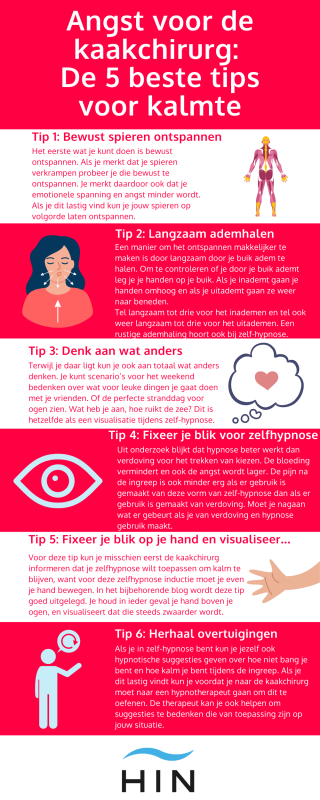
Tip 1: Consciously relax muscles
The first thing you can do is consciously relax. When you notice that your muscles are cramping try to consciously relax them. As a result, you'll also notice that your emotional tension and anxiety will diminish.
If you find this difficult, you can relax your muscles in order . First you move your feet and then relax them. Then you move your calves and relax them. You tighten and relax your thigh muscles for a moment. Then you relax your abdomen, hands, forearms, upper arms and shoulders. Slowly you turn yourself into a rag doll.
Relaxation is the first step for self-hypnosis.
Tip 2: Slow breathing
One way to make relaxing easier is to breathe slowly through your belly. To check if you are breathing through your belly put your hands on your belly. When you inhale, your hands go up and when you exhale, they go back down.
Slowly count to three before inhaling and also slowly count to three again before exhaling. Calm breathing is also part of self-hypnosis.
Tip 3: Think of something different
Sometimes it is very easy to think of something else and sometimes it is very difficult. Maybe you remember when you were in school that your mind was not in it. You were fantasizing about what to do after school until suddenly a teacher called you to order. Or that moment when you "wake up" in the car and have no idea how you got through the last 10 minutes.
While lying there, you can also think about totally different things. You can think of scenarios for the weekend about what fun things you're going to do with your friends. Or envision the perfect beach day. What are you wearing, what does the sea smell like, what kind of people are around you? Are there any birds stealing French fries from you?
This is the same as a visualization during self-hypnosis.
Tip 4: Fix your gaze on a particular point
When fixing your eyes, it is important that your eyes look upward. You don't move your head for this, but you do move your eyes. This can make you feel sleepy and also make you feel focused. When you look "up" you feel this at the top of your eyes.
To choose a point, you can look for a picture, shadow, dot in the wall or just a particular place on the wall or ceiling.
During the eye fixation, also keep breathing well through your belly. If all goes well, this will happen naturally. Also, don't look away while fixing your eyes. Some people report that their vision becomes somewhat cloudy. If you need to blink your eyes do so, but without losing your focus on the point. Also, try to just keep your eyes open.
Scientific research shows that hypnosis works better than anesthesia for tooth extraction. Bleeding is reduced and anxiety is also lowered(1). The pain after the procedure is also less severe when this form of self-hypnosis is used than when anesthesia is used. Just imagine what happens when anesthesia and hypnosis are used.
In addition, hypnosis can also be used for people who are allergic to anesthesia(2).
Tip 5: Fix your gaze on your hand and visualize...
For this tip, you may want to first inform the oral surgeon that you want to use self-hypnosis to stay calm, because this self-hypnosis induction requires you to briefly move your hand. You lie down on the chair and first use tip 1 and 2. Relax and breathe through the belly. Next, you use the hand you always use to hold things and hold it about 30 centimeters in front of your face. You focus your gaze on your hand and squeeze your fingers together stiffly. So your hand is open, but your fingers are sticking together. Then you start visualizing that your fingers are right apart (but so they are not) and that with each breath your hand moves closer to your face (but so it does not). You visualize your hand getting heavier and heavier and how nice it is when it is allowed to relax. When the hand has come to your head visualized, you may finally relax it in real life and put your hand on your belly.
This technique was also examined in the same study of hypnosis against pain, bleeding and anxiety while visiting an oral surgeon for wisdom teeth removal. This technique also worked better against pain, bleeding and anxiety than local anesthesia alone.
Tip 6: Repeat beliefs
If you are in self-hypnosis you can also give yourself hypnotic suggestions about how not to be afraid and how calm you are during the procedure. If you find this difficult you can see a hypnotherapist before you have to go to the oral surgeon to practice this. The therapist can also help you come up with suggestions that apply to your situation.
For example, you can repeat:
- I am calm.
- This intervention makes my life better.
- I am very good at relaxing.
- The oral surgeon wants the best for me.
Through these suggestions, you influence your own behavior during the procedure and the beliefs you have about the oral surgeon. No dentist or oral surgeon is out to hurt you or ruin your teeth. If you have beliefs that question good intentions, it is important to address them with logical suggestions.
Using these 6 tips will help you get through your oral surgeon's appointment. If you want, you can practice the exercises at home first or with a hypnotherapist before going to the appointment.
Want to learn more about how hypnosis can improve your life? Then come to the seminars or check out Hypnosis Institute Netherlands' training courses.
Also pin this handy infographic as a reminder:
Sources:
1. https://www.hindawi.com/journals/prm/2017/1434015/
2. https://www.tandfonline.com/doi/full/10.1080/00029157.2016.1172057
http://www.jcmfs.com/article/S1010-5182%2812%2900224-7/abstract?cc=y
http://www.selfhypnosistalk.com/how-to-use-eye-fixation-for-self-hypnosis/