Externalizing or shrugging off. People who do this I also call shearers. "I have PTSD, I have depression, I have anxiety disorder. I don't believe in labels. I fight that. It takes so much energy out of me. Then I find it kind of easy to say, I'm doing this."
I agree. It's easy to say someone is doing it themselves, though. With this response, all you see is that there is immediate externalization again. The problem is immediately put off again.
That's the Don Quixote strategy. Don Quixote went to fight against windmills because he thought they were giants. He believed in something that didn't exist.
People who have this kind of response who do the same.
Who first say, "I don't believe in labels."
But by mentioning labels, you do unconsciously assume that labels exist. Indeed, it does not exist as a thing. It is something you do.
Then people also often say that the body has a memory. That something is stored in your body.
"Yeah, so? So who does that? You!"
So it's still something you do. Then when people still subtly shrug it off, "It takes me energy." Energy you can't grab either. So you're fighting something that doesn't exist as a thing.
You're fighting like a Don Quixote against a giant that doesn't exist. You are fighting something that has been conceived. Maybe you didn't invent it, but someone else who then tells you about it or has said that's your problem.
Of course, you may have gone through all sorts of things that cause you to do things now that make you feel uncomfortable, make you feel afraid, or perhaps make you afraid to even leave your house.
I get that. Whether it makes sense can be debated. For some things, though, there are things that are not useful for the rest of your life.
For example, if you see people being murdered around you, including your family, this can start to make you feel very f*cked up for a time. You don't have to be a psychic to predict that.
But this feeling is ultimately something you do yourself. No matter how logical it is.
The butcher or the baker doesn't do this, you do this. That sounds really harsh, but on the other hand, it's nice.
Because if you do it, it also means you can do something else.
But it starts with doing. For example, you no longer say you have it, you say you do it. So this starts in your language.
If you can say to yourself, "I'm acting stressed."
Then opportunities open up because you can do something else.
If you say "I have a lot of stress," you're going to fight it like a Don Quixote. Then you're fighting a giant that doesn't exist.
It's super valuable when you realize this for yourself. That you are doing something instead of having something. Because then you can change it, too.
There are three steps you take to stop externalizing your problems and claiming ownership.
Step 1: Do
The first step is to claim that your problem is something you do. That you can distinguish fact from suggestion.
That's important.
Step 2: Thinking
Next, you may be thinking, "Why am I doing this?"
What does it get me? What do I want to avoid?
Is it still necessary for me to avoid it because it brings some benefit?
Step 3: Dare
Dare to let go of your past. Dare not to blame anyone. Dare to truly understand that not only you, but everyone has a story that causes you to do less than helpful things from time to time.
Dare you to.
If you've done all this, thin you can make the change. By then, it often doesn't matter what you do.
My favorite way to solve this is with hypnosis and then with regression. In regression there are these steps.
But other techniques are also fine to stop externalizing, as long as you claim your problem, even if you don't know how to do it differently.
Also listen to this podcast:
https://www.buzzsprout.com/195236/2021433-afschuivers?play=true
In fact, what often happens when you don't do this is that you begin to externalize your problem. This means you start showing inappropriate behavior[1], but always have the excuse that it is because of the problem you have.
For example, you start using drugs and say it's because of your depression. Or you get antisocial behavior and say it's because of your adhd.
Not everyone is comfortable with that, which can mean it affects the friends you have and the work you have.
Claiming your problem and finding a way for you to do things differently can therefore help you get your life on track despite your problem.
This takes guts, this takes practice, but it can be done.
You may notice that you are often unaffected by the problem you are having, until the moment when you experience stress. Then you can no longer control impulses to become aggressive or impulsively do something anyway[2].
Regression against stress triggers your problem
Therefore, it may also be helpful to take a closer look at stress triggers and how they combine with your problem. Do you suffer more from adhd or anxiety or depression when you get busier at work? When your relationship isn't going well? When you face unexpected changes?
Because even this depends on your beliefs about things worth stressing about.
Because when have you ever thought that when you get busy or when things get tough, expressing your problem in your behavior is the solution to reduce stress?
This is another thing you can figure out with regression.
So what do you do with regression now? With regression, you are first put into hypnosis by the hypnotherapist. Then you are suggested to go back to the first moment when your problem arose (or in the case of stress, the moment when it became something stressful).
Then you can revisit this moment in many ways. Depending on your problem and how you are, this may vary. For example, some people are suggested to empathize with other people in that moment. Other people get the suggestion to have their adult self talk to their younger self in that moment. So during the regression, you get the suggestion from your hypnotherapist to do something with it.
This can completely change your interpretation of that moment and remove your problem from your subconscious. Some negative feelings disappear as a result. You then visualize your life up to that point without those negative feelings.
This alone can make you act differently after the hypnotherapy session.
In addition, you can repeat the exercises you did with the hypnotherapist with self-hypnosis. Sometimes you are also given an mp3 to take home for this to help you with this. This can allow you to solve your problems even without direct help from the hypnotherapist[3].
Hypnosis Against Externalization
Researchers also indicate that mindfulness hypnosis can help reduce stress. In doing so, they encourage exploring hypnosis for reducing externalizing problems, depression and chronic pain[4].
For example, with irritable bowel syndrome, which is quite a real problem, hypnotherapy is often already used to calm down and experience a greater sense of control. Research shows that this also helps children and young adults to reduce externalizing their problem[5].
Preventing you from externalizing problems too much is important for several reasons. On the one hand, it allows you to solve your problem so that you suffer less. On the other hand, it also prevents your environment from being bothered by your problems and from losing people you need for your survival, such as your colleagues.
You can use hypnosis to make the mind shift from "I have it" to "I do it." This helps you stop externalizing problems and take a look at how you can deal with problems in a different way.
Hypnosis can help you with this process and in doing so also directly helps against stress that can trigger externalizing problems.
Want to learn more about how hypnosis works? Then come to the free online master class on hypnosis.
Want to get started right away to help yourself or others? Then enroll in one of our training programs.
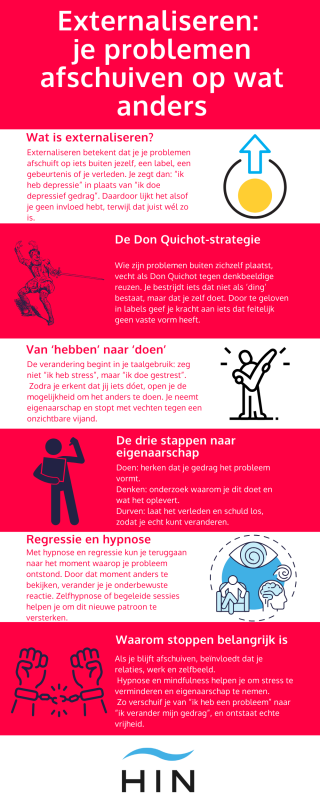
Also pin this handy infographic as a reminder:
[1] https://www.ncbi.nlm.nih.gov/pmc/articles/PMC3091963/
[2] https://www.sciencedirect.com/science/article/abs/pii/S0191886913001906
[3] https://www.tandfonline.com/doi/abs/10.1080/00207148308406620
[4] https://www.tandfonline.com/doi/full/10.1080/00207144.2020.1722028
[5] https://www.researchgate.net/profile/Marjolein_Blink/publication/23133540_S1050_The_Use_of_Complementary_and_Alternative_Medicine_in_Pediatric_Patients_with_Functional_and_Organic_Gastrointestinal_Diseases_Results_from_a_Multi-Center_Survey/links/02e7e518be95faf2d2000000.pdf#page=133