

Ownership comes when you start doing things. You do something yourself and that already makes it yours, but it goes beyond that. The things you have, for example, you see as something you do too.
What is ownership?
Ownership literally means you own something. For example, you own a house or something.
Mentally, ownership is another thing. For example, you feel ownership of the work you deliver or the things you do. You feel ownership of the successes at work, but also ownership of the things that don't go well.
So can you do the same with your health. You take ownership of your body and mind when things are going well. You can also take ownership when things are not going well. This means that you then go and see for yourself what works for you to still get the best out of your life.
Ownership: having and doing
For example, you are holding something and you can let go of it. For example, when you grab a glass or have a book and put it away again.
You also have other things you can't literally grasp, such as motivation. This seems like a thing, but you can't grasp it.
It may seem like something you either have or you don't, but ultimately you motivate yourself or get motivated. Surely it is more of a verb than a noun.
They have made a process to a thing. You have to do something for it, after all. Inspiration may happen to you, but you still do it yourself. You get inspired, so you do something.
The idea that you are doing something for yourself gives you ownership. This gives you ownership of what you do, whether it is something good or bad.
Motivation, depression, compulsion, anxiety, or adhd, you can't grasp it all, but you can say somewhere that you do. This may not feel like it, because you are unconsciously doing so rather than consciously.
You act busy, you get distracted. So how do you do it? For example, I know people with adhd and then I ask if they are ever focused. Yes they are, then they can get all worked up about the subject. So apparently some people with adhd are especially distracted when they don't care.
Then you find out that there are a few things you like and the rest don't interest you. This is true for many people, just think of the 80/20 rule.
Most of the things we do may not make sense, or we don't think are very important. Yet we do them.
Someone with adhd doesn't feel like doing something, is immediately distracted and doesn't do it. That person may also have a better sense of what he does or does not want to do. So this is actually better.
This starts with ownership. I once helped someone with adhd and when he figured out for himself what he was doing now he changed all sorts of things. He changed his diet, he focused more on things he enjoyed, and now he no longer does adhd.
All by taking ownership of his adhd. He even stopped taking medication for his adhd.
Getting help after ownership
This seems easier said than done. But if it were easy, everyone would be doing it. Like eating healthy and exercising. None of this is easy.
In this regard, it is much easier to say you have something and can't do anything about it than to take full responsibility. That's easier than taking ownership.
There's nothing you can do about it
Is that even true? Of course you can't help it if your brain has developed differently or if you're out on a limb. This is just what it is.
Still, it's linky to say you can't do anything about it, because that implies you don't have to do anything. Then you are shifting your problems, for example, to the adhd, to missing a limb or to your depression or something. Or even blaming it on your parents, it's because of your upbringing or because of your genes.
By taking ownership, you can start to change.
Now you may be wondering how? The great thing is that you don't have to do this on your own. You can always ask for help to live healthier. I also have my group of friends, coaches and my crossfit box, so I don't have to take the steps on my own to do what I feel I need to do. Those things can help you tackle things differently than you've done so far.
That way, you make yourself better. You can also go to a doctor, they treat you, they help you that way, so you have the greatest chance of healing yourself. There you get advice and by carrying it out you heal yourself.
By taking ownership and saying "I do," many things can happen that will help you heal yourself.
Also watch this video on ownership:
Ownership and health
Not only with mental problems, ownership can help you take steps to improve your life anyway.
For example, for people who do not feel the connection to limbs that for some reason no longer respond well, the sense of ownership can be generated by a kind of robotic hand that can still be controlled with the brain.
This is important for researchers who have used this to find out that feelings of ownership in the brain cause all kinds of activities[1]. This is very interesting because you can also use hypnosis to stimulate all kinds of activity and even inactivity in the brain.
When you look at sports, losing a sense of ownership can cause children to quit, for example. This can be the case when they play soccer on a poorly performing soccer team or when parents put pressure on the child[2].
Ownership and work
Feeling ownership at work is also important. Do you feel the company you work for is somewhat "yours" even though you don't own it? Then this will help you to be more satisfied with your work, bond more with your work and even feel more confident[3].
Strengthen ownership
The first important tip for strengthening feelings of ownership is to say you are doing something instead of having something. By doing so, you take ownership of your own health.
In hypnosis, taking ownership of your emotions is an important part of making hypnotherapy successful. Especially when gestalt therapy is used.
The person under hypnosis is made aware of certain emotions and beliefs associated with the problem through suggestions. With this you also accept that you are doing something yourself and that you can change it yourself. This even helps you release inner conflicts[4], which is necessary to move forward in your life.
This may also mean taking more ownership of your memories. Some people remember things about their lives as if it happened to someone else[5].
Another way to take ownership of memories and the rest of your life is something we do with regression. With regression, you go back to a moment in your life that caused you not to do certain things when you wanted to do them. You then - while in hypnosis - retrieve the memory of the moment when a certain belief arose that is not helping you now.
Next, you start doing something with that memory. Because often it was a moment in your life when you were a child and then that moment just happens to you. You interpret it with the knowledge you have then. With regression, you go to that moment again and interpret it again, but with the knowledge you have as an adult.
You show more ownership over the event. For example, by empathizing one more time with other people who were there or by completely changing the memory in your mind.
This can be enough to change beliefs about how life works and how you can function. In doing so, you often free yourself from obstacles and can take real ownership of what you do and how you want to do something.
Want to learn more about hypnosis? Then come to the free online hypnosis master class.
Or sign up directly for one of our trainings or events.
Like our upcoming event to launch The Three Minute Reset: Click here.
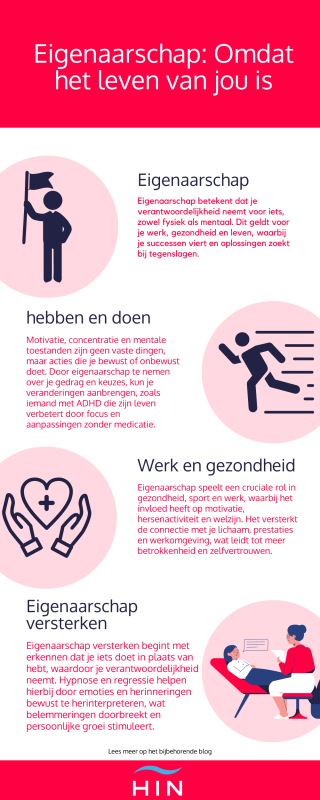
Also pin this handy infographic as a reminder:
Sources:
[1] https://www.sciencedirect.com/science/article/pii/S0010945216302751
[2] https://www.researchgate.net/profile/Peter_Witt5/publication/326910870_Why_ChildrenYouth_Drop_Out_of_Sports_-_Journal_of_Park_and_Recreation_Administration/links/5bf058394585150b2bbdd454/Why-Children-Youth-Drop-Out-of-Sports-Journal-of-Park-and-Recreation-Administration.pdf
[3] https://onlinelibrary.wiley.com/doi/abs/10.1002/job.249
[4] https://www.londonhypnotherapyuk.com/publications/Gestalt-Therapy-Paper.pdf