


Can you have enough possessions? When is enough enough enough? Is your credo to have and keep things? Then chances are you suffer from an addiction to collecting or you have a collecting disorder. To see what you can do against this collecting disorder, in this article I will go over what it is, what causes it and what you can do with that knowledge to stop collecting.
What is a gathering disorder?
Gathering disorder was linked to obsessive behavior disorder (OCD) in the past, but today the two conditions are also seen separately. People with OCD may suffer from collecting rage as 1 of the symptoms, but it need not be the main symptom(1).
If you suffer from accumulation disorder, you have difficulty getting rid of possessions, regardless of the value of those possessions to others.
A piece of paper can already be something you don't want to throw away.
In addition, you collect so much stuff that your entire house is filled to the brim. In extreme cases, you have to make a path in your house between piled up stuff. You can't get to some items in an easy way because there are meters of other items in front of them.
The functions of some rooms are also off limits due to the objects in them. For example, the living room is widely used for receiving visitors, but because there are all kinds of things in the living room, there is no more room for visitors.
A study room also often can no longer be used for work because the desk is overloaded with other objects that make it impossible to use pen and paper or a computer.
Working from home is not something that makes the true collector happy.
The collecting frenzy and its impact on the use of your home also affects the social relationships you have. In some cases, it can even pose a problem outside the home by preventing you from using the bathroom properly.
Poor hygiene is not something you make friends with.
In the process, the safety of your surroundings can play tricks on you. Accumulated items can fall on you or your visitors.
Stuff collecting can go hand in hand with other mental problems, such as depression, OCD or even schizophrenia.
Also, it is often difficult for collectors to properly estimate spaces and be able to plan where what fits.
Collecting stuff also affects task performance, but less so than with OCD. Unfortunately, the influence can still be great enough that collecting can bother you at work .
Is a collecting disorder the same as being addicted to collecting?
Perhaps you don't recognize yourself at all in the image of someone with a collecting disorder, but you do feel like you are addicted to collecting something.
People can accumulate the strangest things. Sometimes this manifests itself in a shopping addiction, but you can also be addicted to collecting free testers.
So you don't have to be a typical collector who keeps everything and can't throw anything away at all.
However, you may find that if you want to thin out your collection you have more trouble doing this than you expected. In that case, you do suffer from a collecting disorder.
If you are a true collector, you can often still sell items from your collection to get back something even more valuable (and which is basically from the same collection).
You speak of a problem and an addiction when you think about your collection all the time and suffer from anxiety when you are no longer allowed to collect or when you have to get rid of something from your collection.
Is addiction to collecting the same as addiction to buying?
As can be seen from the criteria, a shopping addiction does not have to be the same as a collecting addiction. If you love collecting, you also want to see your collection. You then become happy with all the possessions in the collection you have.
With an addiction to buying, you are addicted to the feeling of the buying moment. The moment you buy something for yourself you are very happy, but the collection of purchased items need not make you happy at home.
Indeed, all the goodies with the price tags still on them can make you feel guilty for spending so much on your shopping addiction.
Cause of collecting rage?
Certain beliefs can cause you to suffer from collecting rage. Usually, useful items are kept, such as newspapers and packaging. This is because people don't want to waste anything, for example, because of environmental concerns. Or they find certain objects very beautiful and useful and therefore cannot get rid of it, because what if one day you need it anyway?
Fear is therefore often a cause for collecting. In addition, unfortunately, collecting also produces additional anxiety, but of a different kind. Not being able to make decisions is also often a cause for collecting(2). After all, how do you know for sure what can go and what can't?
Oddly enough, some people with an addiction to collecting also suffer from perfectionism, which sometimes manifests itself in fear of failure.
Gathering is most common in people around age 50, but it can start as early as adolescence. For example, you then start collecting broken toys that you cannot part with.
Around age 50, then, collecting can really become a problem.
A traumatic event can trigger object collecting. I once saw a program on television of an old man who had his house completely filled with anything and everything. In his case, this was because he had lost everything in World War II. This made distancing himself from certain things incredibly difficult for him.
Social isolation or loneliness can also be a cause for collecting. Gathering then eases the pain of loneliness.
Solutions to stop collecting
The sooner you intervene with this addiction the sooner you will be rid of it. Cognitive behavioral therapy is often used to stop addictions and has also been studied for this condition(3)(4).
The younger you are, the faster the treatment kicks in.
In doing so, women are also more likely to get rid of collecting faster than men.
There is also a correlation with the number of cognitive behavioral therapy moments and stopping collecting, being able to dispose of stuff better and cleaning up better.
Why CBT when you can also use hypnosis?
Research also shows that when you use hypnosis during CBT it enhances the effects of the therapy and the therapy then takes effect even faster than without hypnosis.
Precisely because stuff collecting is linked to unconscious beliefs about safety and waste, hypnosis is the ideal way to get rid of this addiction.
During hypnotherapy, you travel with the therapist to your subconscious. To the source of your beliefs that subconsciously tell you that collecting all the stuff is necessary for your survival.
Then, during therapy, you address whether these beliefs are true.
Then you get tools to place new beliefs in your subconscious that will help you stop your collecting behavior, throw things away and clean up better.
Placing new beliefs to stop collecting, for example, is done through hypnotic suggestions. You can get these from the hypnotherapist and you are often given them as homework to repeat the exercises at home. This is because during hypnosis you are more open to other ideas so you absorb and accept them more quickly.
The effects of therapy are then amplified.
For example, one way to eliminate anxiety when throwing stuff away is to visualize getting rid of stuff.
In fact, during such a visualization, you may already experience anxiety. The hypnotherapist can then teach you techniques that will help you calm down. By staying physically calm, your anxiety also remains controllable and you are less likely to suffer from panic.
Conserve
To stop hoarding, you can also challenge yourself to consume. By buying less, you ensure that you slowly but surely use your stash exactly what it was needed for.
In the process, you save money, which makes many people feel good.
Want to learn more about mental techniques to get rid of addictions or help other people with them? Then come to a playshop and check out Hypnosis Institute Netherlands' trainings.
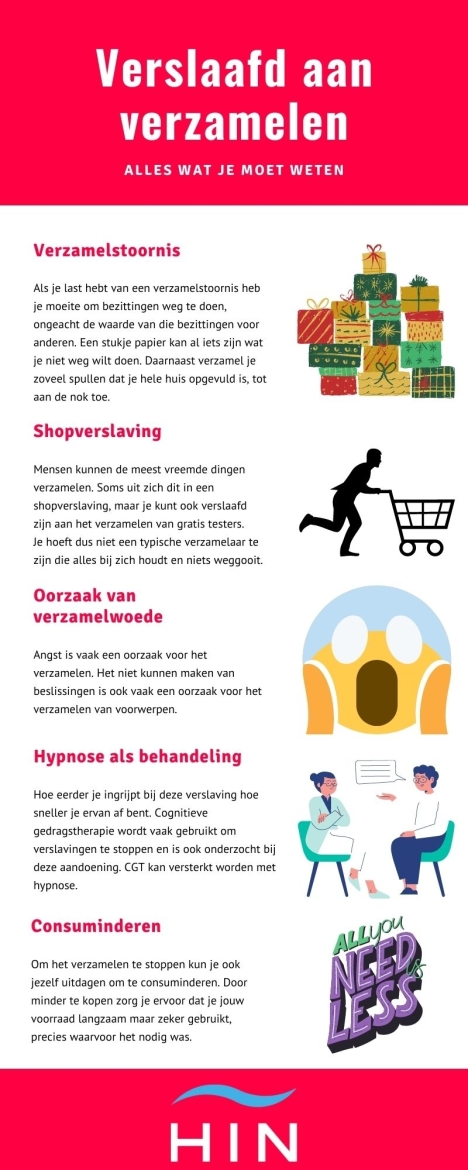
Also pin this handy infographic as a reminder:
Sources:



