

Daydreaming makes you smarter: The surprising science behind daydreaming
You know that moment when you suddenly realize you've been staring outside for ten minutes when you're actually at work? Or that time you were in the car and suddenly couldn't remember how you got to that stoplight? Your mind was elsewhere, wandering to a conversation from yesterday or fantasizing about next weekend.
Daydreaming. You do it a substantial part of your day [1]. Maybe you think it's a waste of time, those moments when your mind wanders and you're just completely out of the here and now. But what if I told you that daydreaming is actually an underrated form of social cognition that helps you move through the world [1]?
What exactly is daydreaming? Your mind wanders freely, uninvited and independent of what you are currently doing. Psychologists long thought it would promote creativity, but the research results turn out to be quite mixed.
In fact, a recent study of 622 Indian young adults shows that daydreaming, while not significantly contributing to creativity, is associated with higher levels of stress, anxiety and depression [3]. So should you constantly suppress your thoughts?
Not at all. Because this is where it gets interesting: not all daydreams are the same. Some forms help you solve problems and give you deeper social insight [2]. Others, on the contrary, distract you from the moment. It's all about balance, and you can learn to find it, for example with hypnosis if you suffer from maladaptive daydreaming.
So why would daydreaming actually make you smarter? How exactly does it work in your brain? And when does it turn from useful to annoying? We'll dive into that in a moment, because the science behind your wandering thoughts is more surprising than you think.
What really happens in your head
Your brain is never truly at rest. Even when you don't seem to be doing anything, it is busy. Research shows that we spend about 30 to 50 percent of our day in our own minds, wandering through inner worlds [1]. This is not wasted time; it is an essential process for how your brain functions.
The Default Mode Network does more than you think
This is where it gets interesting. When your mind wanders during a boring task, something special switches on: the Default Mode Network, or DMN [2]. This complex network of brain regions was actually discovered by accident. Scientists noticed that brains were almost as active during "resting moments" as they were during tasks [3]. The DMN consists of several parts, including the medial prefrontal cortex, the posterior cingulate cortex and pieces of the temporal lobe.
This network forms the neurological basis of daydreaming. It allows you to better understand yourself, recall memories and reflect on your own behavior and experiences. Even more interesting: the DMN makes surprising connections between seemingly unrelated ideas. That's where creative insights come from.
Why daydreamers are better at empathy
Daydreaming is closely related to how you understand others. In fact, the DMN also helps you better understand others. While daydreaming, you are often analyzing social interactions or putting yourself in someone else's shoes [3]. Therefore, people who daydream regularly are often better at empathy.
People who daydream more often score higher on creativity and intellectual ability. Their brains appear to work more efficiently. So daydreaming is not a waste of time, but rather a sign of a well-functioning brain.
Your brain really needs rest
During daydreaming, your brain produces alpha waves (8 to 14 Hz), which occur when you are in a relaxed state. These brain waves are crucial for creativity and processing experiences.
This is why it is so important to give your brain a regular rest. If you work continuously, then the DMN remains switched off while the executive network is active. By taking regular breaks, ideally five to 10 minutes every hour, you give your DMN a chance to get to work.
That explains why your best ideas often come during everyday activities such as showering or walking. Your brain literally needs space to daydream to solve problems in ways that your conscious thinking can't reach. It is as if your brain is working on in the background while you are busy with something else.
Why daydreamers are actually smarter
Many people think that daydreaming is a waste of time. But that is not entirely true, daydreaming can take up to 50 percent of our time and offers several cognitive benefits. In fact, it is a sign of a highly efficient brain.
Your unconscious works harder than you think
When you daydream, your mind accesses information from your unconscious. Different parts of your brain are then activated simultaneously, allowing you to make new connections between seemingly unrelated concepts. Suddenly, you then gain insights or find solutions to problems you didn't consciously figure out.
People who daydream more are generally smarter as well as more creative. Their brain systems also work more efficiently.
Now I understand that this may be hard to believe when you're in the middle of a daydream when you should actually be working. Yet something valuable is happening: your brain is making connections it wouldn't otherwise make.
Spontaneous thoughts as a creative engine
Daydreaming is often associated with creativity for a reason. When your mind can wander freely, spontaneous thoughts arise and are organized into clusters. You combine and associate information in new ways.
The greatest breakthroughs in science and art often occurred during moments of mental relaxation. Paul McCartney dreamed "Yesterday," Einstein developed the theory of relativity during thought experiments. No coincidence, then.
It works because your brain is then not limited by logical, linear thinking. You let go of what "should" and give space to what "could." That is the essence of creativity.
Your dreams come true by seeing them
This is where it gets really interesting. When you daydream about your goals, you visualize successfully achieving them. This process activates the same brain regions as when you actually perform the action. In fact, your brain does not distinguish between what actually happens and what you vividly visualize.
Regular visualization boosts your self-confidence and increases the likelihood of achieving your goals. You program your brain for success, so to speak, and create a mental blueprint. Top athletes, artists and successful entrepreneurs have been using this technique for years to improve their performance.
So taking ownership of your daydreaming also means: consciously choosing what to think about when your mind wanders. Because you do the daydreaming, you too can choose what you do.
When daydreaming gets in your way
Now, I don't want to create the illusion that daydreaming is all roses. For just as a glass of wine with dinner can be relaxing, but a whole bottle causes problems, the same is true of wandering off your mind.
You are there, but also not
You know that feeling when you've been "busy" all day but haven't actually done anything? You stare at your computer, read the same sentence three times, and before you know it, it's already five o'clock. Too much daydreaming causes important information to slip past you and you become less and less connected to what is really happening.
Things get really problematic when you use daydreaming to escape reality. Then you don't learn to deal with real situations and instead become painfully aware of how unhappy you are with how things are now. Not exactly a winning strategy.
When daydreaming becomes a compulsion
A small percentage of adults suffer from what we call maladaptive daydreaming, a condition in which people compulsively engage in vivid fantasies. On average, these people spend at least half of their waking hours in intentionally constructed fantasy worlds.
Might that still sound appealing? It isn't. It creates problems with social relationships, work and study. Research shows that maladaptive daydreaming is often associated with ADHD, anxiety, depression and obsessive-compulsive disorders. In fact, more than half of people with maladaptive daydreaming show signs of OCD.
Your focus disappears like snow in the sun
Excessive daydreaming leads to self-critical thoughts, negative mood and even depressive feelings. Your ability to concentrate deteriorates and you make mistakes faster.
You see this especially with kids in school. They sit there, seeming to look at the teacher, but are actually completely elsewhere. Their parents and teachers then often think they are lazy or not interested. While they just need time to come back to the here and now.
So how do you find that balance? How do you make sure that daydreaming helps rather than hinders you? I'll get to that in a moment.
When daydreaming works against you
You don't have it, you do it. Even with daydreaming. And as with anything you do, you can also overdo it. Daydreaming can then turn from useful to inconvenient.
Dreaming away from what is real
Too much daydreaming causes you to forget important information. You are less connected to your daily life. As a result, you take longer to complete your work, you may not get it done, and that causes stress. But there is another downside: daydreaming becomes dangerous if you use it to vent reality. Then you don't learn to deal with reality at all.
The interesting thing is that you then become more aware of your unhappiness, not less aware. You know you're drifting away, you know it's not real, but you do it anyway. That only makes it worse.
When daydreaming takes over your life
A small percentage of adults suffer from maladaptive daydreaming. These people are compulsively engaged in vivid fantasies and on average spend at least half of their waking hours in intentionally constructed fantasy worlds. This causes problems with social relationships, work or study.
Research shows that maladaptive daydreaming is often associated with other problems: ADHD, anxiety, depression and obsessive-compulsive behaviors. In fact, one study found that more than half of those with maladaptive daydreaming also showed signs of OCD.
Do you recognize this? Then you do. You're not maladaptive daydreaming, you're doing it. And that means you can start doing something else, too.
Why you are becoming less sharp
If you daydream often, your concentration decreases and you make mistakes faster.
You see this especially with children in school. They miss explanations, have difficulty holding their attention. They seem lazy or disinterested, but really they just need time to return to the moment. The problem is that they don't. They keep dreaming away.
So what can you do about it? This is where it gets interesting, because there is a way to get a grip on your daydreaming patterns. A way that may be more familiar than you think.
So what does this all mean for you now? Daydreaming is much more than just thoughts wandering. Your DMN becomes active and your brain makes new connections. Some studies show mixed results about creativity, but it is certain: people who daydream regularly tend to have more efficient brain processes.
You access your subconscious mind, creating insights that your conscious thinking cannot reach. You visualize goals, which enhances your motivation. Your mind makes connections between concepts that are seemingly unrelated.
Hypnosis and daydreaming are very similar. Both are states in which you disconnect from your environment and your subconscious becomes more accessible. The difference? Daydreaming happens spontaneously, hypnosis is focused.
For people struggling with excessive daydreaming, hypnotherapy offers a way out. You learn to take control of your thoughts, break negative patterns. At the same time, hypnosis helps you make healthy dreams come true by aligning conscious and unconscious thoughts.
It's all about ownership. You do the daydreaming, you don't have it, you do it. That means you can influence it, too. You can choose when your thoughts are allowed to wander and when they are not.
Want to learn more about how hypnosis can help you? Join the free master class or register for one of the Hypnosis Institute Netherlands events.
Then take a step toward a healthy relationship with your thoughts and access the powers of your mind.
Because in the end, it's all about: take ownership of your own head. No one else can do that for you.
Key Takeaways
Daydreaming is not a waste of time, but a sign of an efficient brain that makes you smarter by making new connections and generating creative insights.
- Daydreaming activates the Default Mode Network, allowing you to access your subconscious mind and make surprising connections between unrelated ideas
- People who daydream regularly score higher on creativity and intellectual ability - their brains work more efficiently than average
- Visualizing goals during daydreaming programs your brain for success by activating the same brain regions as actual performance
- Too much daydreaming can lead to decreased focus and maladaptive behavior - a small percentage of adults suffer from this
- Hypnosis offers a targeted way to control daydreaming patterns and helps break negative thought patterns
The key lies in finding the right balance: give your brain regular rest to daydream (5-10 minutes per hour), but make sure it doesn't take away from your focus on the here and now. Hypnosis can be a valuable tool here to take control of your thoughts and actually make your dreams come true.
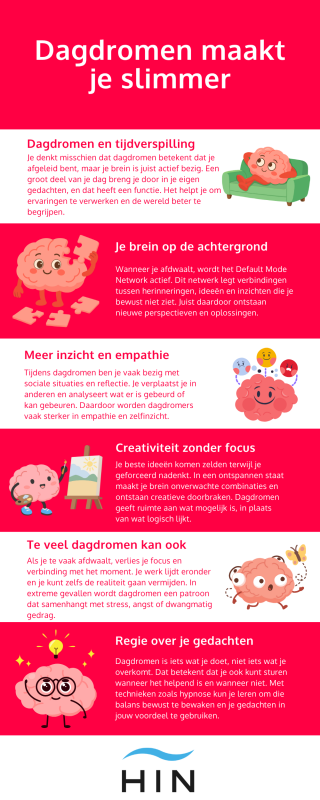
Also pin this handy infographic as a reminder:
References
[1] - https://compass.onlinelibrary.wiley.com/doi/10.1111/spc3.12288
[2]- https://pmc.ncbi.nlm.nih.gov/articles/PMC6246840/
[3]- https://pubmed.ncbi.nlm.nih.gov/26869943/
[4] - https://ojs.ijcp.in/IJCP/article/view/572
[7] - https://libstore.ugent.be/fulltxt/RUG01/002/165/747/RUG01-002165747_2014_0001_AC.pdf