


Ladies and gentlemen, let's talk about the truth. I'm talking about the truth about trauma. A subject that hardly anyone dares to talk about, at least not in the way we are going to do today.
Because let's face it: when we talk about trauma, we often dive straight into heaviness. We talk about terrible events, about grief, about pain that never goes away. But what if I told you that the biggest misconception about trauma is right there? In the focus on what happened?
Watch the vlog:
Trauma: it's not because of the event
Yes, you read that right. And I know this is a hard sell for some people. Maybe you're already in the scaffolding, ready to say, "Edwin, how can you say that? Do you even know what I went through?" And believe me, I know terrible things happen in the world. But the core truth that almost no one talks about is this: trauma is not due to the event itself.
Imagine, and this is an example I often use because it's so nice and simple, you go to a party with a friend. The exact same party. The same music, the same snacks, the same people. Afterwards I ask you, "How was it?" And you say, "Great! What a top party, that music was fantastic." Then I ask the other person, and he says, "Terrible. What a racket, and those people were exhausting."
Same party, two totally different experiences. So is one party "good" and the other "bad"? No. It's the experience. "Yeah, but Edwin," I hear you thinking, "that's taste. That has nothing to do with trauma, does it? If I' ve been beaten by my father and so has someone else, we're going through the same thing, aren't we? Then we're both traumatized, right?"
And therein lies the fallacy. Because although the event is terrible (let's make no mistake about that) in practice you see something very interesting. There are people who remain traumatized throughout their lives by such a childhood. And everyone says, "Logically, that's that father's fault." But there are also people who went through exactly the same thing, were systematically beaten, and now feel fine. What's more, there are people who got their strength from that very thing.
How to. If the event caused the trauma, then everyone who experiences it should have the same result. But they don't. What matters is how you experience that event. How your brain processes that information.
The glasses through which you look
Our brain is a fascinating tool. And the beauty is: we have a choice in how we use that tool. We can view the world through different lenses. Every question you ask about an event forces your brain to look through a specific lens.
When you ask yourself the question, "Why does this always happen to me?" or "Why did this happen to me?", you put on glasses that immediately put you in the victim role. Your brain starts looking for answers that confirm that feeling. Your perspective becomes narrower and narrower.
But what if you ask a different question? What if you ask, "What is the gift hidden in this?"
I know, that may sound floaty or even provocative to some if you're in deep pain. But you force your brain on a different track with this. You force yourself to look at the situation differently. And of course, you have to want it. If you want to hold on to your rightness and your pain, this won't work. But if you're done with it, if you want to leave that ballast behind, then this is the way.
Ask yourself: what did that event give me? Who have I become because of what I went through? Maybe those unpleasant experiences have made you into someone who absolutely does not want to hurt other people. That is an incredible benefit to the world around you. That is strength.
The power of repetition
There is a quote from my old trainer Richard Bandler that has always stuck with me. He once said to someone who had been suffering from an unpleasant experience for years, "Gee, now you've been abused once, but you let it go through your mind constantly. Every day you think about it maybe a hundred times. Wasn't that one time enough?"
The person, of course, was in shock. "How dare you say that?" But reality sank in: yes, that one time was more than enough. Why do we do that to ourselves? Why do we reproduce that event thousands of times in our heads?
What do you think that does to your identity? With your self-confidence? With your self-love? If you mentally repeat a negative event thousands of times, you've been mentally beaten up thousands of times. While physically it may have happened only once. Your brain does not distinguish between a vivid memory and reality. For your nervous system, it is happening again right now.
Why talking often doesn't help
This is where many mainstream therapies miss the mark. Talking about your problem often only makes it worse; there are even psychology scientists who are now taking a critical look at this[1]. Why? Because you retell the story, revisit the emotion, and only strengthen the neural pathways of that trauma. You're creating an ever-increasing defense mechanism.
And then you have methods like EMDR. Don't get me wrong, EMDR can work great[2]. But it has a drawback: your brain instinctively wants to get away from that unpleasant feeling. No one wants to relive that pain. With EMDR, you have to hold onto that image and that feeling while distractions are offered. If you can do that, it's great. But many people can't hold that image because their survival mechanism pulls them away from it. And if you can't hold it, you can't resolve it.
Grasping to let go
In the hypnotherapy we teach, we look at this differently. Hypnosis also works significantly against PTSD symptoms, for example[3].
So how long does it take to let go of something? People often say, "Years, Edwin. That takes years of therapy."
Nonsense. Letting go takes a second. But, and this is crucial, in order to let go of something, you must first grasp it.
Look at your hand. If I ask you to let go of your phone, but you don't have a phone in your hand, you can't let go of anything. You have to grab it first. It works the same way with trauma. You go back to that moment for a moment. You relive it, but very briefly. Five seconds. You grab it, you feel, "Okay, here it is," and then you release it immediately.
That's the power of hypnosis. In trance it comes up, you can't run, you grab it and we "reprint" the experience instantly. We give your brain a new perspective, so you 'grow up again' with a different feeling, so to speak.
The physical toll of trauma
Don't underestimate the impact on your body. I remember a woman who came to me, her body was full of inflammation. Her inflammation levels in her blood were going through the roof. She had tried everything on medication, but nothing helped.
Research also shows that childhood trauma increases certain levels of inflammation in adult life[4].
During one session, we came to a very intense situation from her childhood. Something she had tucked away deeply, but which her body was still "screaming" about. We addressed that situation. She relived it very briefly, grabbed it and released it under my guidance. After the session, she felt like a limp doll, so relaxed was she.
A few weeks later, she had to have her blood drawn again. Guess what? Her inflammation levels were completely normal.
This is what happens when you remove the emotional component, the traumatic perception. You can take medicine all you want, but if the source is an unprocessed trauma, you're mopping the faucet.
Summary
Ladies and gentlemen, it's never the event. It is always your perception of the event. And I know this is sensitive. I don't say this to shortchange victims. In the moment itself, the pain is real and terrible.
But if pain still controls your life years later, that's something your brain does. Not consciously, of course not! If you could consciously change it, you would have done so long ago. So would I.
Most people do not come through life untraumatized.
But it doesn't have to stay with you. You don't have to lug around that ballast. Change your perspective. Grab it for a moment, release it with the right guidance, and become the director of your own life again.
Did you find this an interesting story? If so, please leave a thumbs up or leave a comment on your favorite channel. I read them all and I love hearing what this does to you. And do you have a question you'd like to see addressed in a future podcast? Let me know.
Learn Hypnosis
Instead, do you want to help people get rid of trauma? Then knowledge of hypnosis is incredibly helpful. Come to the free master class for an introduction.
Or register directly for one of my events and trainings.
Have a question about the training? Schedule a 1-on-1 consultation here.
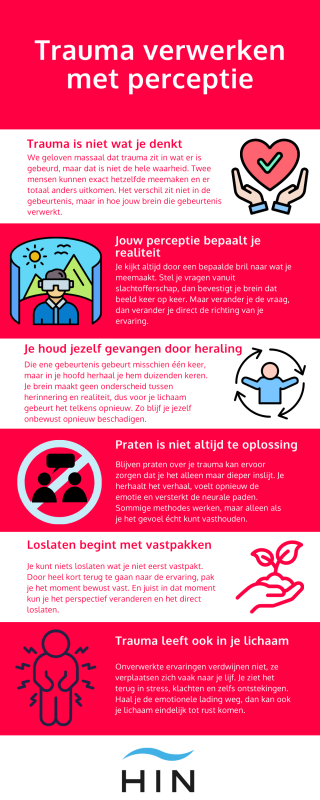
Also pin this handy infographic as a reminder:
Sources:




Cynthia
on06 Apr 2026