


Do you know one of those guys who is in the friendzone and complains about this because he is the perfect guy. He is sweet, kind, compassionate and social according to himself and if she could see the same now they could be happy together, but despite her search for the perfect guy she just doesn't see him. These kinds of thoughts suit the nice guy who actually isn't at all. There may even be communal narcissism.
In this blog, I explain more about them and how to deal with them.
What is a narcissist?
A narcissist is someone who places themselves above other people without any clearly identifiable reason. The narcissist thinks they’re absolutely the best. He or she is the best, the most likable, and believes they deserve priority over other people.
Also, the attention they want to earn is often more than they actually deserve. If the narcissist receives too little attention, he may become angry. In addition, narcissists manipulate people for their own purposes[1].
What types of narcissism do you have?
You would think you could recognize a narcissist from miles away. Unfortunately, this is not the case, this is because they know exactly what the unwritten social rules are and use them to their advantage.
The most well-known type of narcissist is the one who suffers from feelings of grandiosity. This narcissist bluffs his way through a job interview for a top position and loves to brag about outstanding results he has (or hasn’t—but claims to have ) achieved.
A lesser-known form of narcissism is the hidden narcissist. This one is often more withdrawn. Thinks he is grandiose, but does little else with this. For example, this is the unemployed narcissist who is only willing to work for a top job and not before, as a result of which he never achieves that top job and therefore never actually works.
Then you have the communal narcissist, this one uses social ties and skills as an excuse to get all the attention instead of being good at something business-related.
Difference between normal narcissist and a communal narcissist
The communal narcissist and more normal narcissist both feel they are entitled to more attention than average, but have different explanations for this. Whereas the normal narcissist feels that his above-average sense of intelligence entitles him, the communal narcissist feels that his above-average sense of being social entitles him[2].
This does not always mean that the communal narcissist is actually more social than the average person. He just thinks so, and that is sometimes the problem with the nice guy in the friendzone who thinks he deserves the girl because he is so nice, without really having much proof.
Above all, the feeling of giving yourself to other people makes the communal narcissist feel that he is better than the average person.
So how do you become a nice guy?
The annoying thing about being a communal narcissist is that you pretend to be super social, but subconsciously you know super well that you are not as social as you pretend to be.
There are ways to align your conscious and subconscious minds, which can help reduce your narcissism. Research even shows that engaging in social behavior deepens your relationships[3] and that this effect is even stronger in people who struggle with narcissism than in those who do not.
If you think you’re already a nice person—or even the nicest—ask yourself how often you actually help someone. How often do you literally roll up your sleeves to help a friend clean up? How often do you lend a listening ear without talking over them?
If you now realize that this isn’t actually that common, you don’t have to go around telling everyone, of course. But you can literally change your behavior. In your relationship, you can ask your partner about their day and actually listen.
A hypnosis expert can help you practice this and truly keep your attention focused on the conversation. This can be done, for example, with hypnotic suggestions that you repeat at home or listen to during self-hypnosis. These suggestions might include:
"If your mind wanders during the conversation ask nicely what was said and focus back on the conversation."
"When someone tells you their problem you listen and don't tell them someone else's problem."
"You respond to what is being said, not to your own thoughts," he says.
"You are allowed to be open about your own problems," he says.
Why not act like a real nice guy?
Even though you know what you can do to be an actual social and nice person as you can claim if you are a communal narcissist, there may be something blocking you from actually doing that.
In many cases of narcissism, underlying insecurity and shame are the reasons behind the inflated sense of self-confidence. A hypnosis expert can help you identify the source of your insecurity and eliminate it. This can be done, for example, through regression therapy. Through regression, you go back to the moment that created a belief that is harmful to your self-confidence—a belief that causes you to project this to the outside world and claim that you’re actually very sociable.
Beliefs like these often originate in childhood. For example, perhaps you saw how a classmate became super popular after helping a sick classmate, and you said that you’d helped someone too—and the ball started rolling from there. Since children often make illogical connections, it could also be a completely different event that led to these unhealthy beliefs. Because you can now look at it with the perspective of an adult, this can already change your beliefs, allowing you to put your words into action more quickly.
Dealing with a communal narcissist
Are you not a communal narcissist, but are you dealing a lot with someone who brags about his/her social abilities when you don't always see it? Then there are ways to deal with this.
Confront the narcissist's behavior
Some narcissists do seek help to suffer less from this. Ultimately, many people do not want to deal with a narcissist and this does have negative effects on his life. By confronting him or her with the behavior, you can see if he or she is open to change and to help[4].
When someone admits they have a problem, they are also more likely to stick with treatment.
Be open about your feelings
When the communal narcissist has a moment to prove he/she is truly social, being open about how you feel is important to improving the relationship. By revealing how you feel at times when he/she is being narcissistic, that is also a time when that person can identify with you.
For example, indicate that it hurts you that he says he is a good listener, but you are ignored in the meantime.
Being quiet is more likely to provoke misunderstanding. So if you've had a busy day at work, you can be open about this too, so it will be taken into account.
Hypnosis helps
Whether you are narcissistically inclined or living with a narcissist. Hypnosis can help in both cases. In fact, among other things, hypnosis helps you develop the self-confidence you need to confront yourself or others and do so in a healthy way.
There are all kinds of techniques that can be used for this purpose. For example, if you need to take a step, taking this step with a guided visualization can first improve your imagination. Because you "see" yourself taking the step, so to speak, the likelihood of you actually performing that behavior increases.
It doesn't matter if this involves actually helping people or confronting someone with narcissistic behavior that allows work to be done on a healthy relationship. Post-hypnotic suggestion can also help you change your behavior.
In addition, regression and hypnotic suggestions can change unhealthy beliefs, making you more social and assertive.
Want to know exactly how this works? Then come to a free masterclass to get started.
Or attend one of the events or training programs offered by the Hypnosis Institute of the Netherlands.
If you have questions about the training, schedule a 1-on-1 consultation here .
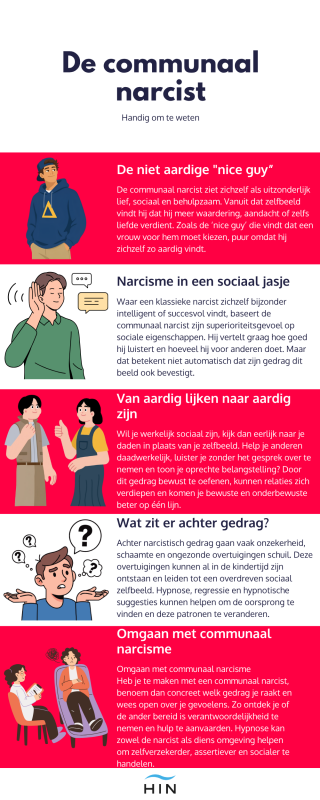
Also pin this handy infographic as a reminder:
Sources:
[1] https://www.psychologytoday.com/intl/basics/narcissism
[2] https://www.psychologytoday.com/intl/blog/finding-new-home/201812/the-communal-narcissist-new-kind-narcissist
[3] https://journals.sagepub.com/doi/abs/10.1177/0146167209340904
[4] https://www.psychologytoday.com/intl/blog/romance-redux/201406/7-strategies-dealing-the-narcissist-in-your-life


