Self-reflection is one of the most important parts of self-development and personal growth. If you have a problem, self-reflection can show you where the problem came from and that can help you determine how to address the problem in the future so that it is no longer a problem.
What is self-reflection?
The meaning of self-reflection is that for a moment you yourself become an object for yourself to reflect upon. This is typically human and mentally it can be quite challenging. You mentally distance yourself from yourself and the situation you find yourself in in order to look at what you are doing now and what is useful to do next.
Very briefly, "dinner" can lead to a moment of self-reflection. You realize, for example, that you are hungry, or that it is almost time for dinner, and then you may have all kinds of thoughts about this that cause you to take the action necessary to finally enjoy a nice dinner. Naming "dinner" is then a moment of self-reflection[1].
Triggers for self-reflection
As you can see, there can be a certain trigger for self-reflection. Usually you are triggered when you notice that something is blocking your path to a certain goal or when you need to make a choice. This can be about something small like "What do I have for dinner?" or it can be about something bigger like "Should I stay with my partner?".
Sometimes self-reflection takes only a moment, but sometimes this process can take years. In the latter case, for example, you may think with some regularity about the solution to a particular problem and your role in it.
Sometimes other people in particular can provide a moment of self-reflection. For example, you get feedback on how you are doing and that can trigger reflection in yourself to see if you understand that feedback or not. You can then empathize with how the other person sees you and reflect on yourself that way.
Then there is also a theory very similar to that your self-reflection begins when you receive feedback from someone else. In fact, you can also start reflecting on yourself when you don't get recognition from someone else, for example. You then have a kind of social battle and in order to win it you start reflecting on yourself to find out what you are doing wrong and what you should be doing to still get that recognition.
You can also reflect on yourself without that feedback by having a kind of internal conversation with yourself, so to speak. In that case, for example, you can imagine how other people might react to you in order to reflect on yourself in that way.
The use of symbols can also trigger self-reflection. For example, if you are in conversation with someone and you describe someone else in symbolic terms, this can cause you to also look at yourself in those terms to find out whether or not you are similar to that other person.
The researchers' description quotes someone talking about tourists, for example, as people who take pictures, buy souvenirs and just stop by the destination. These were then symbols for tourists and this allowed the woman talking about them to verify whether she herself was just a tourist or not[2].
Why self-reflection is important
Self-reflection is important for gaining insights into yourself, which in turn helps you to develop yourself. Being able to identify your strengths and weaknesses can give you an entry point on what you want to work on for your self-development[3].
So reflecting on yourself is important for the life you create, both business and personal, and is important if you want to improve your own behavior. In fact, it is a way to become more aware of yourself, and that is the first step toward change. Being good at self-reflection helps you reduce anxiety, depression and stress and be better at regulating yourself and achieving goals[4].
In addition, self-reflection on how and what you learn, such as when you study, can help you get better grades. However, this has only a small effect[5].
Lack of self-reflection
If you find it difficult to apply self-reflection, it can get in the way of your personal growth quite a bit. This is because there is then a chance that you will not take responsibility for your own behavior and blame other people or a higher power for not achieving goals and the like.
If self-reflection causes less depression, anxiety and stress, lack of self-reflection causes more stress, anxiety and depressive symptoms.
In doing so, your grades may also be lower if you study but find it difficult to reflect on your way of studying.
Self-reflection exercises
There are multiple ways that can help you improve self-reflection. Herewith you will get some ways and exercises for increased self-reflection.
Journal keeping
Keeping a journal is a way to reflect daily on your life and yourself. Research shows that people who keep a journal are better at self-reflection than those who do not keep a journal. (source 4)
Gratitude
An exercise that is also very popular with the HIN is an exercise in gratitude. In this exercise, for example, you can reflect on what you have learned from, say, your parents or a less happy moment/period in your life that you can be grateful for.
For example, you can imagine what you became good at in your life because of how your childhood went.
For example, you can reflect on what wise lesson you took away from a time in your life when things were not going so well for you.
What have I learned
Then we come right to another self-reflection exercise. When something has gone wrong, for example, you can ask yourself what you learned from that. What did you do that led to that failure ? What can you do differently in the future so it won't happen again?
Writing self-reflection
When writing a self-reflection, it is important to make several points, namely:
- What was my goal?
- What did I do?
- How did I do it?
- What was the impact (goal met or not met)?
- What can I do better in the future?
- How can I do better in the future?
Hypnosis
Hypnosis is a technique that can help you with self-reflection[6]. For example, a hypnotherapist can help you gain certain insights into yourself by starting the conversation with you and asking some questions about your problem and your life until that problem became clear.
This can already be done in a preliminary conversation before you go into hypnosis, but can also be done once you have been brought into hypnosis.
You can then get suggestions on how to think about the problem as well, making it no longer a problem.
Hypnosis can help you transform how you think about certain topics. How you think about certain memories and it helps you determine what kind of expectations you can have for the future[7].
Regression
Regression is a hypnosis technique that allows you to reflect on events in your life. With regression you are not always engaged in self-reflection as above, but rather you reflect on an event, for example, and depending on your reflection you can then do other exercises to give that event a proper place in your life.
One of the steps that can be taken in regression is to empathize with other people who were present at that event. By empathizing, for example, you can determine if they had an opinion of you at all, or if they did certain things without you actually having anything to do with why they did what they did.
Usually with regression, you go back to events in your life that happened in your childhood that created limiting beliefs. Only then you didn't know what you know now and by looking at it again, but with your adult knowledge, you can gain many insights about yourself and change your view of certain problems very quickly so that it is no longer a problem. You then know how to deal with it in the future.
Self-hypnosis
Self-hypnosis can be combined with mindfulness for a form of self-reflection[8]. You can think of it as a kind of meditation in which you let thoughts arise, name them and let them go again. This can give you insight into thoughts and emotions you get.
The great thing about self-hypnosis is that you can then also turn affirmations into thoughts that cause your mindset to change so you can better deal with certain problems.
Want to learn more about hypnosis and how it can help you with your personal growth? Then come to a free online master class on hypnosis.
Or sign up for a seminar or one of our training courses, which is also great if you want to help other people get rid of their problems.
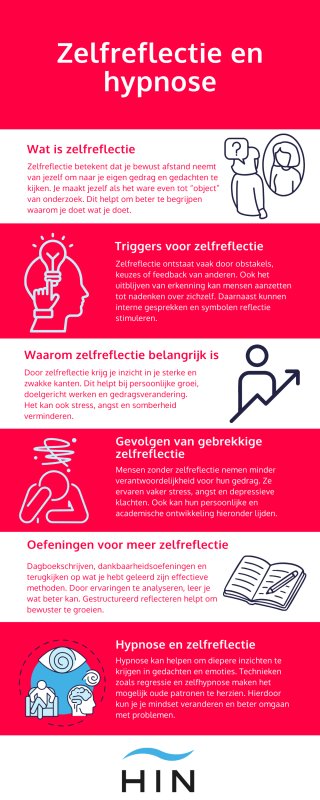
Also pin this handy infographic as a reminder:
Sources:
[6] https://d1wqtxts1xzle7.cloudfront.net/52020041/What_is_Hypnosis___-with-cover-page-v2.pdf?Expires=1658576122&Signature=UF9NE0i3diilUZ5yhBTAcs5IXmnigVwKMCnOxU6jZV8~Zwr714RnCStL6S~SHfNcVP9E7mSnwUzz4BiCwnIETZzlqVcvy7UmI3VGX6XIHeplr4GE3KYvwEr0qky8WPAJBD0uoxlzH7B0eAr4MhM4HuwLyfrdSKg2xeOT75WWfhCifc2VBsJMmS61TJwMZ1eT3AgHnX26UDeMT6F3hOgcI67fj7IOOUBmmzOSaCdlVi65~W2IRb4s-Er7D3vi3ckv5mEuDarEpjwKikJZsyt1kUt6ksg50bV~V-BrF0TFtmeNgrZj9UtrE1kEKt3r~vRC7CFPNG9tjurS5OgQMm5Shw__&Key-Pair-Id=APKAJLOHF5GGSLRBV4ZA