


Stealing is usually a symptom of an addiction, but so can being the addiction. If you watch the news, you often see stealing to pay for another addiction. Stealing, of course, is an activity that involves a lot of stress. After all, you're taking something that doesn't belong to you, and if you get caught, the consequences are dire.
If you then get away with it, you can feel euphoric about it. This feeling can cause you to become addicted to stealing. Still, there are many risks involved, which is why in this blog I will discuss stealing addiction with tips on how to stop stealing.
Someone who is addicted to stealing is also known as a kleptomaniac. This is actually a condition that makes it difficult for you to suppress the impulse to steal(1). Everyone thinks about stealing something from time to time. "What if...." or "I could get away with it" are thoughts that everyone has from time to time, but because we know that it is bad to steal, that it is harmful to the company or person you are stealing from, or a god forbids you to steal, so we don't do it.
No matter the reason, people generally don't steal because it makes most people feel bad.
People addicted to stealing cannot suppress that impulse by logic or by a rule that it is not allowed.
Emergence of a stealing addiction
There can be all kinds of causes for a stealing addiction. It may start innocently because you accidentally failed to pay for something and got away with it. Perhaps you were momentarily conflicted about whether to go back, but it was still nice!
Addiction may also have originated in childhood (2). For example, a boyfriend of mine was once caught trying to steal a few bars of chocolate at the Aldi. The Aldi was kind enough to call his mother instead of calling the police. Then they agreed together that he had to clean the entire store as punishment, supervised by his mother and the manager. This was still in elementary school age. Since then he has never tried to steal anything again.
But what if he had gotten away with it?
For a child then, it can be very tempting to keep stealing, because free candy! Learned young is done old and so you may continue to be a kleptomaniac in your adult life. The idea that it is bad is not yet properly "installed" in childhood and the nasty consequences can stay away if you are not caught.
Consequences of being addicted to stealing
Even if you do know that stealing is bad and you still can't prevent it, you can suffer from kleptomania. In that case, as well as other cases, you may suffer from guilt.
Because you steal a lot, the chances of getting caught are also increasing. This also puts you in contact with the justice system and can cause you all kinds of financial and social problems. For example, having a criminal record does not help if you are looking for a job or want to purchase a loan, insurance or other financial product.
Practically speaking, then, it's also very inconvenient. Go figure, what if you can't get a mortgage or car insurance.
On the contrary, if people know that you steal a lot and can't stop it, it can lead to stigma(3). People don't want to interact with you for fear of also being labeled a thief and you are not allowed to go into people's homes. The fearthat you will also steal from them therefore prevents a normal social environment.
The strange thing is that most people with kleptomania otherwise lead very normal lives. They have a job and, in fact, they don't need the stolen items at all. Getting caught can therefore turn their whole lives upside down.
These guilt, justice problems and other social stigmas can have serious consequences. For example, research shows that people who suffer from kleptomania are more likely than average to attempt suicide(4).
Cause of stealing addiction
An addiction to stealing is not something that is always isolated. There may also be other mental problems in addition to the addiction to stealing. For example, one case study describes a depressed woman who admits during her treatment that she is also addicted to stealing.
Stealing also causes the release of dopamine, which is also important in treating depression(5). So it is actually an unhealthy form of self-medication for the woman in this study.
In addition, eating disorders are also commonly found alongside problems of kleptomania, especially bulimia(6).
The impulse occurs, there is a moment of great fear at the moment the woman in the case study may be caught, and then there is great relief that transitions to guilt. In this case study, the impulse to steal also gets worse when she is in a depressive phase.
What she steals is always also cheap and something she doesn't actually need, which is why she often gives it away to other people.
This addiction is more likely to occur if other family members also suffer from it and if you are a woman. Trauma to the head, such as a fall or accident resulting in brain damage, can also cause you to suffer from kleptomania.
Stopping a stealing addiction
To stop a stealing addiction, it is important to identify the cause. If another mental disorder, such as depression, is the cause, it is important to treat it.
In addition, kleptomania is also treated with cognitive behavioral therapy through hypnotherapy, for example. One example is a case study of a South Korean man who was treated for kleptomania by hypnotic suggestions that caused him to find his behavior abhorrent(7).
For example, if given the impulse to steal, he would become nauseated. Through post-hypnotic suggestions during hypnosis, it is possible to influence behavior.
This technique is also used for other addictions(8), such as drugor alcohol addiction. It also helps well with smoking cessation.
Research also shows that self-help groups help to stop or at least reduce addiction to stealing(9). Researchers therefore suggest finding peers so you can help each other stop stealing, in addition to attending therapy to stop underlying problems.
Helping other people often works well to help yourself, too.
They are also developing many medications to stop addiction to stealing(10).
Tips for quitting a stealing addiction
There are several tips that can help you stop stealing.
1. Acknowledge to yourself that you have a problem with stealing
Recognizing the problem is the first step to solving the problem.
2. Find out the cause of stealing
Determine for yourself why you are actually stealing. Why do you need the dopamine rush of stealing? Did it start in your childhood or is there another cause, such as depression or another addiction in addition to this one?
3. Keep a journal
By keeping a journal, you can find out if there are certain things that trigger you to steal. A bad day at work , boredom, the weather, anything can be a trigger to start stealing. By finding out those triggers, you can use other techniques to get rid of the negative feeling or to better suppress the impulse.
4. Find help
Getting rid of an addiction on your own, of any kind, is very difficult. By seeking help, such as from a hypnotherapist, you can undergo treatment to improve kleptomania.
5. Find peers
If you can find a group in your area or online with the same problem and who also want to stop stealing, you can join them to talk about your problems. They can tell you what techniques have worked for them. In addition, the knowledge that you are not the only one with the problem is good for your self-confidence and will give you another support group around you.
Helping someone with a stealing addiction
If someone confesses to you that they have an addiction to stealing, it is important to remain calm. Confessing an addiction is an important step toward healing.
Realize that you cannot do anything to stop the addiction, the person must do that themselves, but you can offer a helping hand.
Accept that if you too have been stolen from, it is probably not something personal, but really about the stealing itself and the emotions and feelings involved.
Do show that you are concerned about the situation and that you share his/her concerns. For example, you can seek information for him/her for proper treatment to get rid of kleptomania.
You can encourage the person to seek help to stop stealing and even see a doctor together or look for a therapist you trust.
Want to learn more about mental techniques to help yourself or others with addiction? Check out the Hypnosis Institute Netherlands' courses. or sign up for the free online master class on hypnosis.
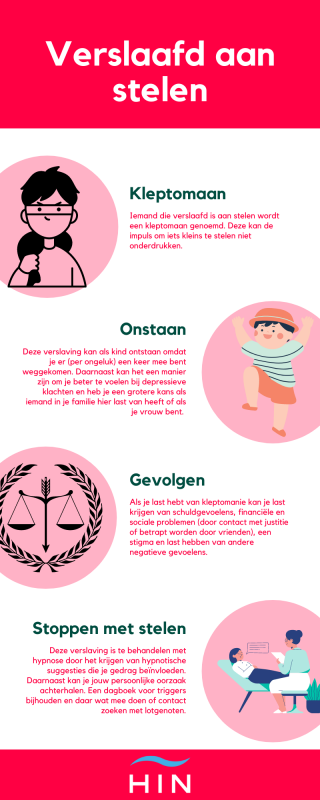
Pin this handy infographic as a reminder:
Sources:
- http://www.mayoclinic.org/diseases-conditions/kleptomania/basics/definition/con-20033010
- https://www.sciencedirect.com/science/article/abs/pii/S0924933816009937
- https://www.sciencedirect.com/science/article/abs/pii/S0010440X14002697
- https://www.tandfonline.com/doi/abs/10.1080/13811118.2013.722058
- https://www.psychologytoday.com/intl/blog/what-the-wild-things-are/201107/gains-and-losses-helping-people-stop-stealing
- https://pubmed.ncbi.nlm.nih.gov/27703105/
- https://synapse.koreamed.org/articles/1017724
- http://www.minddisorders.com/Br-Del/Covert-sensitization.html
- https://pubmed.ncbi.nlm.nih.gov/27703105/
- http://journals.lww.com/intclinpsychopharm/Abstract/2013/03000/Memantine_reduces_stealing_behavior_and.9.aspx