

Ménière's disease is a chronic condition of your middle ear that greatly affects your daily functioning. The disease currently has no chance of being cured, but more than 85% of people who suffer from it can do something about it. This is done, for example, with lifestyle changes, the use of medication and very minor surgical procedures. But these surgeries are used only after all other options have been tried and failed to improve.
Ménière complaints
If you suffer from Ménière's disease, you may suffer from the following symptoms:
- Dizziness (minutes to hours)
- Fluctuating hearing loss (then more then less)
- Tinnitus
- (Feeling of) pressure on the ear[1].
These symptoms usually appear after fluid collects or builds up at the inner ear and then starts to press, but in some cases, you may also gradually become increasingly affected[2].
Ménière treatment
To get treatment for Ménière's disease, it is important to first get a diagnosis. You often get this based on the symptoms, that is, what you are suffering from. You would say you should be able to chart that buildup of fluid, but that is only done after the patient has died[3]. So that's why diagnosis is based on your symptoms.
An MRI can also provide insight into whether you suffer from this disease; your doctor will determine if an MRI is necessary for diagnosis.
They also check that you may not be suffering from another illness that is causing you to have these symptoms.
You then receive treatment, which often consists first of changing things in your lifestyle such as:
- A low-salt diet
- Avoiding stress
- Quitting caffeine
- Avoiding Alcohol
- Drinking lots of water
- Having good sleep hygiene
Doesn't this work to reduce Ménière symptoms? If so, you'll often be given medications that cause you to retain less fluid. If that doesn't work (enough), then you can get other medications such as something with steroids and betahistine.
Is this not working either? Then surgical intervention is considered[4].
So actually there is no mental treatment at all to help you deal with this disease. Something that would actually be helpful since it is a chronic condition. Chances are you will have to deal with it for the rest of your life.
Ménière's disease nutrition
So for nutrition, the first recommendation is to have a diet with less salt and stop drinking alcohol and beverages with caffeine. Is this not helping well enough? Then you can also look at avoiding gluten
As for salt, it is recommended to stay below 2,000 mg. Among other things, this helps you suffer much less from the dizziness that can be caused by Ménière's disease.
Drinking lots of water should help reduce hearing loss. To cause this effect, you will need to drink a minimum of 35 ml per kilogram of body weight.
Say you are 80 pounds, that means you should drink 2.8 liters of water a day.
As for stopping eating gluten, there isn't a whole lot of evidence - except for one case study where someone experienced less discomfort from the condition after not eating gluten for 6 months - but more research needs to be done on this before they can say this works for everyone with Ménière's disease[5].
Of course, it can be quite difficult to start eating less salt. Maybe you're used to regularly eating a bag of chips, salty popcorn or a nice piece of steak with salt. In that case, you need to change some kind of salt habit. If you find this difficult, hypnotherapy can help you make the lifestyle changes.
For example, if you regularly snack on licorice (salt), you can change that habit by taking a sip of water instead. A hypnotherapist helps you visualize your old behavior with a negative emotion and visualize your desired behavior with a positive emotion. Then you will alternate this until your subconscious is left with the new habit (a sip of water) with a positive emotion.
This can be very powerful, for example, to quickly change your dietary habits with hypnosis, so that you will soon suffer less from Ménière's disease. These types of techniques are also used to help people lose weight by changing dietary habits[6].
In addition, tinnitus due to Ménière's disease can also be treated with hypnotherapy[7]. This is often done with visualizations that give you a sense of control over the volume of the tinnitus. If you suffer from that ringing in your ear for days or hours at a time, it can be very annoying.
By visualizing a kind of volume knob and turning it down, you can do a lot to be less bothered by it.
If you're reading this you may be thinking that this is nonsense and so one, two, three is often not going to work. But if you are put into a hypnotic trance by your hypnotherapist, it is much easier to feel and experience this. You will practice with the therapist on controlling the volume and you will be given exercises that you can do at home when you want everything to be quieter for a while.
Ménière's disease exercises
Because you can suffer from spinning dizziness due to Ménière's disease, research is being done to see if spinning exercises can help eliminate this feeling again. It does get annoying when you don't feel confident standing on your feet even between attacks.
Research shows that a few sessions of this type of exercise can help reduce dizziness or vertigo[8].
There are also other exercises to help you suffer less from dizziness or vertigo[9].
There are multiple exercises you can do. For example, you can consciously make movements that normally trigger dizziness in order to train yourself to suffer less from it. This doesn't even necessarily have to be bending down to pick something up, it can also be walking across a shiny floor.
Do you have trouble watching because it seems like the whole world is moving? Then you can also do viewing-stabilization exercises. For example, you look at one point while moving your head.
In addition, you can also do balance exercises[10].
Ménière's disease and your well-being
Dizziness, tinnitus and temporary deafness are symptoms that are not fun to have and have a lot of impact on your daily functioning. Many people who suffer from this disease also have a lower sense of well-being than people who have normal health[11].
Because symptoms fluctuate, you can also suffer a lot of anxiety and tension[12]. You spend the whole time wondering when the next "attack" will occur, which is not helpful at all.
Hypnotherapy can do a lot for you to change habits related to food, but that's not the only thing. Hypnosis also works very well to reduce anxiety. This can be done, for example, in combination with EMDR therapy. This is also used against complaints such as tinnitus and for trauma[13].
What's actually a problem with anxiety is your focus. You want to be able to enjoy the moments when you're not bothered by the condition, but each time the anxiety holds you back. Hypnotherapy can help you shift your focus from the fear of the future (the next attack) to the now (and enjoying what you are doing). This is done, for example, by changing your beliefs about those attacks and the impact they have on your life. This does not mean that the influence becomes different, but that you look at it in a different way so that you can deal with it better and you feel less unhappy because of it.
Then, you can also repeat hypnotic suggestions at home, so that you continue to absorb these new beliefs well. These can be beliefs such as:
"I stay in the moment with my mind."
"When I worry about the future I actually suffer twice, once is enough."
"I eat healthy and drink enough water."
These are just examples. Depending on your beliefs and the suggestions you receive, you may repeat something else that better suits your situation.
Want to learn more about how hypnosis works and how you can use it to help people? Then come to the free online master class.
Or enroll in one of the HIN's training courses, ideal if you are a coach or otherwise help people. The trainings are conducted online from a professional studio and with plenty of assistance for one-on-one attention.
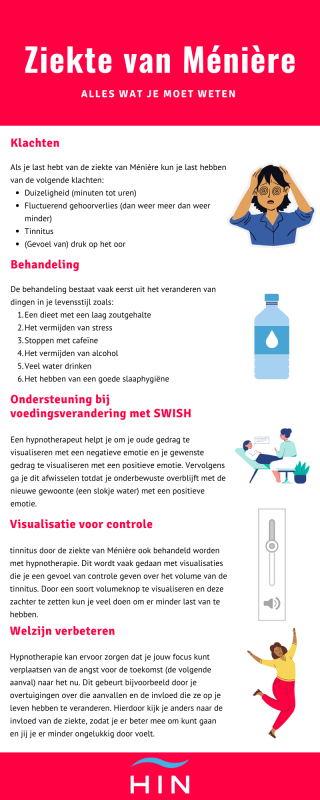
Also pin this handy infographic:
Sources:
[10] https://vestibular.org/article/diagnosis-treatment/treatments/vestibular-rehabilitation-therapy-vrt/