

Accredited Hypnotherapy Training: From Beginner to Certified Professional
Would you like to take an accredited hypnotherapy training course from the #1 Hypnosis Trainer in the Netherlands? Then you have come to the right place with Edwin Selij. He is the owner and founder of Hypnose Instituut Nederland and has been giving hypnosis training courses for years. In fact, he was the first in the Netherlands to teach modern hypnotherapy via livestream.
You may be wondering why this is so important. Becoming a good hypnotherapist? That simply starts with a solid education. If you choose an accredited hypnotherapist training program, you will have assurance about the quality of your training. Your chances on the job market will also increase a lot. As a licensed hypnotherapist, you simply stand stronger with potential clients and insurance companies.
Only which training is the right one for you? Exactly what skills will you learn? What all do you need to eventually start working as a certified professional? These are questions many beginning students struggle with, and I get it.
Therefore, in this article, I will take you step by step through the entire process. From your first introduction to hypnotherapy to the moment when you can start your own practice as a licensed professional. We will look at the main criteria for a good education, what to expect during your studies, and exactly how the certification process works.
Why choose an accredited hypnotherapy training program?
Choosing an accredited hypnotherapy training program is not just a decision. It affects your entire future career as a therapist. Let's be honest about why this recognition is so valuable and what happens if you choose an unrecognized training program.
What does "recognized" mean in hypnotherapy?
A recognized training means that your training has been accredited by official bodies such as CPION or KTNO, for example. Simply put, there are strict quality requirements and professional standards that the training must meet.
Interesting detail: the Supreme Health Council advises that the use of hypnosis should only be legally entrusted to licensed health professionals with appropriate training. That says it all, I think. We at hypnosis institute Netherlands have such appropriate training.
Benefits of accredited training
An accredited hypnotherapist training program will provide you with the following:
- Reimbursement by health insurance companies: Your prospective clients will receive reimbursement for sessions through their supplemental health insurance. Not insignificant.
- Professional network: Access to a wide network of colleagues, referrers and potential clients specifically seeking licensed therapists.
- Career prospects: You can work in private practices and clinics or offer hypnotherapy as part of a broader therapeutic offering.
- Certainty: You will work with a degree that has real value in the field.
As a licensed hypnotherapist, you are stronger in the marketplace. You can make a positive impact on your clients' lives while also building a thriving practice. That's what you want, right? So also look into training programs that offer marketing and building your practice. This is often an underserved area.
Risks of unaccredited training
Taking a non-accredited training course? That comes with risks:
- No formal proofs: Without recognized qualifications, clients may face difficulties in filing complaints or obtaining reimbursements.
- Limited credibility: Clients are advised to seek help only from therapists with legally recognized training.
- Missed opportunities: Many health insurance companies only reimburse treatments by licensed therapists.
So it makes sense to choose an accredited hypnotherapy training program that will equip you with the right knowledge, skills and recognition. Want to learn more about how you can become a professional hypnotherapist? Check out the training with us and find out how we can help you make your dreams come true.
How do you choose the right accredited hypnotherapist training program?

If you're looking for an accredited hypnotherapist training program, there's more to it than you might think. It's not just about finding the best training - it's about finding the right training that fits your ambitions and goals.
What to consider when choosing
Selecting a hypnotherapy training program? There are a few essential points you should really pay attention to. Always check if the training is registered with the CRKBO and KTNO. Can you join a professional association. This is often only possible after a minimum two-year training namely.
Training with psychosocial basic knowledge (PSBK) is also important - it ensures that health insurance companies will partially reimburse your treatments from supplementary insurance after graduation. The curriculum must also meet the PLATO attainment levels. These are not just administrative details; they literally determine whether you will later be recognized as a professional.
Recognized agencies and labels
The Netherlands has several labels and agencies that guarantee the quality of training. It can be a bit overwhelming, all those abbreviations, but here are the main ones:
- CPION/SHO accreditation: This guarantees that your training is at college level
- NRTO hallmark: Recognition for quality and professionalism in the private training industry
- CRKBO registration: ensures VAT exemption of training courses
- KTNO Accreditation: Quality assurance for professional training in complementary care
You also have professional associations such as the NBVH, VBAG, VIT, VIV and LVNT that recognize training. After registering with a professional association, you become registered with the Register of Complementary Care Professionals (RBCZ).
Online vs. physical training
Today, you have a choice between traditional physical training and online variants. Modern hypnotherapy is increasingly taught via livestream, which of course offers a lot of flexibility for your study schedule. By the way, Edwin was a pioneer in this - he was the first in the Netherlands to teach modern hypnotherapy via livestream.
Whatever form you choose, always check that it has the same accreditations as physical training. Some people think that online is less valuable, but that does not have to be the case at all.
Experiences of other students
The experiences of fellow students can give you valuable insight into the quality of a training program. The NBVH, for example, has about 400 members who are all trained at the HBO level and renew their licenses annually after careful scrutiny.
Want to learn more about what our students experience? Check out the training with us and find out why so many people choose our accredited hypnotherapy training program.
What will you learn during an accredited hypnotherapy training program?
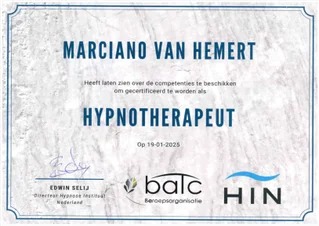
During an accredited hypnotherapy training program, you truly get all the tools you need for a professional career. The curriculum is not simply put together - it is built from years of experience with what works in practice.
Basic principles of hypnosis
You begin by recognizing different states of consciousness. Awake trance, mundane trance, meditative trance and absorption trance - all have their own therapeutic applications. The interesting thing is that you probably already know these states from your own experience. Think of those moments when you were completely absorbed in a book or movie. That is absorption trance, and exactly that state can be used therapeutically later.
You'll also learn to use hypnotic language patterns to naturally influence the unconscious mind. This goes beyond what many people think hypnosis is.
Hands-on exercises
What I find very valuable about good training: after each demonstration, you immediately start practicing in threesomes. That way you really get the techniques down. In many training courses there is a rule of thumb of one supervisor for every seven participants, so you get plenty of personal feedback. You immediately notice what works and what doesn't.
Treatment techniques and ethics
You'll be introduced to techniques such as regression therapy, ideomotor response, ego state therapy and visualizations. But just as important is ethics. Confidentiality, informed consent, respect for autonomy - these are not just theoretical concepts. You will learn how to recognize competency boundaries and why the principle of "do no harm" is so central to everything you do.
Supervision and peer review
Throughout your training, you will work in peer review groups where you will discuss case histories. Here you can practice your own input and learn from experienced colleagues. That supervision by experienced therapists helps you to truly understand and integrate practical experiences.
Preparation for certification
Upon successful completion, you receive a recognized certificate, sometimes even with international recognition. Certain programs also offer opportunities for continuing education (PE) hours, which is essential to your development as a licensed hypnotherapist. Because, of course, learning doesn't stop after your degree.
From student to licensed hypnotherapist: the certification process
Your accredited hypnotherapy training has been completed. Now what? Then the real work actually begins: certification and registration. After all, these steps determine your professional status as a licensed hypnotherapist. Let me walk you through this process, because this is where many people stumble.
Requirements for certification
For full certification, you typically need a college-level hypnotherapy degree. In addition, you must have a Psychosocial Basic Knowledge (PSBK) degree. Do that? Then you have everything you need.
Why is this combination so important? Simple: without that PSBK, no health insurance company will later reimburse your treatments. That's just the reality you have to deal with.
The exam process
The certification process? Mostly a final written test. Some courses keep it simple: 40 multiple-choice questions of which you must get at least 70% right. Other institutions make it a little more complex. Then you have to get an average of 5.5 or higher on your homework, plus a passing grade on an open-book exam you take at home.
Upon successful completion, you will receive your accredited diploma. And then? Then you can finally start working as a professional.
Registration with professional associations
With your degree in hand, you can become a member of recognized professional associations. NBVH, VBAG, VIT, VIV or LVNT - all good options. For membership you submit your diplomas, your certificates, a Certificate of Good Conduct (VOG), and you agree to the professional code.
The NBVH works with annual licenses. Every year you get a new license if you meet all the requirements. This keeps you on your toes, because you must continually meet the requirements.
What can you do after certification?
Once registered with a professional association, you will be registered with the Register of Complementary Care Professionals (RBCZ). "Registered therapist BCZ®," by the way, is a protected title - "hypnotherapist" is not. That does make a difference in how clients see you.
Next, you can apply for AGB codes. As a result, health insurance companies will partially reimburse your treatments from the supplementary insurance. As a beginning therapist, you can be guided by an experienced colleague for the first two years. Annual continuing education and at least four intervision meetings per year will keep your knowledge up to date.
Taking ownership of your career means taking these steps seriously. Because without those papers, you're just a hobbyist, no matter how good you are.
You're almost
An accredited hypnotherapy training program? That's just the foundation for a good career as a hypnotherapist. We have seen in this article how important that official recognition is for your credibility, reimbursement opportunities and professional development. Choosing the right training requires good research on accreditations, labels and what other students think of it.
The curriculum of a solid hypnotherapy training program gives you all the essential skills. From hypnotic language patterns to therapeutic techniques and ethical guidelines. Upon completion, a certification process awaits that will take you from student to licensed professional. Your learning process doesn't stop there, of course. Ongoing continuing education and peer review keep your knowledge current.
For ambitious therapists, accredited training provides access to professional associations, insurance reimbursement and a wide network of colleagues. That's why I recommend: check out training with us and discover how you can take your therapeutic skills to the highest level.
Choosing an accredited hypnotherapy training program? That's an investment in yourself as well as in the well-being of your future clients. With the right knowledge, skills and certification, you stand strong in a growing field where professional hypnotherapists truly make a difference in people's lives. And I grant you that.