
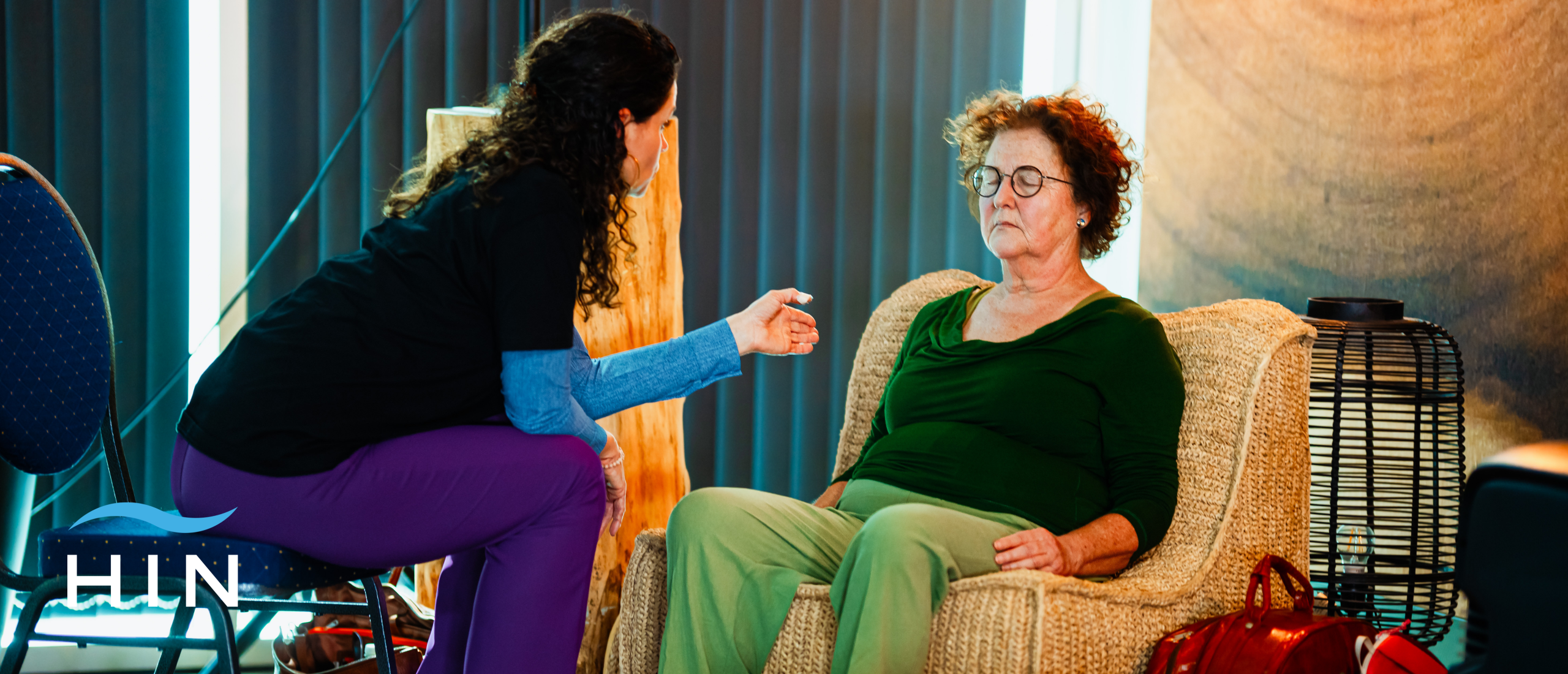

What if you are highly sensitive and you feel other people? You feel how your husband feels. You feel how your children feel, and if that's not going well, then you don't feel well either.
A woman who was highly sensitive and was having this problem, she sent me an audio, and it even made her vomit. So she feels very involved, and I would even say she is intertwined with her family.
When her husband or son comes home and they have had a bad day, she feels it immediately.
To dampen that feeling, she started to numb herself.
But that, of course, is not convenient either.
If you are highly sensitive, there are two solutions and I will give one of them, as it fits her situation.
The model
There is a model I like to use to help people and therein lies the solution.
There are 3 points of interest in this model:
- Me
- Other
- Meta (3rd position, helicopter view)
When I'm in my first position, I feel fine. I know what my needs are. I know what I want. I know what I care about. Me,me,me. That's a good place to be.
The pitfall of this place is that you only have a view of yourself. You don't look at what the other person wants. You don't grab the helicopter view and see what is happening in the process with the other person. If it goes all the way through, you even suffer from narcissism, becoming selfish and self-centered.
Then it's just "me" and drown in yourself.
The Other
The other is also a good position to be in. Because if I can put myself in the other person's shoes and know what the other person wants and what drives them - I understand the other person - Then I can tune into the other person. Then I want to accommodate that other person. Especially in a relationship whether it is friendly, romantic or familial.
If I know what drives my child. What he values and likes and I can relate to that, we will have a better relationship.
This I found very difficult. I'm pretty first position oriented. I really had to learn to put myself in the other person's shoes. You do learn that with a wife and four kids. This learning has been super rewarding for me. I can recommend it to everyone. Especially if you are strong in the I.
Then don't just go find something fun for your child, do something with it. For example, my child likes Leage of Legends (a game) and then I went with him to a game in Brussels. This was mind-blowing. I stepped into his world.
I used to take him into my world, to a soccer game, out to dinner.... All things I like to show him certain things of the world. That's fine, but do this the other way around for a change.
Maybe not when he's 4 or 5, or maybe. I started this when my kids were 11/12. Really try to go into the other person's world to be less in your IC and more connected.
This woman was doing just this too much. This one was totally absorbed in the other person. More people do this. For example, the other person always gets to choose what to eat. They forget themselves. Then when the other person falls away, they are completely lost.
They have lost track of who they are, what they want and what they care about.
Research also shows that people who are very preoccupied with others are more likely to suffer from stress, depression and anxiety[1]. This is something I also recognize from my own life.
Especially if you are highly sensitive, it is important to be able to properly regulate your emotions. After all, the more negative states you get from all the signals you receive, the less confidence you have in being in control of your own emotions. This can indeed cause fatigue and depressive symptoms[2].
The helicopter view
Third, you have the meta-position. The helicopter view. When you're in it, you see the process between you and the other person. Is it going well? Are we on the same page?
In companies, this view is also used to map processes and systems.
But then you must not be emotionally involved, because if you are, you often go to those other positions. In the meta you are not emotionally involved, but you can observe what is there. It's good or not good, but you don't get very emotional about it. You are zoomed out.
That's a good position, too. Sometimes you have to get out and see:
How I'm doing now, is this helpful?
I often do this position after the fact. When I notice that a conversation didn't go well, or something just went really well. Then I think about how I was sitting there afterwards. How did I react? How did the other person act?
Then I often find that I could have said things in a different way.
This has also helped me a lot and now I can do it during meetings. In 1-on-1 meetings, I still find it difficult.
There are people who are very good at it. They can make adjustments during a conversation. In meetings and training sessions I can do that, but not in a "normal" conversation with 1 other person.
In a group, I can switch to what I want and what the group wants.
The pitfall in this is that you can get personification disorder. Then you are no longer in your body at all. This is often due to trauma. Trauma to the IC, often also BY the other. This is so painful that you dissociate. You are no longer in your body, but only in the helicopter view.
People also report that they no longer feel anything, because if they go to the self or other, they feel that pain again and they don't want that.
The solution is not easy, because it is precisely to do go back into yourself and live through what you need to live through. This does not have to take years, it can often be done with a vigorous hypnosis session.
After all, the body needs to get rid of trauma. If you don't do anything with it, you won't get rid of it. It is important then that you re-establish the connection between body and mind.
Highly sensitive is being engaged with others
If you are highly sensitive, you are only concerned with the other person. Ask yourself what you want, what you care about or what you want to do. What are your hobbies? Make it important.
Mothers often start worrying and thinking about the other too, and then when the children leave home, you suffer from empty nest syndrome.
You can say "I am highly sensitive," but you can also say:
"I do a lot for others and I'm involved with others a lot, and it tires me out," he said.
That woman also got tired, and when you are involved with others a lot, this is also tiring. Then you are also very concerned about that.
If with yourself the need is "As long as the other person feels good, then I feel good too." that is a very separate situation. After all, why shouldn't everyone just take care of themselves? If I make sure I feel good and the other person makes sure he or she feels good, then we all feel good.
So if you sit with others a lot. Then pay more attention to your IC. What are your hobbies? And pay attention to that.
Maybe it's yoga and then you start doing that for 30 minutes every day."Mommy please don't bother" and do yoga.
From the I, you can help, understand and empathize with the other person, but not by completely putting yourself in the other person's shoes. That you are the other and that you empathize with the other.
One person suffering is more than enough.
That may sound fierce, because when you see your child suffering you want to help them. However, you don't do that by suffering with them. That doesn't help.
That's easy to say, though. I also have four children, when my child suffers I feel it too. But I know intellectually that this compassion is not going to help them. Understanding, however, can help. That you can say to your child "I understand. The situation is k*t too."
But it doesn't help to totally revel in that understanding and feeling of your child. Your child is already doing that, and it often doesn't lead to a solution either.
Truly helping the other person
So what can you do to help the other person? Well, by helping the other person help themselves. There are 4 areas you can pay attention to.
- Mentally, does he need to think differently?
- Emotionally, should he feel differently?
- Physically, just train with that body.
- Spiritually, does he have anything that makes sense?
One of those four is not going well, and meaning is perhaps the most important. Because when it makes sense, the rest usually falls into place.
Then physically, because if you are not comfortable mentally or emotionally, just start exercising 6 days a week and after 3 months you usually feel better.
If that includes eating more salad, than McDonalds, you'll feel even better.
Suppose you are physically fine, but you still have mental or emotional problems, there may be more to it, such as trauma.
So if your child has something, let him vent and see how you can help him. Also distance yourself with the helicopter view to come up with good ideas.
You can also practice this by setting up chairs and thinking back on how it went. You can then sit in any chair to take the "role" you need at that moment.
Then ask yourself "What can I do to improve?" and in doing so, put your own needs at the forefront a little more often. Especially if you are already too preoccupied with the other person.
Engage in self-care. Schedule things and express that you have a life of your own. Your partner often likes you more immediately then, too.
That high sensitivity then often becomes more of a talent than something you are burdened by.
Also watch this video:
Do you find this interesting and would you also like to gain knowledge to help yourself or others? Then come to the free master class.
Or register directly for one of our events or trainings.
Sources: