Climbing stairs is very common in the Netherlands. Most houses do have stairs. Therefore, fear of stairs can be an incredibly awkward fear. So what can you do to help someone with a fear of stairs? What do you do if you yourself suffer from this fear?
The annoying thing about anxiety is that it can have an awful lot of impact on your body, causing you to stiffen up. Just let that be very inconvenient when climbing stairs. You really have to bend your knees and keep your balance . Stiffness then does not help.
In this blog, we take a closer look at that fear and how you can solve it.
Fear of falling down the stairs
Fear of stairs can be about two things. It may be about the fear of falling down the stairs, or it may be due to a fear of heights. A fear that is actually also related to the fear of falling from a high height.
But first, let's talk about the fear of falling down the stairs. This is a fear that arises logically, either because someone has fallen (almost) down the stairs themselves once, or knows someone close to them who has experienced it with terrible consequences.
Almost everyone knows someone who has died from a fall down a flight of stairs, for example. Some fears can also be passed down from parent to child. So if one parent had a fear of stairs, the child may have unconsciously copied it.
Fear of heights
Then there are stairs you can see through, such as a glass staircase or a staircase made of metal fencing. For people with a fear of heights and stairs, it can turn their stomachs.
In this case, you actually need to figure out what caused the fear of heights.
Fear of pain
A less obvious reason is fear of pain. For example, if you've had knee surgery, this fear may arise. This can cause you to find it exciting to use your knees, and since they play a big role in stair climbing anyway, this can also cause fear of stairs.
Research does show that after knee surgery, climbing stairs should return to normal after some time and then the anxiety should actually go away automatically as well[1]. If not, hypnosis may be able to play a role.
Fear of type steps
Not everyone always has a fear of stairs, either. People can also have a fear of a certain type of staircase, as mentioned, a glass staircase or any staircase that can be seen through can cause anxiety because of a fear of heights.
Then you have people who are afraid of escalators, because the timing with getting on and off is always a bit tense anyway. Or they've seen too many videos on the Internet of escalators going wild (often in2nd world countries). Of course, the chances of something like that happening in the Netherlands are super small. However, if in a certain location you can only take an escalator, then it is important to overcome that fear.
Effects of fear of stairs
The annoying thing about a fear of stairs is that it can even have psychological consequences. If the fear makes you feel that it is very difficult to climb stairs, it can lead to anxiety and depression.
Being precisely NOT afraid will make you feel better, make you less likely to commit suicide and even lower your risk of developing dementia[2].
Reason enough to overcome the fear of stairs.
A hypnotherapist can use a number of techniques to help people with this.
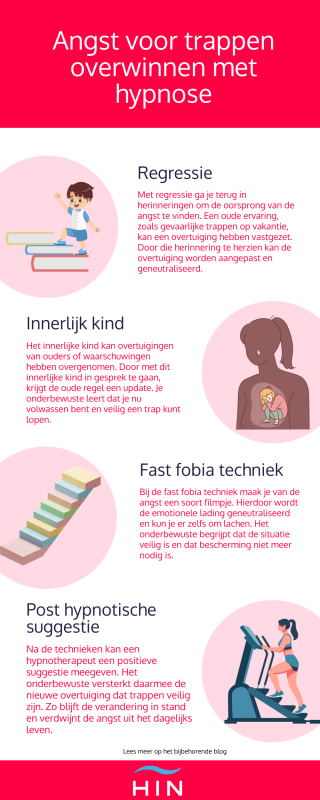
Regression to find the cause
This is something you can do with regression. For example, an experience from a vacation can even cause a person to become incredibly convulsive about climbing stairs, so the danger of falling can already become real. Whereas if that person walks up stairs effortlessly when he is carefree.
With the regression technique, you go back into a person's memories to find out where the belief "stairs are scary" originated. We did experience a case where visiting a ruin with dangerous stairs caused stair phobia.
Then you can do something with that memory to fix the belief[3].
Depending on what the reminder, for example, you can start the conversation with the inner child.
The Inner Child
Indeed, the inner child may have adopted a parent's fear that heights are dangerous. In addition, a parent may have accidentally warned the child to walk carefully up the stairs, and this may then have made such an impression that the line "stairs are super dangerous" was created.
By then starting the conversation with the inner child, you can update that rule. Stairs are safe. After all, you are now an adult human being with adult skills to climb stairs.
Fast phobia technique
In our experience, the fast phobia technique can do a lot to overcome fear of stairs quickly. In this technique, you transform the fear by seeing yourself and making the fear irrelevant.
Then when you do use memory like regression, you can also make a video of it.
In the case of fear of pain after knee surgery - while everything is back to normal - the technique with the video could help convey to the subconscious that all is well. That the phase of knee surgery and recovery has been completed well.
That it is done and the recovering knee no longer needs to be protected. The knee can now do again what it always could.
So you have the period before the anxiety occurred. Then there was nothing going on. In addition, you have the period after the anxiety arose, then there was also nothing wrong.
You make a video of that. A hypnotherapist will help you with this. With this video, you then do all kinds of things, so you end up laughing at the fear.
Laughing at fear is very important to neutralize anxiety.
Also watch this video on the fast phobia technique:
In Hypnosis Institute Netherlands' training , one day is spent learning this technique and how to help people with it.
Post-hypnotic suggestion
Once the techniques have been applied to overcome the fear of stairs, people can still receive a post-hypnotic suggestion . This actually helps your subconscious to maintain the change in your thoughts about the fear.
Usually a hypnotherapist then suggests how nice life is, and how over time a person notices that he no longer has a fear of stairs at all. How he walks up every staircase he encounters without thinking.
Incredibly cool!
What technique does a hypnotherapist use
So, as mentioned, there are multiple techniques that help overcome anxiety, but which technique will a hypnotherapist use?
A hypnotherapist makes that choice following the exploration conversation. In this conversation, a client, the person with stair fear, tells more about the fear, the origins of the fear and the impact the fear is having on the person's life.
Indeed, this gives the hypnotherapist clues as to which technique may be useful to use.
After applying a technique, a hypnotherapist also checks to see if it has worked for you. If it did not immediately, a hypnotherapist may apply another technique or even encourage you to revisit your memory.
Because everyone has their own unique life, it is not always easy to predict which technique will be used. One person may be helped from the fear of stairs in 30 minutes, while someone else may take 2 hours to get back to dealing with stairs normally.
Want to learn more about hypnosis and how you can use it to help yourself or others? Then come to our free online master class for an introduction.
Or register directly for one of our events or trainings.
Pin this handy infographic as a reminder:
Sources: