


Have you ever lost something when you were sure you knew where you put it? Have you ever felt like you weren't sure whether you were meeting someone at 1 or 2? Have you also had an argument with your friends about whether the dress was blue or white? And did those events make you doubt yourself? Doubting your mental state and whether your vision of the world is still correct?
To find out if that doubt is justified and to stop doubting yourself, I give you tips and knowledge in this article.
Then I can tell you right now that if you haven't been diagnosed with psychosis or Alzheimer's you don't have to doubt yourself. Of course you can be wrong from time to time, but this does not have to mean that you have to doubt yourself.
After all, doubting yourself is not healthy and can greatly affect relationships around you.
Ultimately, you make certain observations on which you base behavior. If someone turns out to be a gossipmonger you don't tell them your deepest secrets.
Doubting yourself and your relationship
If you doubt yourself, chances are you also doubt your partner's love for you. Research shows that people who doubt themselves are more likely to feel that they are in an inferior relationship even though their partner clearly loves them(1).
This also makes you doubt that you have a nice future with your partner, when that doubt does not belong in your life at all.
Researchers also indicate that a kind of dependency situation arises when you doubt yourself in a relationship. People who doubt themselves need a partner to be very reactive, and they need many moments that show that the partner loves them. The belief in oneself therefore becomes dependent on the behavior of the partner.
This is a great shame, because if you are not convinced of yourself your partner can say he/she loves you just as many times, but it still does not have the desired effect.
Doubt about yourself can fortunately be dispelled by yourself. Ultimately, that's better for yourself and for your relationship.
Doubting yourself and your work
Doubting yourself at work also has consequences. If you doubt yourself, at least you are already trying to temper expectations. As if you want to warn people in advance that what you are doing can also possibly fail.
Or that you may even do something to yourself that makes you unable to perform the task and therefore not be seen as responsible for performing the task. You can hit yourself on your thumb, so to speak, which will prevent you from carpentry(2).
In the process, doubting yourself at work also creates pessimism and negative thoughts about yourself that reduce your self-confidence and self-assurance.
Cause of doubting yourself
Self-doubt is not often something that arises spontaneously. You may have experienced things that caused you to doubt yourself. For example, you thought you could do something, but then things still went wrong.
For example, research shows that people in Asia often doubt themselves more than Europeans despite their good performance. The difference is in forgiveness. In fact, Asian culture is less forgiving than European culture. The idea that making mistakes is unforgivable can therefore be a source of self-doubt when it is not necessary at all(3).
There are even people who can manipulate you, making you doubt yourself. This is also known as gaslighting. This term comes from a movie in which a man keeps turning back the light of gas lamps slightly. His wife notices this, but then denies that he did so and accuses her of going a little crazy.
This causes her to start doubting herself tremendously, causing all sorts of other problems.
Finding yourself after emotional neglect
To find yourself again and have a solid foundation on which to build, it is important to identify your cause for doubting yourself.
For example, if you doubt yourself because someone has talked to you that you can't do anything, it is important to change those beliefs again.
Fortunately, beliefs that someone else has placed on you can easily be replaced with hypnosis and self-hypnosis.
With hypnotherapy, a hypnotherapist can easily replace the beliefs you hold about yourself by the other person. The illogic of the beliefs is revealed. In fact, you uncover them yourself with the help of a few questions from the hypnotherapist.
Because you are susceptible to adopting suggestions, the hypnotherapist can also rebuild faith in yourself with hypnotic suggestions. These may include:
You're smart.
You are handsome.
You are strong.
You are looking to the future.
To enhance the effects of hypnotherapy, you can also practice self-hypnosis at home. For example, you then repeat the suggestions that further reinforce beliefs that make you stronger.
Tip #1: Use self-hypnosis
By using self-hypnosis, you can influence your subconscious so that you are more confident in your own abilities and doubt yourself less.
Tip 2: Find out the cause of doubting yourself
If you are not manipulated, chances are that an event in your past has caused you to doubt yourself. If you can figure out that event, you can see if you can look at it in a different way than you have done so far.
Having failed once doesn't have to lead to fear of failure.
Instead, you can determine what you actually learned from that moment and how to prevent it in the future.
If you find it difficult to identify the cause on your own, a hypnotherapist can help. This can include regression therapy, but there are other options as well.
Trust In Yourself
Trusting in yourself is sometimes easier said than done. Initially, you can reinforce the beliefs you have about yourself with the first tip.
In addition, you can reinforce the feeling that you can actually trust in yourself with visualizations. I have heard on occasion that people only start doing something when people can imagine it. To do something, it is important that you first "see" how to do it.
Tip 3: Visualize what you want to trust in
Fortunately, self-hypnosis also allows you to visualize very well. If you have doubts about giving a presentation or delivering a good job, you can remove those doubts by visualizing how to do it.
During self-hypnosis, you first focus on your breathing. For example, you sit or lie down in a comfortable place. Then you breathe calmly through your belly. If this goes well you close your eyes and, in the case of a presentation, first visualize the place where you are going to do it.
Next, visualize yourself preparing. You may need to set up a projector or lay out notebooks for people coming to view the presentation.
You visualize how you greet everyone when they come in. How when they are seated you introduce yourself and start presenting. How to stay calm when asked questions and what you do when you don't know the answer: "I'll come back to that later and if not, I'll email it to the whole group.".
Tip 4: Use mindfulness
If you doubt yourself, you may notice this through thoughts that are demotivating and that stop you from doing what you do best. By applying mindfulness, you can find out when you get those kinds of thoughts and if you are not suffering from the same kinds of thoughts all the time.
By becoming aware of this, you can do something about it.
Another benefit of mindfulness is that you perform a task with more focus. This also makes you less likely to make mistakes, improving confidence in yourself through experience.
Tip 5: Don't be too hard on yourself
Currently, we live in a world of criticism and you have to be able to stand it. As a result, you can also become very strict with yourself that you have to be able to do certain unrealistic things. For example, I can tell myself that I have to be able to run a marathon in 2 hours. Unfortunately, most professionals can't even do that so how realistic is it that I can do that? If that makes me doubt myself it doesn't actually make sense at all.
Therefore, it is important to have self-compassion. Things are allowed to go wrong, and when you do something right it is certainly allowed to be celebrated. Doing something right may be "normal," but when you doubt yourself, doing something right is just a reason for celebration!
Tip 6: Relax
When you work hard, whether at work or just in your personal life, sometimes things go wrong. If you put too much pressure on yourself, this can create self-doubt. Therefore, relax from time to time. Take yourself away from the situation that makes you doubt yourself and go do something fun. Walk, paint, exercise as long as it is relaxing me-time.
Want to learn more about mental techniques to doubt less and enjoy more? Then come to a free online master class on hypnosis or check out the Hypnosis Institute Netherlands' workshops and trainings.
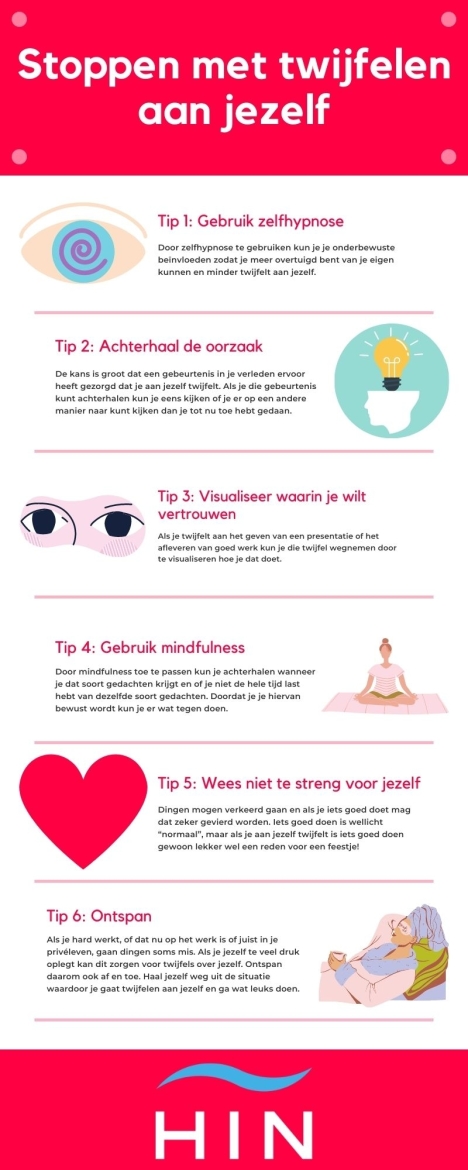
Also pin this handy infographic as a reminder:
Sources:
- https://journals.sagepub.com/doi/abs/10.1177/0146167201274004
- http://onlinelibrary.wiley.com/doi/10.1111/1467-6494.00104/abstract
- https://www.sciencedirect.com/science/article/pii/S1041608010000634