

Glad you're reading this. Today we are going to talk about something that can change your whole life, whether you are behind the wheel of a car or behind the wheel of your own destiny. We're going to talk about roles, about identity and about the question, How do you really change who you are?
I recently received a fantastic question under one of my videos from Josje. And let me be honest: Josje asks the question that basically everyone asks themselves the moment they start something that is exciting. She wrote:
"Hey Edwin, here’s a fun suggestion for a video: How can you prime or hypnotize yourself when starting with driving lessons? I just started and I notice that my identity sticks to: 'I'm not a driver. This is not going to work for me.' How do I change this hypnosis?"
See, this is gold. This is the core of what we at the Hypnosis Institute Netherlands (HIN) are working on every day. Because Josje has figured it out: she is in hypnosis. A negative hypnosis, that is. She is telling herself a story that is blocking her. And the great thing is: if you know how that hypnosis works, you can also turn it around.
Watch the video:
The Power of the Role: Back to Your Childhood
Let's step back in time for a moment. Remember when you were about five or six years old? You didn't have to take an identity management course back then. You just did something.
Someone said, "Shall we play cowboy and Indian? You're the villain and I'm the policeman." What happened at that moment? Boom!
Within one second, you were that crook. You started walking differently, you looked around nervously, you looked for a place to hide. You didn't think, "Yeah, but do I have the right papers to be a crook? Am I criminal enough? What if the policeman doesn't believe me?"
No, you took on the role , and your behavior followed naturally from that role. As a child, you understood this perfectly. You were a princess, a knight, a pirate. Your identity was fluid.
But somewhere along the way to maturity, we lost that skill. We have come to believe that we are "somebody" and that we must remain that "somebody. We got stuck in our own definitions.
The danger (and power) of identification
In psychology, we are familiar with the infamous Stanford Prison Experiment. Philip Zimbardo locked a group of young men in the university's basement. One half was labeled "prisoner," the other half "jailer."[1]
Although the experiment was later criticized in part for instructing the participants, the gist remains: those men started behaving so extremely according to their roles that the experiment had to be discontinued after five days. The keepers became cruel and the prisoners became enslaved or rebellious. Why? Because they became the role.
When you assume the identity of someone who can do something, your brain automatically starts looking for the means to perform that behavior. If I say to you, "You are a pianist," and you truly believe that to your core, learning the piano is no longer an arduous task. It's just what you do. After all, a pianist plays the piano.
The mistake we all make: "I'm not (yet) a..."
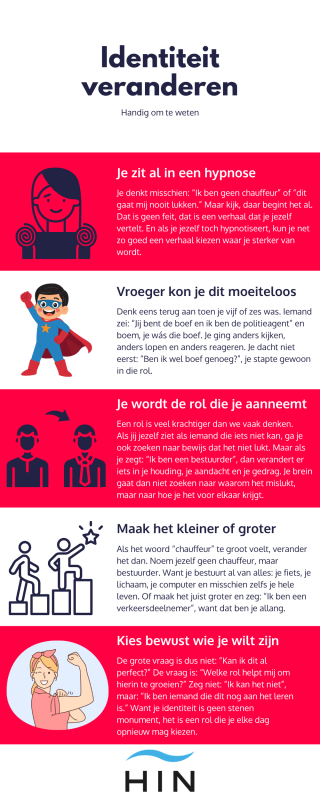
Josje says, "I'm not a driver." And that's where it goes wrong. In our training programs, we tell students on day one, "You are a hypnotist."
Of course, they don't believe that right away. They think, "I've never put anyone into a trance, I don't know the techniques yet, how can I be a hypnotist?" But that's the opposite world. If you see yourself as a "student" or as someone who is "trying to hypnotize," then you are acting out of insecurity.
But when you decide, "I am a hypnotist," your whole attitude changes. Your voice becomes more confident, your focus sharpens. And then when a technique fails once, you don't think, "See, I can't do it." No, then you think, "That's crazy, I'm a hypnotist, so I just have to try something else."
Research also shows that your behavior (and thus the results you achieve) depends on your identity or desired identity[2].
Your results follow your identity, not the other way around.
And for this, you can use NLP tricks.
If the step from "I am a klutz behind the wheel" to "I am Max Verstappen" is too big, then we have to start juggling words and concepts. In NLP (Neuro-Linguistic Programming), we call this Chunking.
1. Change the Word (Down-chunking).
Josje uses the word "driver. That word may feel very big and heavy to her. A driver is someone who spends all day on the road, who knows all about traffic rules, who perhaps drives a truck or a cab.
If that word is too loaded, change it. Are you a driver? Maybe not (yet). But are you a driver? Chances are you've been a driver for years.
- Do you ride a bicycle? Yes.
- Do you control a computer? Yes.
- Do you control your own legs when you walk? Sure do.
So you can already govern. The skill of "driving" is already in your system. Now you are simply going to apply that same skill to a new object: a car. By changing the word from "driver" to "driver," you take the pressure off.
2. Seeking the abstraction (Up-chunking).
You can also go in the other direction. Make it bigger and more abstract.
- A motorist is a road user.
- Are you a road warrior when you walk? Yes.
- Are you a road warrior on a bicycle? Absolutely.
You understand how traffic works. You know to stop at red lights and keep to the right. You are already a successful traffic participant, or you would have been run over long ago. If you identify yourself as an "experienced road user," then that car is just a new tool in an environment you already know.
How do you apply this in practice?
Imagine, you get into that teaching car next time. Instead of thinking, "I hope I learn," you do the following:
- Establish identity: Say to yourself, "I am the driver of this vehicle." Not "I am trying," not "I am learning," but "I am."
- Use your "Inner Child": Pretend. Just like you used to play cowboy. Put on that "driver's hat. Feel how a confident driver sits in that seat. How does he hold the steering wheel? How does that one look in the mirrors?
Research shows that different clothing affects behavior even in adults[3]. So don't wear for your environment the clothes that go with the job you want, but do this for yourself. If necessary, literally put on a driver's hat.
- Apply the "Not Yet" Rule: If you make a mistake (and you're going to make one, because it's part of the job) never say, "I can't do it." Say, "I am a driver who has not yet mastered this particular action."
See the difference? The identity ("driver") remains intact. Only the skill needs some fine-tuning.
The universal law of influence
This principle applies to everything. Do you want to lose weight? Don’t say, “I’m trying to eat healthy.” Say, “I’m someone who takes good care of my body.” Do you want to start a business? Don’t say, “I’m a budding freelancer.” Say, “I’m an entrepreneur who adds value to the world.”
After all, you are already a hypnotist. Every day you are influencing people. You're influencing your partner to unload the dishwasher, you're influencing your boss for a pay raise, and most importantly, you're hypnotizing yourself all day long with the stories you tell yourself.
If you ’re going to hypnotize yourself anyway, why not do it with a story that makes you stronger?
Who do you choose to be?
For anyone reading this who is struggling with something: your identity is not a stone monument. It is a role you choose every day. If that role of "I can't do it" no longer serves you, put on a different costume.
Start experimenting with that up-chunking and down-chunking. Find the logic in what you can already do and draw that line to what you want to achieve. The world is one big play and you are the director, the lead actor and the audience.
Remember: you are already much more than you think you are. You just need to start being it.
Is this something you find challenging, or something you’d like to help others with? Then knowledge of hypnosis and hypnotherapy is incredibly valuable. Come join my free masterclass to get started.
Or sign up right away for one of the Hypnosis Institute of the Netherlands’ events and training programs.
Have a question about the training? Schedule a free 1-on-1 consultation here.
Also pin this handy infographic as a reminder:
Sources: