
Some life stories are neatly linear, but Désirée Vergers' has been through ups and downs and with three strong themes: music, sports and mental transformation. She began as a classical flutist in top Dutch orchestras, then shifted into the world of exercise physiology, personal training and wheel teams, and finally found her core in working with the subconscious, through hypnosis, flow and behavioral transformation.
The common thread? An insatiable curiosity about what really makes people literally move.
In this article, we take you through her path to the Hypnosis Institute Netherlands (HIN), what she learned there, and how it permanently changed her work, and life. We explore her "life before," the tipping points, the training experience, and the "life after." FlowSpinning and DeepFlow®, her own method of consciously evoking the flow state to make life more fun and lighter.
It started with music: As it should
Désirée's early career takes place at the highest level of classical music. For years she worked as a flutist in top orchestras. Sounds romantic, but behind the scenes she encountered a world that, especially in times of mergers and declining subsidies, became increasingly competitive and harsh. The atmosphere was anything but light.
Then life strikes: she loses a baby. The loss draws a line through everything that seemed natural and prompts an inner call: "Man, go live." For Désirée, that becomes a turn toward sports. First as a participant playing sports "like crazy" to channel raw grief and then professionally.
Cyclists have a hard time sticking to schedules
From group indoor cycling classes, Désirée grows into personal training, exercise physiology and coaching cycling teams. She immerses herself in training theory, nutrition and recovery. But in practice, she bumps into something intriguing: why don't people stick to excellent schedules? Why does Monday motivation turn into procrastination on Tuesday?
That question, "What makes us want something but not do it?" turns out to be the door to her next chapter. Désirée decides to study psychodynamic therapy. Hypnotherapy is one subject among many, but exactly that subject touches the heart of her quest.
As early as year one, she begins working with her sports clients in trance. She doesn't have all the therapeutic finesse by then, but she does notice: when you tap into the subconscious, habits shift with it. Where "schemes" often leave people with guilt and shame, hypnosis opens the door to a different, deeper control of behavior.
Why hypnosis "clicked" with her
Désirée puts it sharply: "The conscious brain works with willpower. The subconscious with programming. And exactly that programming guides roughly the vast majority of our daily behavior. So we often try to correct the 95% (subconscious) with 5% (conscious). That feels like skating on too thin ice: three weeks goes well, and then the plan collapses."
She continues: "Hypnosis changes the direction of communication: instead of the conscious mind fighting old patterns, you connect with the system that carries those patterns. You can "tell" the subconscious that the old solution (smoking, not sleeping enough, working too much, keeping yourself small) once served, but is now counterproductive. This creates space for new habits, without willpower."
Deepening: Mind-Eye-Power, sharing work and the search for "how to"
Curious as she is, Désirée dives further. She studies Mind-Eye-Power (working with the subconscious through the eyes) and attends training courses in Belgium on share work and the concept of the virtual gastric band.
She teaches many interventions, but also notices a gap: "I knew what I wanted to do in hypnosis, but not how to get someone into hypnosis quickly and properly."
That practical gap from theoretical understanding to smooth craftsmanship brings her to the Hypnosis Institute Netherlands.
The move to the HIN: from "heavy" to "light and human"
Désirée starts at the HIN with year 1 online, followed by year 2 (also online) and deliberately chooses year 3 on location. This proves to be a pivotal point.
Learning online worked, but in her case required discipline. On location in Assendelft, she experienced something she missed elsewhere: lightness.
Whereas previous psychotherapy training programs could sometimes end up in "label-seriousness" and group drama, at HIN she experiences a different approach: you do look at pain and patterns, but with different eyes, namely pragmatic, playful and solution-oriented.
Therapy doesn't have to be lead-heavy to work deeply. That perspective feels like coming home.
She also calls it her "nicest group ever": inspiring, positive and human. The didactics are hands-on; the hypnotizing itself becomes simple, quick and natural. It was exactly the piece she was looking for.
The tipping point: from crowded practice to stage and products
As a result, Désirée has been running a crowded practice for years. Successes pile up, but the price is high: full evenings, full Saturdays, sports classes in between, and eventually a hefty tax bill.
The bucket is overflowing.
In her third year at HIN, the question immediately rings true: "Where do you want to be in a year?" The honest answer surprised even herself: not even more practice, but to the stage. Sharing knowledge. Getting groups moving. Bringing lightness to how people look at themselves and direct their lives.
That clarity, fueled in part by HIN's way of working, leads to a strategic turnaround: the practice shrinks to two and a half days, investing the rest of her time in building methodology, programs, trainings and a vision that can reach many people at once to help them with their health and other issues.
Such as FlowSpinning.
FlowSpinning: music, trance and behavior in the room
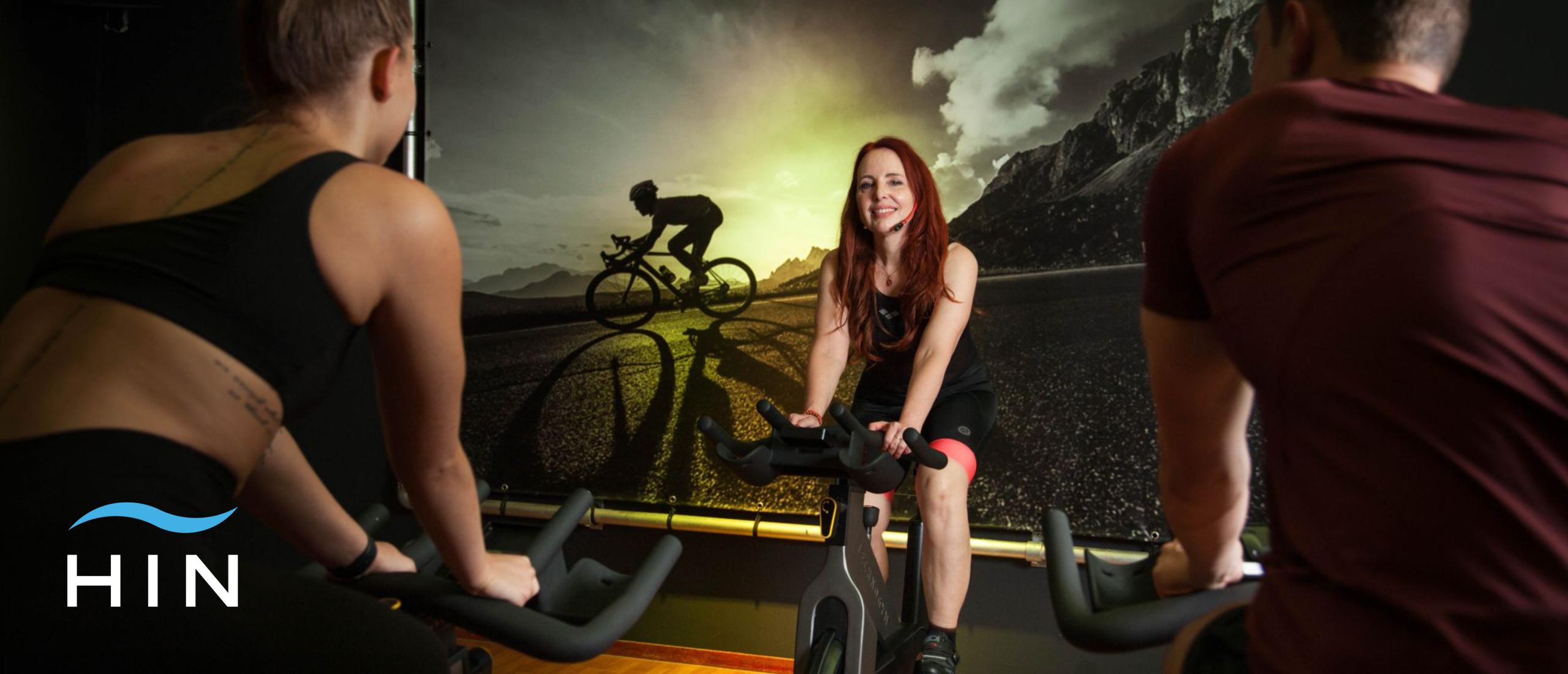
In addition to her practice, Désirée still teaches sports classes, such as spinning, and that's where something remarkable happens. As Désirée uses hypnotic language day in and day out, the entire spin class unconsciously begins to resonate with her.
A meandering psychotherapist addresses her: "Do you realize you're putting the whole group into a trance?"
The penny drops. With her musical background, she understands rhythm and structure; with her knowledge of sports, training and exercise physiology and training cyclists, she understands what people struggle with when it comes to movement and focus. Knowledge of hypnosis appears to be the missing ingredient to help people in the flow state grow personally.
FlowSpinning was born: a spin class in which the flow state (a form of focused, calm-alert attention) is elicited and linked to personal goals.
During the corona period, they are experimenting (despite the faltering open/close context of gyms) with a setup that explores the effects: two similar groups (both with sleep and nutrition plans), one with regular spinning, one with FlowSpinning.
The observation: the flow group loses more pounds, achieves athletic goals better and exhibits (measured via smartwatches) higher heart rate zones for longer, while participants subjectively perceived that they had to work "less hard" and went home with an "empty head."
For Désirée, this is confirmation to further professionalize FlowSpinning: her own training, a book (almost finished), and now FlowSpinning is on the schedule as a separate class at SportCity. National rollout is now the subject of discussion there.
And they do more with that flow state.
From FlowSpinning to DeepFlow®: the flow state as a way of life
Where FlowSpinning brings flow to the gym, DeepFlow® lifts that principle to everyday life. Feel free to call it "self-hypnosis with a friendly coat": practical tools to influence your subconscious brain, direct your state of being and make life lighter.
Not waiting for flow to happen to you, but knowing how to evoke it, during work, walks, conversations, or just when stress builds.
To this end, Désirée also organizes team outings. A playful, in-depth team program with explanations of the conscious and subconscious brain, elements of systemic work and sharing work, game elements and concluding FlowSpinning. It is team building with a "deep" side benefit: insight, energy, connection and concrete tools.
In addition, people can also receive 1-on-1 coaching for DeepFlow® and join groups where participants learn what "knobs" they can turn in their lives: behavior, recovery, nutrition, exercise, self-talk, energy management and, of course, conscious access to the flow state.
That flow state helps to get more in touch with the subconscious and use movement for this purpose to work with the subconscious to live healthier lives and even achieve other personal goals.
Désirée is building this together with her husband, Ton Witkamp: he focuses more on concept development and content, she is the trainer and the face. The ambition is clear: to roll out DeepFlow® nationwide and scalable.
What knowledge of sports, music and hypnosis can do. But the Hypnosis Institute Netherlands still made the difference for her.
Studying at HIN: what made the difference?
Désirées evaluation of the HIN has three pillars:
- Expert and simple: Hypnosis not as lofty mysticism, but as a human, learnable craft. The "how do I bring someone into hypnosis quickly and well?" became concrete and smooth.
- Lightness with depth: The HIN does not deny pain and complexity; it teaches you to work with it without a fetish of heaviness. This makes the work more effective and sustainable for both client and practitioner.
- Community and energy: In Year 3, on site, Désirée experiences her "most fun group ever." Learning is fun, practice is safe, feedback is honest and warm. That setting makes knowledge stick and courage grow.
The net effect? She leaves HIN not only with better techniques, but with a different professional image: less solo "hourly billing" and more creating, teaching, inspiring.
Want to see what Désirée is all about? Go here to her website about DeepFlow®
Would you like to learn hypnosis, just like Désirée?
You can take the training in person or online. Would you like to have a no-obligation chat to see if this is right for you? Schedule a one-on-one consultation here. You won’t be speaking with a salesperson, but with an experienced HIN coach who works with this training program and clients on a daily basis. In 20–30 minutes, you’ll get a clear sense of whether this is the right step for you and which start date suits you best.
The schedule for these sessions fills up quickly around the start of each group. Is there still a time slot available that works for you? Then book it now.