


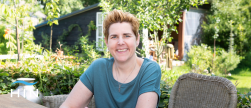
Who Are You. For Alice Aangeenbrug of Bridge Coaching, that's not a question you answer in one sentence. What she does, though, she can tell you clearly. She has her own practice and helps people who are stuck in stress, burnout symptoms and inner turmoil. People who are still functioning, but feel things are no longer right the way they are.
"You feel like: I'm still functioning, I can keep going this way for a while, but it's not really the most palatable route."
It is precisely those people Alice helps to get back to themselves. Less in the head, more in the body and more on their own path. "That head may rattle a little less," she says. "And people may sink back into their bodies more, where it happens. So they can experience life as beautiful again."
Although her practice is based in Amsterdam, Alice currently works primarily online. This fits well with her style of counseling. Her clients are at home, in their own familiar surroundings. As a result, more relaxation is often already present before the session begins.
"I work very much from attunement and from creating a safe field. If someone is sitting at home, that's actually 50 percent already created."
Safety is essential to Alice. Especially when people start looking at a problem, pattern or old pain with her. Then there has to be space. A bed in which someone feels safe enough to honestly explore what's going on.
Working online is also appropriate for herself. Alice has MS, which has made her consciously look at what supports her energy. "For me, this is also the most delicious way in which I can flourish in my energy," she says. That says a lot about her way of working. She doesn't believe in pushing beyond boundaries, but in alignment. In looking at what is right. For the client and for herself.
Via Kukuru to the HIN
Alice came across Hypnosis Institute Netherlands through Kukuru, Giel Beelen's platform. Edwin Selij was a guest there. Then she started following him on social media. Especially the one-on-one sessions Edwin did on Instagram fascinated her.
People would come in with a problem, he would engage with them, and after half an hour or an hour, something seemed to change substantially. "I just didn't know: what is he doing? And I just thought: I want this too. I love this."
This fascination did not come out of nowhere. Alice had been coaching since 2013 and had later studied yoga nidra. Yoga nidra is a reclining, guided meditation form that combines relaxation, visualization, intention and states of consciousness.
In yoga nidra, she already encountered elements close to hypnosis. She learned about brain waves and about the thèta state, a state often associated with deep relaxation, dreaming, REM sleep and contact with the subconscious.
"That's really the state in which you can communicate nicely with the unconscious," he says.
She also later recognized the language in yoga nidra as hypnotic. A kind of vague, Milton-like language that leaves room for the subconscious. Some fantasize one way, others a completely different way.
For Alice, something fell into place. If she got better at hypnosis, she would also get better at everything she was already doing. "If I get really good at hypnosis, then everything I do becomes even better," she said. That became the reason to take the training at HIN.
Back to her own talents
The training didn't just bring Alice techniques. She also reconnected with her own talents.
Before further shaping her practice, she worked in HRM, among other fields. There she found that she liked the work as a confidant the most. Especially the moments when people really ran into something and they could explore together what was going on.
During the training, she recognized that again. "I felt: this is really a talent of mine. To go into depth with people when they get stuck somewhere."
Alice is curious about what is happening beneath the surface. She likes to look at a problem from multiple angles. What happens when you look at it this way? And what changes when you approach it from a different perspective?
In the training, that talent emerged again. Not as something new, but as something that was always there and now became more clearly visible. "I really came back into connection with my own talents. I really enjoyed that."
Personal expansion through training
The HIN works in a very hands-on way. You get theory and then go and practice directly. This means that sometimes you are the one guiding the session and sometimes you are in the chair as the client yourself.
For Alice, the latter also became personally valuable. She brought in themes around her MS in the exercises and found that a lot of space opened up. "As a result, I created a lot of freedom around those issues. That has really been a relief."
The training didn't change her diagnosis, but it did change her relationship to the challenges that come with it. She began to see things differently. With more space, more gentleness and more possibilities.
"I look at my challenges very differently now. It has given me a lot of expansion and I am grateful for that."
She also brings that experience to her practice. Alice knows firsthand what it's like when your body signals limits. She also knows how quickly physical limitations can make you think more limited. This is precisely why inner space is so important to her.
From 1.0 to 3.0
Alice took all three courses at the HIN back-to-back. She started in January 2024 and completed in November 2025. She attended the 1.0 online, the 2.0 and 3.0 live.
She clearly experienced the structure of the training. In the 1.0 and 2.0, you learn a lot through scripts, protocols and set structures. She found that valuable because it gives you a solid foundation.
Yet the 3.0 in particular stuck with her. "In the 3.0 you really start to find your own methodology. It's only there that you yourself emerge more."
Whereas the earlier trainings provided more handholding through scripts and exercises, Alice says the 3.0 requires more individuality. You learn not only to implement what you have learned, but also to look at how you use it. What suits you? What are your talents? How do you use hypnosis in a way that feels natural?
"You have to do a little thinking yourself," she says with a laugh. "And that appeals to me a lot."
Language that makes something shift
A key component that Alice took from the 3.0 is working with language. Not just talking nicely, but really listening to the client's words.
Alice has a talent for capturing language and giving it back. Sometimes she will let a word or phrase from the client come back later in the conversation in a place where the person is not expecting it. Just because of that, a new insight can suddenly emerge.
"Then a kind of insight automatically arises. Like, oh, that's actually how I can look at it, too."
For Alice, these are special moments. She sees then that something is changing. Sometimes not big or dramatic, but subtle and palpable.
"You see an immediate shift. A piece in the body that actually relaxes."
This affects her at work. Not because she is imposing something on someone, but because the client begins to see or feel something themselves. A new perspective. An opening. A softer view of something that was previously stuck.
"That's crazy to experience. To be able to be a part of that."
The sauce of self
After completing the 3.0, Alice started doing mostly. Not following one set protocol, but in her own way.
Everything she has learned she carries in her backpack: coaching, yoga nidra, hypnosis, regression, language, attunement and her personal experience. In the session, she looks at what is needed.
"I have all that training in my backpack and I do my own thing. What's needed then rolls out."
That doesn't mean the techniques have disappeared. On the contrary. In retrospect, she often recognizes what she used. Then she thinks: this was conversational hypnosis. Or: this is what I really learned at HIN. But she doesn't start a session with the idea that she necessarily has to use a certain technique.
"That's not how it works. I don't take it into the session ahead of time."
For Alice, it starts with alignment. Who is sitting across from her? What is needed? Where is there tension? Where does space arise? And what may be looked at together?
Working with the subconscious mind
Working with the subconscious touches Alice deeply. It began when she was introduced to yoga nidra through her MS.
Because of the limitations she experienced, she found that she also began to think more limited. Yoga nidra gave her space. For a moment all worries aside. To feel for a moment that being in this moment was good. Experiencing for a moment that she was more than her symptoms or limitations.
"I had started thinking pretty limited because of the limitations I was experiencing. And I felt: I want to avoid that."
Through yoga nidra, she got in touch with relaxation, intentions, visualizations and the subconscious mind. There she felt how much space could be created when you don't just work from the conscious head. Later, during hypnosis training, that deepened even further.
"It's wonderful," she says of working with the subconscious.
For her, the subconscious is not a vague concept, but a layer in which many patterns, beliefs and old solutions are stored. Solutions that were once useful, but can later begin to pinch.
The power of regression
One part of the training that particularly touched Alice was regression. Especially in the 2.0, she found that fantastic to do.
In regression, you often get in touch with younger parts of yourself. The inner child. The part that once experienced something and found a solution to it.
Alice loves that work because she sees how much relaxation can happen there.
"That's where the problem usually originated, in childhood. And that child found a very good solution to that. Only later that solution doesn't match who you are now."
In regression, that younger part can still receive recognition, safety or reassurance. Not to change the past, but to soften the load on it.
"It's so healing to show that child that you've actually come an awfully long way."
Sometimes peace arises. With yourself. With old situations. With parents who may not have meant it. With a pattern that was once necessary, but now no longer needs to be carried.
Alice also sees this reflected in clients. People later feedback that their lives feel easier. Like they no longer have to carry something around.
"It's wonderful to see what that does when someone middle-aged just connects with that little child and resolves something there. Then so much space and energy is released."
For people who feel that things can be different
The people who come to Alice are often not completely broken down. They can still keep going. They are still managing. They are doing their jobs, caring for others and keeping things going.
But inside, it no longer feels free.
The head is on too much. The body is giving signals. There is tension, fatigue or restlessness. And somewhere there is the desire to feel again: this is me, this is right, this is how I want to live.
Alice helps people make that move back. Not by forcing, but by looking together. By creating safety. By combining language, hypnosis, yoga nidra and coaching in a way that suits the person facing her.
She uses what she learned at HIN not as a stand-alone trick, but as part of her own way of working. Alignment is central. Safety is central. And the body is allowed to participate again.
Because change doesn't just happen in the head. It often happens right underneath. In the body. In the subconscious. In that one moment when something relaxes and space opens up.
Want to know more about Alice?
Alice helps people with stress, burnout symptoms and inner turmoil to experience more space, peace and connection with themselves again. She works online from her practice Bridge Coaching.
You can find her on Instagram at @bridge.coaching.co.uk.
Would you like to help people with hypnosis, just like Alice?
You can take the training in person or online. Would you like to have a no-obligation chat to see if this is right for you? Schedule a one-on-one consultation here. You won’t be speaking with a salesperson, but with an experienced HIN coach who works with this training program and clients on a daily basis. In 20–30 minutes, you’ll get a clear sense of whether this is the right step for you and which start date suits you best.
The schedule for these sessions fills up quickly around the start of each group. Is there still a time slot available that works for you? Then book it now.


Jan
on May 30, 2026