
Do you have a sugar addiction, want to quit, but can't? Maybe you've already stopped temporarily once, yet you've started again. The button has apparently not been pushed properly.
This is a response I received from a woman on a call to submit problems. I then asked her what stopped her from just quitting again, since she had succeeded before anyway.
But yes, it snuck back in.
Filters and your sugar addiction
I find that interesting because it makes me think about filters. You get an awful lot of information to process every day. You get 11.2 million bits of information (1 letter is 5 bits) per second.
But you can't process that so you filter. That's what your subconscious does with your senses. What you see, hear, feel, smell or taste.
You know yourself that you don't see or hear everything. Bats hear more than we do, a dog smells better, a snake sees very different things (even heat). So as humans we are very limited and when you are born you can still hear up to 20,000 Herz, but after that it only gets worse.
That's 1 of your filters. In fact, we have dozens of them. This is what I call metaprograms. In fact, the way you think is also a filter.
I take out 1 filter because that's where the solution lies.
After all, people either want to get somewhere, or they want to get rid of something.
- 70% (over 2/3rds) of people want to get rid of something, that's how they generally think. These want to get away from pain.
- 30% (just under 1/3rd) of people want to go somewhere, that's how they generally think. Those want to move toward pleasure.
If you know the way you think, you can change it. The woman I helped indicated that she had stopped because she was fed up with it. She was actually having body aches, stiffness and heart spasms and then she was able to stop and did a reset with fasting and juicing.
Of course, you can never keep that up for long. After all, willpower runs out, because you draw that from a kind of mental store of energy. I also think this way, I also get away from the pain, but when the pain is gone, I only have willpower left to stop and that is often not enough[1].
Indeed, the incentive that initially gave the energy to quit is gone.
So she tried some things again and a candy here and there and before you know it she's in her old pattern.
I once had another one of those clients who wanted to lose weight and had succeeded, but a year later was there again. Namely, he could no longer button his favorite pants.
And every time he came back after a year.
So the strategy was to get away from the pain. After one session some things worked, but at some point the pain was gone and things went wrong again.
Tackling sugar addiction without willpower by using your filter
By changing your filter, your way of thinking, you actually ensure that you can pick up a healthy lifestyle without willpower.
Instead of the filter, away from pain, as a hypnotherapist you then install in people the filter: toward pleasure. Or you have to make the pain different.
As a therapist, you may hear "I don't want this, I don't want that, I get pain everywhere etc. etc."
Then, as a therapist, you ask, "Where do you want to go?"
That often leaves them blank. Not everyone knows that.
But the realization comes then, that otherwise they will remain stuck in that circle of being fine, and then slipping again until there is enough pain again to quit the sugar addiction. The so-called yoyo effect.
That's how I think too, but because of that, I know I need to change. That's why I changed my goals.
I changed it so that if I'm not working on my goal, it hurts. I also added that when I am working on my goals I move toward pleasure. However, that does diminish because that means I have the pain filter instead of the goal filter.
For example, I go to basic-fit at 5:15 in the morning, but I don't do it for fun. I do it because if I don't, it's painful. Now I don't go every day, but when I don't go it feels like a miss. I can do this for a few days, but I can't not come for 1 week. I can't, because it doesn't feel right.
I gravitate toward fun. However, make no mistake about fun. Short-term fun is top-notch. I felt top after a workout! But I don't feel that way every workout. Something also fails sometimes and sometimes you feel weak and it's hard. So that doesn't help in terms of momentary pleasure.
But I do it because I have a purpose . In my head, I have something very important in my head. When in 80 I want to be able to deadlift 200 pounds. That's my goal. I can't even do it now, but I'm 48 so I have 32 more years. So then I'll be able to do it.
The idea of age breakdown is not in my head. No, in my head is that with 32 years of training , I am going to reach this goal.
This means much more. Even if I don't succeed, suppose it only gets to 150 pounds? Then I will still be strong and fit. If I fall then I still get up.
So the goal has many implications. Muscle strength, for example, is important. One of the factors important in cancer for your survival is to have muscle mass. This is because then you can have chemotherapy better. That doesn't mean you survive, but you improve your chances.
I also quit smoking by using this strategy.
So if you're thinking "I need to get away from pain". So then you have to link the thingy that is sugar with something painful. You get the idea that every time you take a bite of a cookie, it causes a cramp or other pain.
This is also where a hypnotherapist can help. That's when you create the nocebo effect. The opposite of the placebo effect. This is often there with medications, but you can use this.
So a therapist might say that every time you take a bite of something you get some kind of pain. That's also how I quit smoking. Every puff I take, then I feel tightness in my chest. This got worse and worse and then I quit smoking. When I think about it now, I still feel it. So I haven't smoked for over 15 years now. Actually then you are reframing your addictive behavior and that helps to quit addictions[2].
So can stopping snacking. It has purely to do with how your mind works; it doesn't have to be real.
The best part is that it doesn't require any willpower, because the pain just makes you not want it anymore.
We did the same with this woman. It's a good starting point. It looks real, but it's not. It's purely for the idea of being done with it.
So you start fast like a hare, but for the long haul, you also need a goal. Something you can do as a tortoise.
So what do you want? Make that SMART (specific, measurable, autonomous, realistic and time-bound). So when I'm 80, I can deadlift 200 pounds. Found that to be a realistic goal.
I did this purely for my brain. You can also say "If I'm 75 and I'm playing with lego with my grandchildren, I can get up without help.". In fact, many 70-plus people can't get up without help, and especially as you get older, it becomes increasingly difficult. The ultimate big goal is that you can.
So in your mind, you have to make it a big deal that you eat sugar and then you don't achieve those goals.
You understand that your brain can still say `yes, but we all die'then, so you have to flip that switch to kind of realistic pain.
So you need to make a very important big goal, so that you also have the button turned right in the long run. This big goal is to link pleasure and then therefore pain to sugar.
Beware though, emotions like guilt or shame don't help[3]. That often just makes you eat more sugar.
It must be painful in the sense that you physically feel something. This does not have to be real, with hypnosis you can manage this mentally. It has to be something that scares you.
On the contrary, if you have a style of thinking toward pleasure, then you just have to make the image you want to go to totally awesome.
Helping people with hypnosis
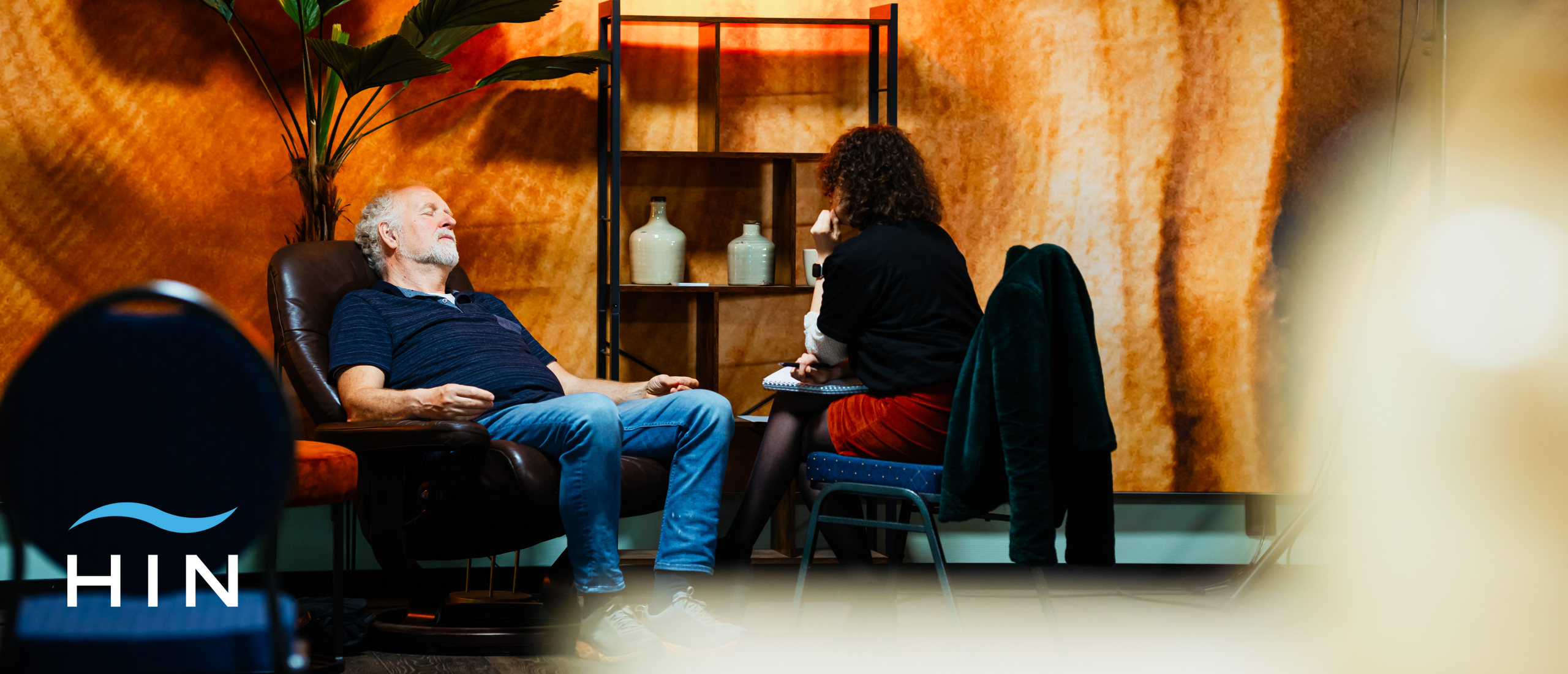
Would you also like to learn this kind of trick to help yourself or others who are having problems? Then knowledge of hypnotherapy is very helpful. Come to the free online master class for an introduction.
Or register directly for one of our events or trainings.
Also watch this video:
Sources: