

What if I told you that the pain you’ve been living with for years—and that has probably already cost you a small fortune in treatments, physical therapy, or counseling—might actually be relieved much faster than you ever thought possible?
This doesn’t have to involve heavy medication, complicated medical procedures, or vague spiritual states. Simply by understanding how your brain stores and processes information, you can do a lot to combat pain.
This summer, I held summer school sessions. The insights we gain there are rock-solid. During one of the sessions, there was a woman who was suffering from prolonged, severe pain. We did what I’m about to explain to you, and it worked very quickly. That’s why I want to share this with you—because if she can do it, then you can, too, at the most basic level.
Let’s take a closer look at how our brain works and how you can regain control of your own body.
Watch the video:
Step 1: Honestly Assessing the Pain (The Starting Point)
If you want to achieve a result, it’s helpful to know what your starting point is. You’ll want this to be crystal clear.
When it comes to pain, we do this in practice by “rating” it. This means we rate the pain on a scale from 0 to 10, where 10 is absolute hell (the worst thing you can imagine) and 0 represents a completely painless state where you feel absolutely nothing.
I asked her, “How are you feeling now?” The answer was clear: a solid 8 to a 9. That’s the kind of pain that takes over your daily life instead of letting you live your own life.
I asked further: “Has it ever been lower?” Yes, it has been lower at times, but since 2004, it has never been lower than a 5.
Think about that very carefully for a moment. For more than twenty years, this woman’s life has been colored, constrained, and limited by a baseline level of pain that has never—and I mean never—dropped below five.
Of course, you understand that this woman had tried everything over the years. She had gone through the conventional medical system. She had explored alternative paths. She had searched for solutions.
That’s what people do when they’re in pain. They look for relief. But then came the crucial question: had she done this, too?
Step 2: Why Traditional Methods of Fighting Pain Don’t Work
Changing the sensation of pain is incredibly difficult. Try doing it with sheer willpower. For example, sit on the couch and say to yourself: “I now decide that the pain-free sensation is here—pain, go away!”
So what happens then?
That’s right: it often just gets worse. Your brain actually focuses on that word and that signal, which amplifies the sensation in your nervous system[1].
Fighting pain is like fighting quicksand. The more energy you put into it, the deeper you sink.
But what if you apply a differentmodality? Then it changes immediately.
And then you might be thinking: Modality? What on earth do you mean by that, Edwin? Well, it’s very simple:
- Feeling is a modality. That’s how you physically experience what’s happening in your body.
- Hearing is a modality. It consists of the sounds, voices, and tones in your head or around you.
- And here’s the thing: seeing is also a modality. These are the images, colors, and shapes that your brain generates.
When we translate pain into another modality, magical things suddenly happen in your nervous system. Instead of getting stuck on the word “pain,” I want to “up-chunk” it—that is, elevate it to a higher and more abstract level.
Pain is, of course, still pain, but a “feeling”… well, that’s broader. It can be pain, but it can just as easily be joy, warmth, or a tingling sensation. A feeling is neutral in nature. It all depends on the meaning you attach to it.
So I immediately began reframing the word “feeling.” I asked her, “Okay, what does that feeling look like?”
Step 3: Give the pain a shape and a color
She thought for a moment and said, “Yes, it’s dark with roots.” Aha. Dark with roots. That’s a beautiful internal image. Her unconscious mind had linked that physical sensation to a dark form that was winding its way through her shoulders and neck like roots.
And from that moment on, we were able to start experimenting. Because once something has taken shape in your imagination, you can begin to change the parameters of that image. And when you change the parameters of the image, the physical sensation associated with it changes immediately. That’s how the brain works.
What did I do? I asked, “Can you make it lighter too? Like, completely white? Can you do that?” She started working on it in her mind. I asked, “Yes, and what happens now?” Her eyes opened, and she said in amazement, “Huh… it’s a six.”
Boom! Immediately, we dropped two to three points on that scale from zero to ten—from an eight or nine to a six—simply by adjusting the color and brightness of the internal image. No surgery, no medication—just a simple mental shift in modality (from feeling to what you see).
Of course, we didn’t think, “We’re already there,” so we just kept going. I said, “Make it even lighter.” She adjusted the image further, and at one point she even got it below five. That hasn’t happened since 2004!
Research also shows that visualizations influence the neural pathways involved in pain processing[2]. Here’s what that might look like in practice.
The look on that woman’s face when that happened… man, that really spoke volumes. It was like, “Wait a minute, have I been walking around with this for twenty years when I actually have control over it myself?” That pure sense of wonder is why I find this work so incredibly cool.
Step 4: The Twist—What’s Actually Standing in the Way? (Secondary Gain)
But then something very unusual happened. You’d think: we’ll keep going until it reaches zero, and then we’ll celebrate. But that’s not always how the human brain works.
At one point, the pain in her left shoulder and left neck had completely disappeared. Zero. Gone. Unprecedented. But what happened on the right side? There, it suddenly got worse. It shot up to an eight, a nine—it became more intense. The left side was gone, but the right side was getting worse.
I thought to myself: Hey, that’s interesting. There’s something else going on here. This isn’t just a technical issue with the modality anymore. There’s another mechanism at play here.
You see this quite often in people. Because what do you gain from the pain? And just as important: what does it cost you if you suddenly no longer have that pain?
Does that sound strange when I put it that way? Maybe at first glance. Surely you don’t think anyone wants to be in pain? Of course, no one wants that consciously. But we’re all made up of different parts of our brain. You might have a part that subconsciously wants to protect you from something.
Just think about it:
- What if that pain suddenly draws the attention of those around you—the attention you’ve otherwise been longing for?
- What if a specific health condition or a government benefit is involved?
- What if your entire daily routine, your identity, and your social life are built around it?
- Or—and this happens very often—what if you’re afraid of disappointment? If the pain goes away now, you’ll be very happy, but what if it comes back in a week? The blow and the disappointment will be enormous.
To protect you from that disappointment, part of your brain may choose to reignite the pain somewhere else. As if to say: “We’ll hold onto this for a while, because as long as you have this, you know where you stand and won’t be caught off guard by false hope.”
It may sound like science fiction, but it’s pure psychology.
Step 5: The Little Cloud and Subconscious Logic
To be able to work with that protective part as well, I also created an image of that gain and that protection. I asked, “What does that part look like?” She said, “It’s like a little cloud.” I said, “Okay, what does that little cloud want to tell you?” Of course, she didn’t know the answer consciously right away. But that’s okay, because your unconscious mind does understand the language of metaphors and symbols.
I told her, “You now subconsciously understand what that little cloud wants, and you’re acting on it.” Yeah, that’s a pretty abstract/vague sentence, I know. Consciously, you might not make much sense of it at that moment, but your subconscious gets the message right away.
And what do you think happened once we acknowledged that and turned that little cloud around? Suddenly, that right side collapsed like a house of cards, too. It became a two! So the bottom line: a zero on the left, a two on the right. Never—and I mean never—had it been this low in all those years.
How can you put this to use today?
This is the immense power of NLP, hypnosis , and recognizing your own thought strategies. You don’t have to passively accept what your body tells you. You can start playing with the controls of your own brain.
Are you currently experiencing any discomfort? Do you have a nagging pain in your back, a stiff neck, or tension in your shoulders that just won’t go away? Then try this out for yourself today:
- Rate the pain: How intense is it on a scale of 0 to 10? Write it down or say it out loud to yourself.
- Ask about the modality: Ask yourself, “If this feeling had a shape and a color, what would it look like?” Don’t dismiss it as if it doesn’t exist; just let your brain come up with an answer.
- Change the parameters: Start experimenting. Make the image lighter, give it a different color, make it shrink, or let it fade into the distance in your imagination. See what happens to the intensity in your body.
- Explore the underlying reasons: If necessary, ask yourself, “What might this feeling be trying to tell me subconsciously, or what is it protecting me from?”
Give it a try and let us know in the comments below this episode how it went for you. I’m really, really curious to see if this helps you lower that intensity and regain control over your own emotions!
Helping people with modalities
You, too, can help yourself and others with these techniques, but it’s helpful to know exactly what you’re doing. Come to a free masterclass to get an introduction to hypnotherapy.
Or register directly for one of our events and trainings.
Are you wondering if the training program is right for you, or do you have other questions about it? Schedule a one-on-one consultation.
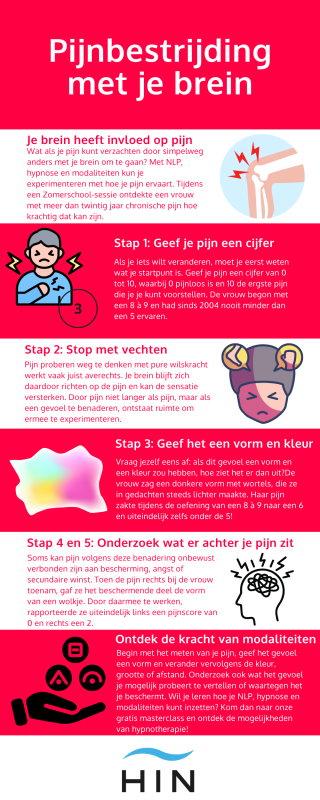
Also pin this handy infographic as a reminder:
Sources:


